
WordPress
Enterprise Website Best Practices for Rapid Growth

José Debuchy
February 6, 2026 | 3 min to read
Pressure mounts whenever a high-traffic e-commerce site struggles with slow load times or security concerns during major sales events. For any American or Canadian digital leader, optimizing an enterprise website is no longer just a technical challenge, it is a vital business priority. This article lays out the best practices that drive scalable architecture, robust security, and seamless multi-channel integration, giving your team sharper control over content delivery and digital risk management.
Key Takeaways
| Point | Details |
|---|---|
| Holistic Approach | Treat the enterprise website as a strategic asset that requires an integrated framework for performance, security, and user experience. |
| Architectural Considerations | Choose the appropriate architecture model, such as Microservices or Tiered, based on scalability needs and team capabilities. |
| Proactive Security Measures | Establish a comprehensive security strategy that includes regular audits and compliance with standards to protect sensitive data. |
| Agile Marketing Workflows | Leverage AI-driven autonomous workflows to improve marketing efficiency and personalized user engagement. |
Defining Enterprise Website Best Practices
Enterprise websites represent complex digital platforms designed to support high-performance business operations across multiple departments and user segments. Unlike standard corporate websites, these digital ecosystems require sophisticated architectural approaches that prioritize scalability, security, and content flexibility.
At their core, enterprise websites must address several critical technical and strategic requirements:
- Performance optimization for global user bases
- Robust security frameworks protecting sensitive corporate data
- Flexible content management enabling rapid marketing deployment
- Advanced integration capabilities with existing enterprise systems
- Compliance and governance controls for regulatory requirements
Building an effective enterprise website demands a holistic approach that transcends traditional web development paradigms. Organizations must view their digital platform as a strategic asset, not merely an online brochure. Enterprise content management strategies play a pivotal role in achieving this transformative digital infrastructure.

Successful enterprise websites distinguish themselves through architectural resilience and adaptive design principles. They anticipate complex user journeys, integrate multiple data sources seamlessly, and provide personalized experiences across diverse technological environments. This requires a multidimensional approach that balances technical sophistication with user-centric design.
Pro tip: Conduct a comprehensive digital audit of your current web infrastructure to identify scalability bottlenecks and potential integration challenges before initiating enterprise website redesign projects.
Types of Enterprise Website Architectures
Enterprise website architectures represent complex technological frameworks that determine how digital platforms integrate, scale, and perform under diverse business requirements. Web application architecture styles have evolved significantly, offering organizations multiple strategic approaches to digital infrastructure design.
The primary enterprise website architecture types include:
-
Monolithic Architecture
- Single, unified codebase
- Simplest to develop and deploy
- Limited scalability and flexibility
-
Tiered (N-Tier) Architecture
- Multiple interconnected layers
- Moderate complexity and scalability
- Supports separation of concerns
-
Microservices Architecture
- Distributed, independently deployable services
- Highest scalability and maintainability
- Complex initial implementation
-
Micro-Frontends Architecture
- Modular frontend development
- Enables independent team workflows
- Supports complex enterprise ecosystems
Each architectural approach presents unique advantages and challenges. Monolithic architectures offer simplicity but struggle with scalability, while microservices provide exceptional flexibility at the cost of increased initial complexity. Organizations must carefully evaluate their specific technological requirements, team capabilities, and long-term digital strategy when selecting an appropriate web architecture.
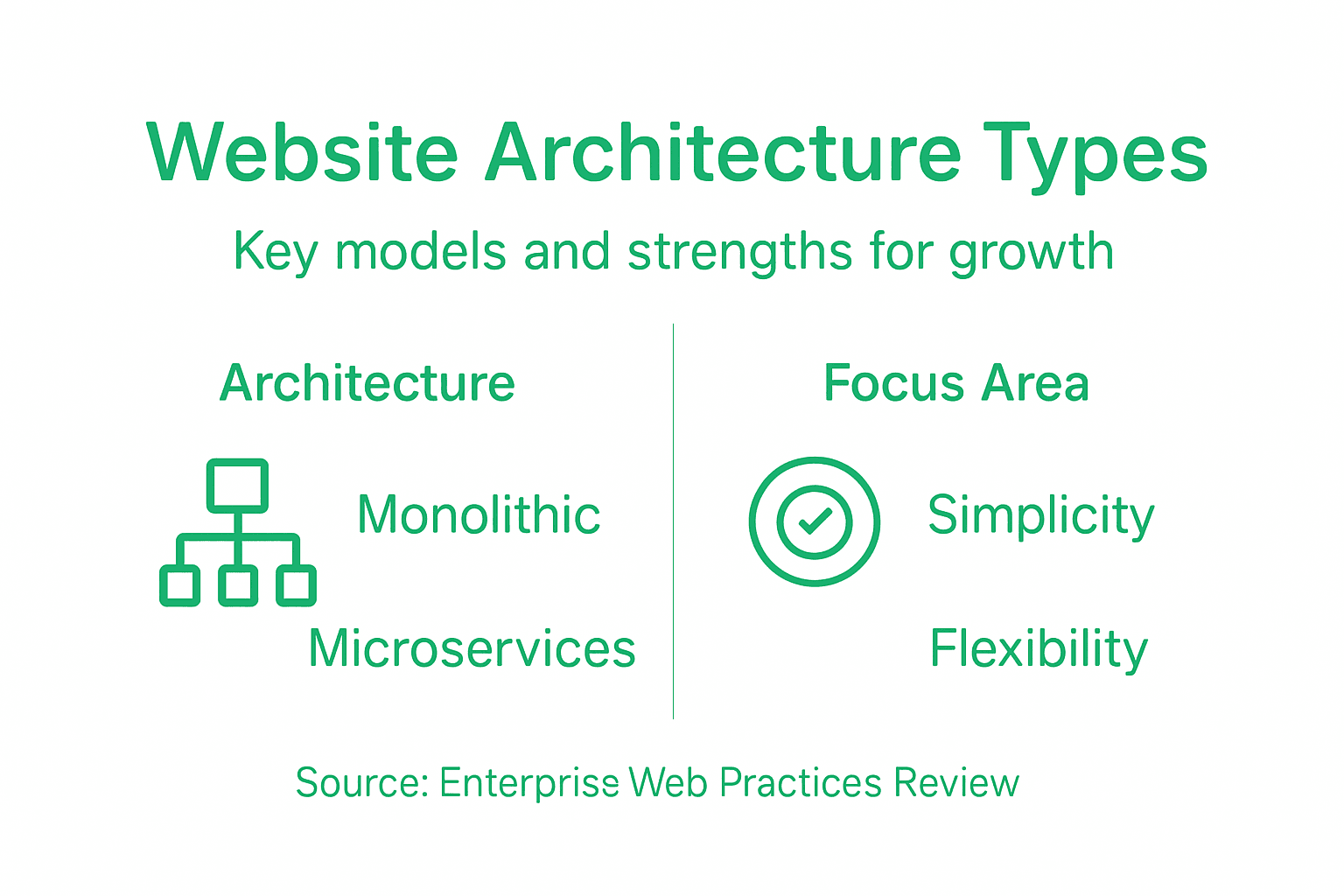
Here is a comparison of major enterprise website architecture types and their strategic suitability:
| Architecture Type | Best For | Key Drawback | Example Use Case |
|---|---|---|---|
| Monolithic | Rapid MVP launches | Difficult to scale | Internal informational portals |
| Tiered (N-Tier) | Large apps with clear layers | Moderate scalability | E-commerce websites |
| Microservices | High-growth, complex platforms | Complex initial setup | Global SaaS applications |
| Micro-Frontends | Independent team deployments | Frontend management needs | Diverse, multi-brand platforms |
Successful enterprise website design transcends technical implementation. It requires a holistic understanding of business processes, user experience requirements, and technological constraints. Scalable web architecture strategies play a critical role in creating robust, adaptable digital platforms that can evolve with organizational needs.
Pro tip: Conduct a comprehensive architectural assessment that maps your current technological ecosystem, future growth projections, and team capabilities before selecting a website architecture model.
Key Features for Scalability and Performance
Enterprise websites demand sophisticated technological capabilities that go beyond traditional web development approaches. Enterprise web development strategies require a comprehensive framework addressing performance, security, and operational resilience across multiple digital touchpoints.
Key scalability and performance features include:
-
Cloud Hosting Infrastructure
- Distributed server networks
- Automatic resource allocation
- Global content delivery
-
Advanced Load Balancing
- Traffic distribution across servers
- Prevents single point of failure
- Maintains consistent user experience
-
Security and Compliance
- Multi-factor authentication
- End-to-end data encryption
- Regular security audits
-
Performance Optimization Techniques
- Content Delivery Networks (CDNs)
- Intelligent caching mechanisms
- Efficient code architecture
Successful enterprise platforms prioritize scalability, security, and seamless integration as foundational design principles.
Technological integration represents another critical dimension of enterprise website performance. Modern organizations require robust connections between diverse systems like CRM platforms, marketing automation tools, and enterprise resource planning (ERP) solutions. Enterprise web development workflows increasingly emphasize continuous integration and deployment pipelines that enable rapid, reliable digital ecosystem evolution.
The following table summarizes how advanced features support enterprise website scalability and performance:
| Feature | Value for Enterprises | Typical Business Impact |
|---|---|---|
| Cloud Hosting | Flexible resources, global reach | Handles surges, lowers downtime |
| Advanced Load Balancing | Distributes user traffic efficiently | Consistent experience worldwide |
| Continuous Integration | Rapid deployment and updates | Reduced release risks and delays |
| Security Monitoring Tools | Detects threats, ensures compliance | Minimizes breaches and regulatory issues |
Pro tip: Implement comprehensive performance monitoring tools that provide real-time insights into website scalability, identifying potential bottlenecks before they impact user experience.
Ensuring Security and Compliance Standards
Enterprise websites operate in increasingly complex regulatory environments that demand sophisticated security approaches. Cybersecurity risk management requires a comprehensive framework that addresses technological vulnerabilities and organizational governance simultaneously.
Critical compliance and security standards include:
-
Regulatory Compliance Frameworks
- GDPR for data privacy
- PCI-DSS for payment systems
- HIPAA for healthcare data
- ISO/IEC 27001 certification
-
Technological Security Protocols
- Multi-factor authentication
- End-to-end encryption
- Regular security audits
- Intrusion detection systems
-
Data Protection Strategies
- Secure access controls
- Comprehensive backup systems
- Anonymization of sensitive information
- Regular vulnerability assessments
Enterprise security is not a destination, but a continuous journey of adaptation and improvement.
Website security standards represent a dynamic ecosystem of technological controls and organizational policies designed to protect digital assets. Organizations must implement multilayered security approaches that balance robust protection with operational flexibility, ensuring compliance without compromising user experience or system performance.
Successful enterprise security strategies integrate technological solutions with comprehensive governance frameworks. This holistic approach requires ongoing education, regular system assessments, and a proactive stance toward emerging digital threats.
Pro tip: Develop a cross-functional security committee that includes representatives from IT, legal, and operational teams to create a comprehensive and adaptive security strategy.
Empowering Marketing With Autonomous Workflows
Modern enterprise marketing demands unprecedented levels of agility, efficiency, and personalization. AI-powered workflow transformations represent a revolutionary approach to reimagining marketing team capabilities and operational effectiveness.
Key components of autonomous marketing workflows include:
-
Content Generation
- AI-driven copywriting
- Personalized messaging
- Multilingual content adaptation
-
Campaign Management
- Automated audience segmentation
- Dynamic content optimization
- Real-time performance tracking
-
Workflow Orchestration
- Cross-platform integration
- Intelligent task routing
- Predictive resource allocation
-
Analytics and Insights
- Automated reporting
- Trend identification
- Prescriptive recommendations
Autonomous workflows transform marketing from a manual, time-consuming process to a strategic, intelligence-driven function.
Marketing AI agent orchestration enables marketing teams to transcend traditional operational limitations. By leveraging intelligent systems that can perceive, plan, and execute complex tasks, organizations can dramatically reduce manual intervention while increasing overall marketing productivity and precision.
Successful autonomous workflow implementation requires a strategic approach that balances technological capability with human creativity. Marketing teams must transition from tactical executors to strategic directors, leveraging AI systems to amplify their creative potential and strategic thinking.
Pro tip: Develop a comprehensive skills mapping exercise to identify which marketing tasks are best suited for autonomous workflows and which require human creativity and strategic oversight.
Pitfalls to Avoid in Enterprise Implementations
Enterprise website development is fraught with complex challenges that can derail even the most well-intentioned digital initiatives. Enterprise website design pitfalls represent critical risk points that organizations must strategically navigate to ensure successful digital transformation.
Key implementation pitfalls include:
-
Overcomplicated User Experience
- Feature bloat
- Cluttered interface design
- Excessive navigation complexity
-
Performance and Technical Limitations
- Slow page load times
- Non-responsive mobile designs
- Inefficient code architecture
-
Security and Compliance Risks
- Inadequate data protection
- Weak authentication protocols
- Inconsistent security standards
-
Operational Maintenance Challenges
- Infrequent system updates
- Poor version control
- Limited scalability planning
Strategic foresight distinguishes successful enterprise implementations from catastrophic digital failures.
Website maintenance challenges demonstrate that continuous monitoring and proactive management are essential for sustaining digital platform reliability. Organizations must develop robust frameworks that anticipate potential vulnerabilities and create adaptive technological ecosystems capable of evolving with changing business requirements.
Successful enterprise implementations demand a holistic approach that balances technological sophistication with user-centric design principles. This requires cross-functional collaboration, continuous learning, and a commitment to ongoing digital optimization.
Pro tip: Conduct quarterly comprehensive audits of your digital infrastructure, evaluating performance metrics, user experience feedback, and potential security vulnerabilities.
Unlock Enterprise Website Potential With Scalable WordPress Solutions
The article highlights the challenges of building enterprise websites that scale effortlessly while maintaining security, performance, and marketing agility. If you struggle with eliminating developer dependency for daily publishing or balancing rapid content deployment with strict governance, these pain points are exactly what 40Q addresses. Our proprietary FAS Block System™ empowers marketing teams to launch campaigns and localized content quickly without sacrificing IT control over security and scalability.
Discover how your organization can implement enterprise-grade WordPress platforms designed for high-traffic, content-heavy environments. Visit 40Q Agency to learn more about our AI-assisted content workflows and enterprise security solutions. Take the next step in achieving rapid growth with a websitearchitecture built for future-proof performance and marketing autonomy. Explore how enterprise content management strategies complement this approach and see real-world examples of scalable web architecture strategies that align with your growth objectives.
Frequently Asked Questions
Recommended

Oct 9, 2024
WordPress
Is ACF banned from Wordpress?
Nov 25, 2025
WordPress
Why Fortune 500s Are Choosing WordPress in 2025
Jan 19, 2026
WordPress