
WordPress
What is marketing agility? A 2026 guide for enterprise teams

José Debuchy
March 12, 2026 | 3 min to read
Most marketing leaders don’t realize 58% of marketing initiatives take over six months to reach the market. That’s six months of watching competitors launch, iterate, and win while your team waits for approvals and resources. Marketing agility breaks this cycle by enabling faster execution, smarter collaboration, and better results through iterative workflows designed for today’s pace.
Key takeaways
| Point | Details |
|---|---|
| Speed advantage | Agile marketing teams cut production time in half and reduce cycle time by up to 30% compared to traditional approaches. |
| Collaboration boost | Cross-functional squads eliminate silos and achieve higher success rates through transparent, data-driven workflows. |
| Better outcomes | Iterative testing and customer feedback loops increase conversion rates by 15-20% and improve campaign effectiveness. |
| Strategic alignment | Agile methods balance speed with brand governance when implemented as a mindset shift, not just rituals. |
What is marketing agility and why it matters
Marketing agility is the capacity to respond quickly to market changes, customer signals, and business priorities through iterative workflows and collaborative team structures. It replaces rigid annual planning with flexible sprints that deliver value incrementally.

Traditional marketing processes weren’t designed for the rapid pace of today’s digital environment. When campaigns take half a year to launch, you’re operating on outdated assumptions about customer needs and market conditions. Agile marketing solves this by prioritizing adaptability over perfection and feedback over guesswork.
For enterprise marketing and IT leaders, agility means aligning marketing execution with fast-moving business objectives. It connects marketing autonomy with strategic control. Marketing teams gain the freedom to test, learn, and optimize campaigns without waiting for IT resources or executive sign-off on every decision.
Core principles of marketing agility include:
- Transparency through visible workflows and shared metrics across teams
- Collaboration that breaks down silos between creative, analytics, and technical functions
- Data-driven decisions based on real customer behavior, not assumptions
- Iterative delivery that ships value in small increments rather than big-bang launches
- Customer focus that prioritizes solving real problems over internal politics
A common misconception treats Agile as simply running daily standups or using kanban boards. Real marketing agility requires a mindset shift toward experimentation, learning from failure, and empowering teams to make decisions. The rituals mean nothing without the underlying cultural change.
How agile marketing improves speed, collaboration, and results
Agile marketing transforms how enterprise teams plan, execute, and optimize campaigns through specific practices that measurably improve outcomes.
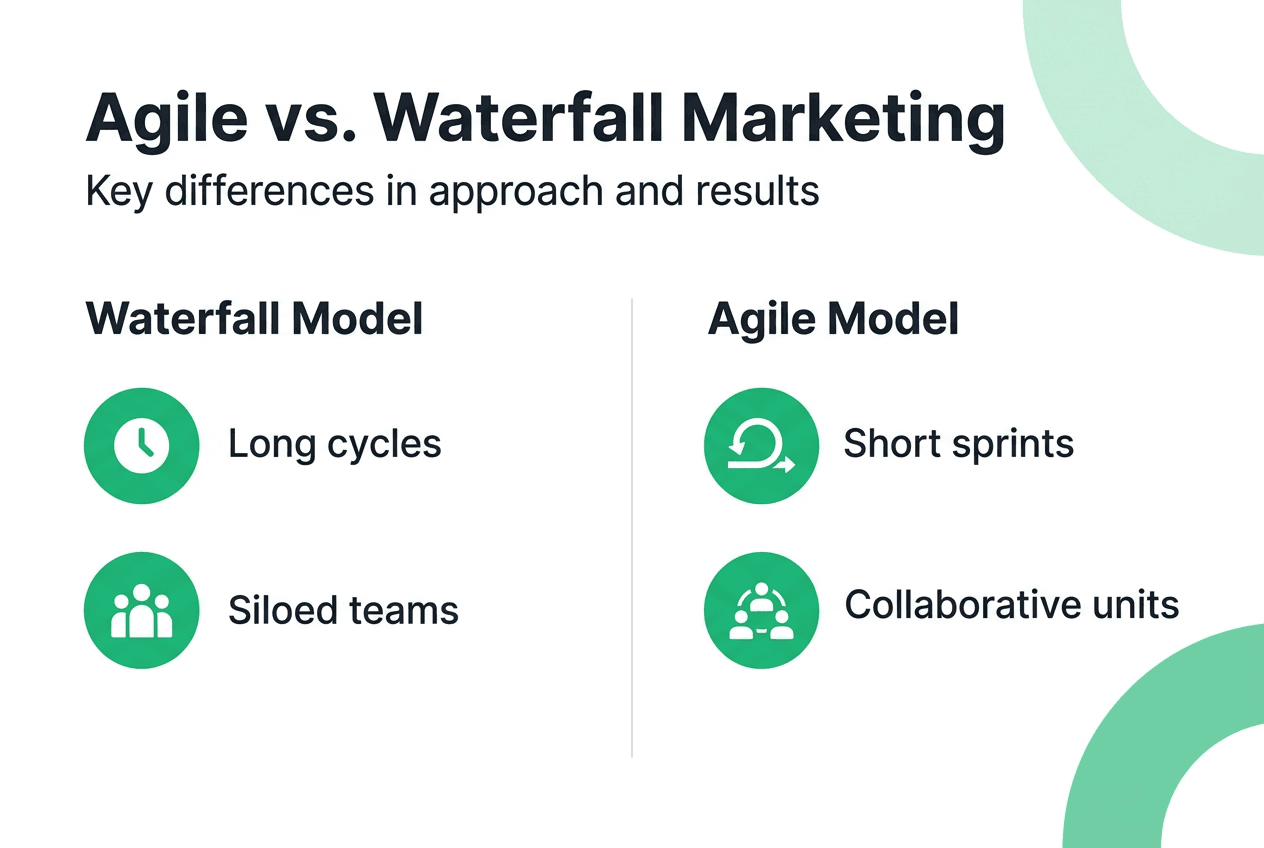
Short sprints, typically two to four weeks, replace lengthy campaign cycles. Teams commit to specific deliverables, ship working marketing assets, then gather feedback before the next iteration. This rhythm creates accountability and prevents projects from lingering in approval limbo for months.
Cross-functional squads bring together strategists, designers, writers, analysts, and developers in small autonomous units. Nine out of ten marketing teams using Agile methods consider themselves extremely or very successful. The reason is simple: when everyone needed to ship a campaign sits together, decisions happen faster and handoffs disappear.
The speed gains are substantial. Teams practicing agile marketing have cut their average production time in half. What used to take six months now ships in three. What took three weeks now takes one.
Efficiency improvements compound over time. Organizations implementing an Agile marketing operating system improve efficiency by 20-25% within the first year. That’s the equivalent of getting an extra quarter of productive work from the same team size.
Data-driven iteration is the secret weapon. Instead of launching a campaign and hoping it works, agile teams test variations with real audiences, measure results, and double down on what performs. This approach increases conversion rates by 15-20% compared to one-and-done campaign launches.
Key practices that drive these results include:
- Daily standups to surface blockers and align priorities in under 15 minutes
- Sprint planning sessions that break big campaigns into deliverable chunks
- Retrospectives that capture lessons and improve team processes continuously
- Visible backlogs that show what’s in progress, what’s next, and what’s blocked
- Customer journey mapping that identifies high-impact touchpoints for testing
Collaboration breaks down the traditional silos between brand strategy, demand generation, and content teams. When everyone shares the same sprint goals and success metrics, execution sharpens. Marketing ops stops being a bottleneck and becomes an enabler.
Pro Tip: Integrate your agile marketing workflows with enterprise content management systems that support rapid publishing. The best process in the world still fails if your CMS requires developer tickets for every landing page change. Look for platforms that let marketing teams ship content independently while IT maintains decoupled governance over performance and security.
The combination of speed, collaboration, and data creates a compounding advantage. Your team learns faster than competitors. You optimize campaigns while others are still seeking approvals. You build organizational muscle memory for what works in your specific market. That’s the real power of marketing agility, and it shows up in your autonomy scorecard metrics.
Navigating challenges and nuances in marketing agility
Adopting agile marketing isn’t just a process change. It requires cultural shifts that many enterprises struggle to implement effectively.
The biggest hurdle is moving from command-and-control to collaboration and curiosity. Traditional marketing rewards following the plan. Agile marketing rewards learning fast and adapting. Leaders must become comfortable with experimentation, which means accepting that some tests will fail. That’s not a bug, it’s the feature.
Treating Agile as rituals rather than a mindset shift leads to performative implementations. Teams run standups but still wait for executive approval on every decision. They plan sprints but never ship until everything is perfect. They use kanban boards but maintain rigid hierarchies that prevent squad autonomy. These surface-level adoptions deliver little value.
A critical risk is losing brand stewardship while chasing speed. Agile squads can lose sight of holistic customer experience and brand governance when they optimize for velocity alone. A squad that ships landing pages fast but ignores SEO best practices or brand voice guidelines creates technical debt and customer confusion.
Common pitfalls include:
- Focusing on output metrics like tasks completed rather than outcome metrics like conversion lift
- Fragmenting customer experience by letting squads operate in isolation without alignment
- Neglecting long-term brand building while obsessing over short-term campaign performance
- Skipping retrospectives when teams get busy, which prevents learning and improvement
- Forcing agile methods on teams without training or coaching support
Balancing squad velocity with strategic marketing objectives requires intentional governance. You need clear brand guidelines that squads internalize, not 50-page PDFs nobody reads. You need shared customer data that informs decisions across squads. You need periodic alignment sessions that connect tactical sprints to quarterly business goals.
The integration challenge extends to technology. Agile marketing works best when your content management system supports autonomous publishing. If marketing teams still need developer tickets to launch campaigns, your agile process hits a bottleneck at the digital experience layer.
Pro Tip: Build brand consistency into your agile workflows by creating reusable content templates and component libraries. When squads use pre-approved design systems and messaging frameworks, they ship faster without sacrificing brand integrity. This approach combines speed with strategy rather than trading one for the other.
Another nuance involves stakeholder management. Executives accustomed to reviewing fully baked campaigns may resist iterative delivery. They want to see the final product, not a minimum viable version. Educating leadership on the value of fast feedback loops and continuous improvement becomes part of the agile transformation.
Cross-functional squads also surface organizational tensions. When a marketing squad includes developers, who do those developers report to? How do you balance squad priorities with platform maintenance work? How do you prevent squads from building custom solutions that create long-term technical debt? These questions require thoughtful answers, not blanket policies.
The path through these challenges starts with small wins. Pilot agile methods with one team or one campaign type. Demonstrate results with data. Build internal champions who can evangelize the approach. Scale gradually rather than mandating enterprise-wide adoption overnight.
Implementing marketing agility in your enterprise marketing strategy
Transforming traditional marketing to agile requires deliberate steps that address team structures, processes, and technology foundations.
Start by establishing cross-functional squads focused on specific customer segments or business objectives. A typical squad includes five to nine people with complementary skills: strategy, creative, analytics, technical execution, and project coordination. Agile squads empower teams and improve accountability through smaller autonomous units.
Follow this implementation sequence:
- Define squad missions aligned with business outcomes, not organizational charts. A squad might own customer acquisition for a specific product line or retention for a geographic region.
- Establish sprint cadences, typically two weeks, with consistent planning, execution, and retrospective rhythms. Consistency builds momentum.
- Create visible backlogs that prioritize work based on business impact and customer value, not whoever screams loudest or ranks highest politically.
- Implement daily standups of 15 minutes or less to surface blockers and maintain alignment without becoming status report marathons.
- Set outcome-based success metrics tied to business results like pipeline generated, conversion rates improved, or customer engagement increased.
- Conduct sprint retrospectives where teams honestly discuss what worked, what didn’t, and what to try next without fear of blame.
- Scale gradually by adding squads and refining processes based on lessons learned rather than forcing immediate enterprise-wide transformation.
The technology foundation matters enormously. Agile marketing delivers value only when teams can publish content, launch campaigns, and test variations without technical bottlenecks. Scalable web publishing platforms that offer marketing autonomy become strategic enablers.
Key platform capabilities for agile marketing include:
- Component-based content systems that let marketers assemble pages without coding
- Workflow automation that routes approvals based on content type and risk level
- A/B testing tools integrated directly into the publishing interface
- Analytics dashboards that show real-time campaign performance
- API connections that sync with CRM, marketing automation, and other enterprise tools
Compare traditional waterfall to agile marketing approaches:
| Aspect | Traditional waterfall | Agile marketing |
|---|---|---|
| Planning cycle | Annual or quarterly | Sprint-based, 2-4 weeks |
| Campaign launches | Big-bang releases | Iterative delivery |
| Feedback loops | Post-campaign surveys | Continuous testing |
| Team structure | Siloed functions | Cross-functional squads |
| Decision authority | Centralized approval | Distributed autonomy |
| Success metrics | Output-focused | Outcome-focused |
| Cycle time | Months | Weeks or days |
Agile marketing reduces cycle time up to 30% compared to waterfall. That compression happens through parallel work, faster decisions, and eliminating handoff delays.
Your enterprise WordPress environment should support agile workflows through enterprise-grade content management that balances autonomy with governance. Marketing teams need the freedom to create and publish quickly. IT teams need confidence that performance, security, and compliance standards are maintained automatically.
Advanced capabilities like search functionality become competitive advantages when agile teams can deploy personalized content experiences without custom development. The platform should enable speed, not constrain it.
Alignment between agile marketing tools and business goals prevents tool sprawl. Evaluate technology through the lens of does this help squads ship value faster while maintaining quality standards? If the answer is no, skip it regardless of how impressive the feature list looks.
Success requires executive sponsorship and cultural change management. Leaders must model agile behaviors: embracing experimentation, making decisions with incomplete information, and valuing learning over always being right. When executives demand perfection and punish failure, agile marketing dies despite whatever processes teams follow.
Enhance your marketing agility with 40Q’s enterprise WordPress solutions
Your marketing team’s agility depends on having the right technology foundation. 40Q specializes in enterprise-grade WordPress solutions that eliminate technical bottlenecks and empower marketing teams to launch campaigns at the speed your business demands.
Our proprietary FAS Block System gives marketing teams component-based content assembly without developer dependency. You maintain brand consistency and governance while gaining the autonomy to test, iterate, and optimize quickly.
We partner with medium and large organizations that need speed to market without sacrificing reliability, security, or compliance. Our implementations support agile workflows through intuitive publishing interfaces, automated workflows, and advanced search capabilities that create personalized experiences.
Whether you’re starting your agile marketing transformation or scaling existing practices, our theme setup services and strategic consulting help you build the technical foundation that makes marketing agility practical, not just aspirational.
Frequently asked questions about marketing agility
Recommended

May 7, 2025
WordPress
How Enterprise Content Teams Are Adopting AI Tools in 2025

Jun 4, 2025
WordPress
The Cost of Tech Debt: What You’re Really Paying for With Legacy CMSes
Oct 28, 2025
WordPress