
WordPress
Why rapid website deployment matters for enterprise agility

José Debuchy
March 26, 2026 | 3 min to read
Rapid website deployment is no longer a luxury for enterprise organizations. It’s a competitive necessity. Companies that can push updates multiple times daily are seeing 367% sales growth compared to those stuck in traditional release cycles. For marketing leaders and IT directors, the challenge is clear: deliver content faster without sacrificing security, stability, or compliance. This article explores how modern deployment strategies transform enterprise agility, the technologies that make it possible, and the methodologies that keep your systems secure while moving at speed.
Key Takeaways
| Point | Details |
|---|---|
| Frequent automated releases | Continuous deployment enables multiple daily production updates with lower failure rates and faster time to market. |
| Content decoupling enables agility | Headless CMS decouples content management from presentation, letting marketing update content independently while developers optimize security and performance. |
| Edge deployment benefits | Global edge networks reduce latency and improve security by distributing content and updates closer to users. |
| Proven business gains | Real world deployments show 367% sales growth and 18% CTR improvement. |
Understanding rapid website deployment and its business impact
Rapid website deployment refers to the practice of releasing code changes to production environments frequently, often multiple times per day, using automated continuous integration and continuous delivery pipelines. Unlike traditional release cycles that bundle changes into quarterly or monthly updates, rapid deployment treats each feature, fix, or content update as an independent release candidate. This approach fundamentally changes how enterprises manage their web presence.
The business case for rapid deployment is compelling. Organizations implementing continuous deployment benchmarks achieve up to 12 daily releases with failure rates below 5%, delivering updates 45% faster than traditional methods. This velocity translates directly into competitive advantage. When your marketing team can launch a campaign landing page in hours instead of weeks, you capture market opportunities that slower competitors miss entirely.
Consider the measurable business outcomes. Companies adopting rapid deployment strategies report substantial improvements across key metrics:
- Revenue acceleration through faster feature delivery and market responsiveness
- Reduced defect rates due to smaller, more manageable change sets
- Improved customer satisfaction from quicker bug fixes and feature requests
- Lower operational costs by eliminating manual deployment processes
- Enhanced team productivity when developers and marketers work without bottlenecks
Real world data validates these benefits. One enterprise implementation achieved 367% sales growth and 18% CTR improvement after transitioning to rapid deployment practices. These gains stem from the ability to test, learn, and iterate in real time rather than waiting months to validate assumptions.
The impact extends beyond pure speed. Rapid deployment fundamentally changes organizational dynamics. Marketing teams gain autonomy to execute campaigns without waiting for development sprints. IT directors maintain tighter security postures because patches deploy within hours of discovery rather than waiting for the next release window. Product managers validate hypotheses with actual user data instead of relying on assumptions.
“Elite performers deploy 208 times more frequently than low performers and have a lead time from commit to deploy that is 106 times faster, while maintaining change failure rates below 15%.” — State of DevOps Research
For enterprises exploring these capabilities, understanding enterprise website best practices provides essential context for implementation strategies that balance speed with governance requirements.
How headless CMS and edge deployment enhance agility and security
Headless CMS architecture separates content management from presentation layers, giving enterprises unprecedented flexibility in how they deliver digital experiences. Unlike traditional monolithic systems where content, business logic, and frontend code intertwine, headless approaches treat content as data accessible through APIs. This decoupling allows marketing teams to update content while developers independently optimize performance and security.

Edge deployment takes this further by distributing your website across global content delivery networks. Instead of serving all requests from a central server, edge platforms cache and serve content from locations closest to your users. This architecture delivers three critical benefits: dramatically faster load times, enhanced security through reduced attack surfaces, and automatic scalability to handle traffic spikes.
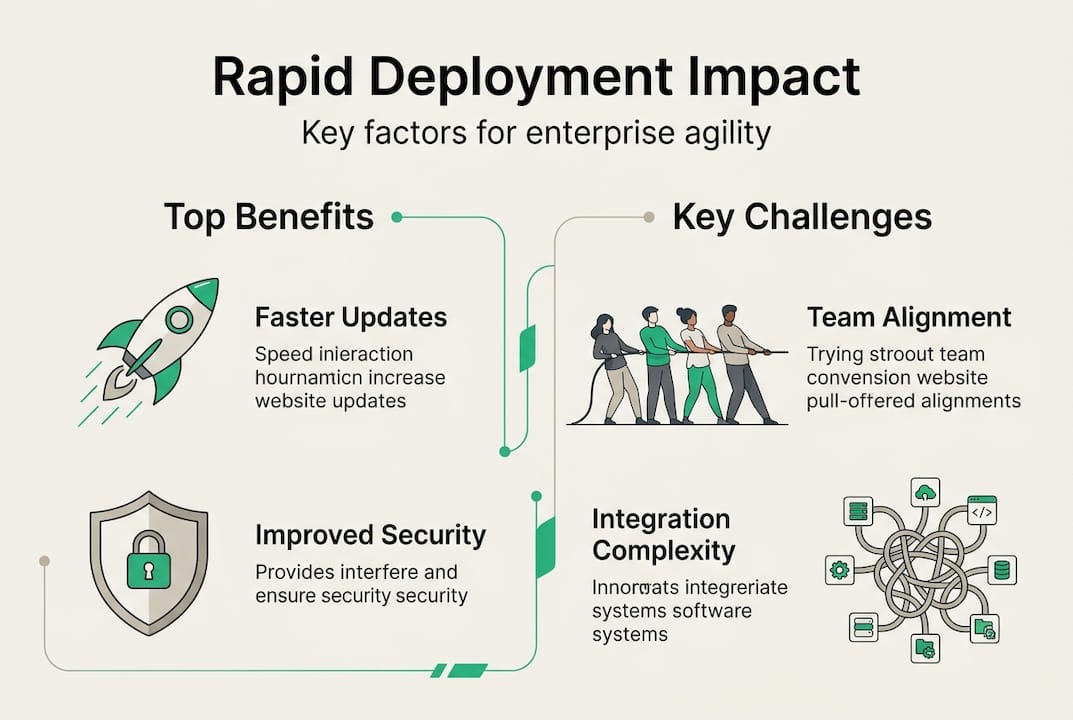
The security advantages are particularly significant for enterprises. Traditional server-based deployments expose numerous attack vectors through database connections, server-side processing, and plugin vulnerabilities. Edge deployed sites eliminate these risks entirely. Your production environment becomes a collection of static assets with no server to compromise, no database to breach, and no runtime vulnerabilities to exploit.
Performance improvements are equally dramatic. Organizations implementing headless CMS with edge deployment achieve 20x faster upload times and maintain sub-200ms response times even under 10,000+ concurrent users. These improvements directly impact conversion rates, with every 100ms of latency costing approximately 1% in sales for e-commerce operations.
| Capability | Traditional CMS | Headless + Edge |
|---|---|---|
| Content update speed | 15-30 minutes | 30-90 seconds |
| Security vulnerabilities | Database, server, plugins | Minimal attack surface |
| Scalability ceiling | Vertical scaling limits | Virtually unlimited |
| Global performance | Single region latency | <200ms worldwide |
| Deployment frequency | Weekly to monthly | Multiple times daily |
Marketing teams benefit from content independence. You can update landing pages, launch campaigns, and publish blog posts without touching code or waiting for developer availability. IT teams gain security and performance guarantees that would require massive infrastructure investments in traditional architectures.
Pro Tip: Implement Incremental Static Regeneration to get the best of both worlds. Your site remains fully static and secure, but specific pages regenerate automatically when content changes, eliminating the need for full site rebuilds and enabling true real time publishing.
The future of enterprise CMS increasingly centers on these decoupled architectures, where content teams work independently while IT maintains full control over security, compliance, and infrastructure decisions.
Best practices and methodologies for successful rapid deployment
Implementing rapid deployment requires more than fast pipelines. It demands systematic approaches that ensure speed never compromises quality or security. Modern continuous deployment platforms like GitHub Actions, GitLab CI, and CircleCI provide the foundation, but methodology determines success.
Progressive delivery techniques mitigate the inherent risks of frequent releases. Rather than pushing changes to all users simultaneously, you can deploy to small user segments first, monitor performance and error rates, then gradually expand reach. This approach includes several proven strategies:
- Canary releases that expose new code to 5-10% of traffic before full rollout
- Feature flags that enable or disable functionality without deploying new code
- Blue green deployments maintaining two identical production environments for instant rollback
- A/B testing frameworks that validate business impact before committing to changes
Automation forms the second pillar of successful rapid deployment. Manual processes cannot keep pace with multiple daily releases. Effective CI/CD pipelines automate testing, security scanning, and deployment verification, catching issues before they reach production. Key automation areas include:
- Comprehensive test suites covering unit, integration, and end to end scenarios
- Security scanning for dependency vulnerabilities and code quality issues
- Performance testing to validate load times and resource utilization
- Accessibility checks ensuring compliance with WCAG standards
- Observability platforms like OpenTelemetry tracking deployment health in real time
Implementing a reliable rapid deployment pipeline follows a structured approach:
- Establish baseline metrics for current deployment frequency, failure rates, and recovery times
- Implement version control and branching strategies that support parallel development
- Build automated testing infrastructure covering critical user journeys and business logic
- Configure CI/CD pipelines with staged deployments and automated rollback capabilities
- Deploy observability tools to monitor application health, user experience, and business metrics
- Institute regular deployment retrospectives to identify bottlenecks and improvement opportunities
- Document runbooks for common scenarios and empower teams to deploy independently
The technical implementation matters less than the cultural shift. Rapid deployment succeeds when organizations embrace small, frequent changes over large, risky releases. When teams trust their automated safeguards, they move faster with confidence.
Pro Tip: Invest in deployment observability from day one. Track not just whether deployments succeed, but their impact on business metrics, user experience, and technical debt accumulation. This data informs the speed versus safety balance and prevents the accumulation of hidden costs.
Organizations looking to implement these practices benefit from understanding how to future-proof your CMS with architectures that support rapid iteration without compromising long term maintainability.
Navigating challenges and edge cases in rapid deployment
Rapid deployment introduces specific challenges that enterprises must address, particularly in regulated industries and high-stakes environments. The promise of speed can create new risks if implemented without appropriate guardrails and governance frameworks.
Regulated industries face unique constraints. Healthcare organizations must maintain HIPAA compliance. Financial services require SOC 2 certification. Government contractors need FedRAMP authorization. These requirements often mandate specific security controls:
- Single sign-on integration with enterprise identity providers
- Self-hosting capabilities to maintain data sovereignty
- Audit logging for all content changes and deployments
- Role-based access controls with separation of duties
- Encryption at rest and in transit for all sensitive data
The speed versus safety trade-off becomes critical at scale. Moving fast without automation creates technical debt that eventually paralyzes development. Organizations implementing rapid deployment without proper testing infrastructure experience 60% higher incident rates compared to those balancing speed with systematic quality controls.
| Consideration | Fast but unautomated | Balanced approach | Slow but manual |
|---|---|---|---|
| Deployment speed | Hours | Hours | Weeks |
| Safety/reliability | Low (high risk) | High (controlled risk) | Medium (human error) |
| Long term cost | Very high (debt) | Low (sustainable) | High (opportunity cost) |
| Implementation complexity | Low initially | Medium | Low |
| Scalability | Poor | Excellent | Poor |
Technical debt accumulation represents a hidden cost of poorly implemented rapid deployment. When teams prioritize speed over code quality, they create maintenance burdens that compound over time. Shortcuts in testing, documentation, and architecture eventually slow development more than traditional release cycles ever did.
The solution lies in automation investment. Organizations that automate testing, security scanning, and deployment verification can move fast safely. Those that skip automation to move faster initially find themselves slowing down as technical debt accumulates and incident rates climb.
Enterprise environments also face integration complexity. Your deployment pipeline must work with existing tools for monitoring, security, compliance, and business intelligence. Legacy systems may not support API-driven automation. Data migrations require careful orchestration. These realities demand pragmatic implementation strategies that acknowledge constraints while working toward ideal architectures.
Pro Tip: Maintain deployment reversibility as a non-negotiable requirement. Every release should include automated rollback capabilities tested as rigorously as the forward deployment. This safety net enables teams to move fast because they know mistakes can be undone in minutes rather than hours.
For enterprises balancing these considerations, scaling with confidence requires CMS platforms that support both rapid iteration and enterprise governance requirements.
Explore 40Q’s solutions for rapid, secure website deployment
Navigating the transition to rapid deployment requires expertise in both technology and enterprise workflows. 40Q specializes in building WordPress platforms that give marketing teams publishing autonomy while maintaining the security, performance, and governance that IT directors require.
Our proprietary FAS Block System™ eliminates developer dependency for day-to-day content operations. Marketing teams launch landing pages, campaigns, and localized content in hours instead of weeks. IT teams retain full control over infrastructure, security policies, and compliance requirements. This balance enables the agility that rapid deployment promises without sacrificing enterprise standards.
As a WordPress VIP partner, we implement enterprise-grade WordPress solutions designed for high-traffic, content-heavy organizations. Our platforms integrate headless architectures, edge deployment, and AI-assisted workflows that accelerate content production while maintaining quality standards. We build systems that scale to millions of pageviews without performance degradation.
Our advanced search capabilities ensure users find content instantly, even as your site grows to thousands of pages. Our theme setup services implement design systems that maintain brand consistency across all content while enabling marketing teams to create variations quickly. Every solution we build focuses on eliminating bottlenecks that slow enterprise content operations.
Frequently asked questions
Recommended
Aug 28, 2025
WordPress
MCP Made Simple: A Beginner’s Guide for Marketers and WordPress Teams

Jun 18, 2026
WordPress
Is WordPress Good Enough for Enterprise?

Feb 3, 2026
WordPress