
WordPress
Cloud-Based WordPress: Empowering Enterprise Autonomy

Martin Szigeti
January 13, 2026 | 3 min to read
More than 60 percent of American enterprises cite publishing speed as a critical challenge for digital marketing teams. For marketing directors managing high-traffic platforms, delays and compliance risks can disrupt campaigns and slow down innovation. Cloud-based WordPress solutions deliver the control, security, and scalability needed to empower content teams with real autonomy—making rapid global publishing and governance a reality for marketing professionals.
Key Takeaways
| Point | Details |
| Cloud-Based Flexibility | Cloud-based WordPress offers scalability and rapid content publishing, enhancing digital agility for enterprises. |
| Deployment Options | Enterprises can choose from SaaS, PaaS, and IaaS models, each providing unique benefits based on operational needs. |
| Marketing Autonomy | Advanced features empower marketing teams with tools for SEO, content management, and analytics without heavy IT dependency. |
| Security and Compliance | Robust security frameworks protect sensitive data and ensure compliance with regulations, essential for enterprise operations. |
Defining cloud-based WordPress for enterprises
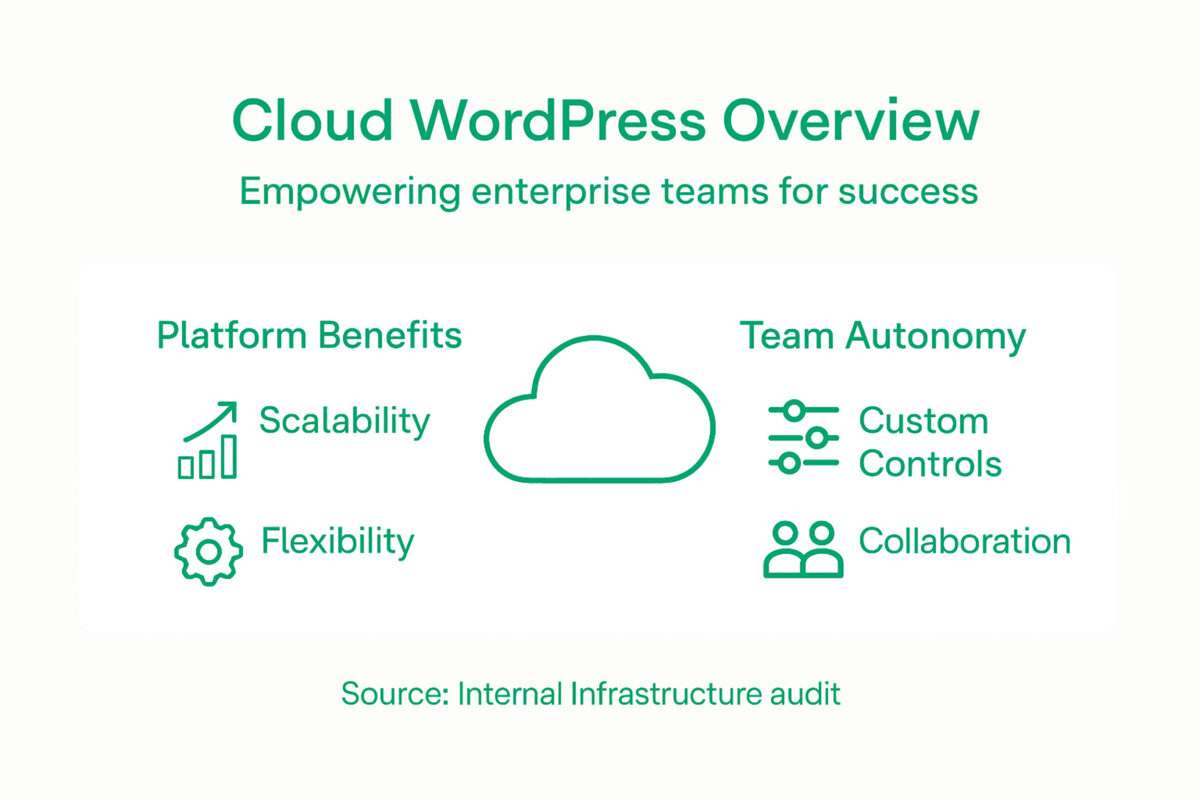
Cloud-based WordPress transforms enterprise content management by leveraging scalable, flexible digital infrastructure that enables rapid publishing and global content distribution. Enterprise-grade WordPress platforms have evolved beyond traditional content management systems, offering sophisticated solutions for organizations seeking digital agility and performance.
At its core, cloud-based WordPress integrates robust hosting environments with WordPress’s powerful content management capabilities, allowing enterprises to deploy websites, applications, and digital experiences with unprecedented speed and reliability. The platform supports complex content models, advanced editorial workflows, and seamless integrations with enterprise systems through its modular, API-driven architecture.
Key enterprise benefits of cloud-based WordPress include:
- Scalable infrastructure supporting high-traffic digital platforms
- Enhanced security protocols and governance frameworks
- Flexible deployment options across public, private, and hybrid cloud environments
- Rapid content publishing and multichannel distribution
- Cost-effective digital transformation without extensive custom development
Pro tip: Conduct a comprehensive infrastructure assessment before migrating to cloud-based WordPress to ensure seamless integration and minimize potential disruptions.
Types of cloud-based WordPress solutions
Enterprises have multiple cloud-based WordPress deployment strategies to choose from, each offering unique advantages in scalability, control, and operational efficiency. WordPress deployment models range from comprehensive managed solutions to highly customizable infrastructure configurations that align with specific organizational requirements.
The primary cloud-based WordPress solutions include three distinct service models:
- Software as a Service (SaaS): Fully managed hosting with automated scaling and maintenance
- Platform as a Service (PaaS): Development-focused environments supporting custom application lifecycles
- Infrastructure as a Service (IaaS): Flexible infrastructure control with maximum customization potential
Each deployment model presents unique trade-offs between operational complexity, cost-effectiveness, and technical control. SaaS solutions offer the fastest time-to-market with minimal infrastructure management, while IaaS provides enterprises maximum flexibility in configuring their WordPress ecosystem. PaaS represents a balanced approach, enabling developers to focus on creating digital experiences without managing underlying infrastructure complexities.
Here’s a quick comparison of the main cloud-based WordPress service models for enterprises:
| Service Model | Management Level | Customization Potential | Best For |
| SaaS | Fully managed | Low | Rapid deployment needs |
| PaaS | Moderate management | Moderate | Application development focus |
| IaaS | User-managed | High | Custom infrastructure control |
Pro tip: Conduct a thorough assessment of your organization’s technical capabilities, budget constraints, and scalability requirements before selecting a cloud-based WordPress deployment strategy.
Key features enabling marketing autonomy
Enterprise WordPress platforms deliver comprehensive marketing autonomy features that empower teams to create, manage, and optimize digital content without constant technical intervention. These advanced capabilities transform traditional content management by providing marketing professionals direct control over their digital strategies and execution.
Key features enabling marketing team independence include:
- Role-based access controls that define precise user permissions
- Intuitive content management interfaces for seamless editing
- Customizable editorial workflows supporting complex approval processes
- Integrated SEO optimization tools
- Multilingual content management
- Responsive design capabilities
- Rapid landing page creation
The platform’s robust plugin ecosystem and API integrations further amplify marketing autonomy by connecting WordPress with critical business systems like CRM platforms, marketing automation tools, and analytics dashboards. This interconnected approach allows marketing teams to execute data-driven strategies, launch campaigns, and adjust messaging rapidly without requiring extensive IT support or developer intervention.

Pro tip: Conduct periodic training sessions to maximize your team’s understanding of WordPress autonomy features and continuously explore new plugin capabilities.
Security, compliance, and governance standards
Enterprise WordPress platforms prioritize comprehensive security and compliance frameworks that protect organizations against evolving digital threats while maintaining operational flexibility. These robust security measures go beyond traditional website protection, integrating advanced protocols that safeguard sensitive data and ensure regulatory adherence across complex digital ecosystems.
Critical security and governance standards include:
- Proactive vulnerability scanning
- Regular security patching
- DDoS protection mechanisms
- Comprehensive audit logging
- Role-based access control (RBAC)
- Content approval workflows
- Advanced identity and access management
- Configurable privacy settings
Enterprise WordPress solutions provide granular governance capabilities that enable organizations to implement strict security policies while maintaining the agility required for digital innovation. These platforms support compliance with global standards such as GDPR, HIPAA, and PCI DSS through configurable settings that allow IT teams to define precise user permissions, monitor system activities, and control plugin integrations without compromising user experience or operational efficiency.
Pro tip: Conduct quarterly security audits and maintain a comprehensive inventory of authorized plugins to minimize potential vulnerabilities in your WordPress enterprise environment.
Risks, costs, and alternatives to consider
Enterprises must carefully evaluate the potential risks associated with WordPress deployment to ensure a strategic and comprehensive digital infrastructure approach. Understanding these challenges allows organizations to develop proactive mitigation strategies and make informed technology investment decisions.
Key risks and cost considerations include:
- Security vulnerabilities from third-party plugins
- Performance bottlenecks at enterprise scale
- Ongoing maintenance and update requirements
- Complex integration challenges
- Personnel training and skill development
- Hosting and infrastructure expenses
- Compliance and security management costs
While WordPress offers significant advantages, organizations must conduct thorough cost-benefit analyses that account for both direct and indirect expenses. This includes evaluating specialized enterprise WordPress services, assessing internal technical capabilities, and determining whether managed solutions or in-house development aligns better with organizational goals. Alternative content management platforms should be compared against WordPress, considering factors such as total cost of ownership, scalability, security features, and alignment with specific industry requirements.
Below is a summary of typical enterprise WordPress risks alongside mitigation strategies:
| Risk Factor | Example Scenario | Suggested Mitigation |
| Third-party plugins | Vulnerabilities via add-ons | Strict plugin vetting process |
| Performance limits | Slowdowns during high load | Load balancing and caching |
| Integration issues | Data sync failures | API documentation and testing |
| Compliance concerns | Regulatory noncompliance | Routine compliance audits |
Pro tip: Develop a comprehensive migration and risk assessment framework before transitioning to enterprise WordPress, including detailed evaluations of technical requirements, potential integration challenges, and long-term strategic objectives.
Unlock Enterprise Marketing Autonomy with Cloud-Based WordPress Solutions
Enterprises face the challenge of balancing rapid content publishing with strict controls over security, scalability, and governance. This article highlights the need for platforms that empower marketing teams while allowing IT departments to maintain full control. At 40Q, we address these exact pain points through our enterprise-grade WordPress platforms tailored for high-traffic organizations. By integrating our proprietary FAS Block System™, we eliminate developer dependency, enabling marketing teams to quickly launch landing pages, campaigns, and localized content without sacrificing performance or compliance.
Discover how our solutions enable your marketing and IT teams to collaborate seamlessly with maximum autonomy and enterprise security. Visit 40Q Agency to learn more about our approach. Ready to accelerate your enterprise WordPress journey with AI-assisted content workflows and robust governance? Start today by exploring how our enterprise-grade WordPress platforms can transform your digital strategy and empower your teams like never before.
Frequently Asked Questions
Jun 17, 2026
WordPress
Marketing Autonomy Platforms vs. Alternatives: A Complete Comparison

Feb 26, 2026
WordPress
7 Essentials for a Robust WordPress Security Checklist

Apr 11, 2026
WordPress