
WordPress
Content governance: drive efficiency and control in 2026

José Debuchy
April 12, 2026 | 3 min to read
TL;DR:
- Effective content governance enhances publishing speed, compliance, and accountability in large organizations.
- Core mechanisms include RBAC, granular permissions, workflows, lifecycle management, and audit logs.
- Proper governance empowers teams with autonomy while maintaining security and control.
Governance has a reputation problem. Many marketing and IT leaders associate it with red tape, slow approvals, and frustrated content teams. That reputation is wrong. When built correctly, a content governance framework is the single most reliable driver of publishing speed, compliance, and cross-team accountability. Content governance in large organizations shows that organizations with structured governance publish faster, make fewer costly errors, and scale content operations without proportional headcount growth. This article breaks down what governance actually means, how to build it, and why it is the foundation every enterprise WordPress team needs.
Key Takeaways
| Point | Details |
|---|---|
| Governance drives efficiency | Strong governance frameworks streamline content creation and minimize publishing risks in enterprise environments. |
| Core mechanisms work together | RBAC, workflows, permissions, and automation collectively support secure and scalable content management. |
| Editorial workflows must scale | Structured editorial processes and clear roles keep teams agile as organizations and content complexity grow. |
| Lifecycle management is critical | Managing content from planning to archiving ensures ongoing compliance and reduces unnecessary costs. |
Why governance matters in content management
Governance in content management is not a policy document sitting in a shared drive. It is the live system of roles, permissions, workflows, and controls that determines who can create, edit, approve, and publish content, and under what conditions. For medium and large organizations, this distinction matters enormously.
Without governance, content operations tend to develop the same predictable problems:
- Content sprawl: Hundreds of pages accumulate without ownership, review dates, or clear purpose.
- Inconsistent quality: Multiple authors publish with no shared standards, creating brand and compliance risks.
- Permission chaos: Editors gain admin-level access over time, and no one audits it.
- Compliance exposure: Regulated industries face real legal risk when outdated or unapproved content stays live.
- Slow recovery: When something goes wrong, no audit trail means no fast fix.
These are not edge cases. They are the default outcome for any organization that grows content volume without growing its governance infrastructure.
Strong governance frameworks solve this by creating clarity at every stage. WordPress governance best practices for enterprise teams show that structured access control and defined workflows reduce publishing errors significantly while accelerating time to market. The key is that governance does not add friction. It removes the wrong kind of friction, the kind caused by unclear ownership and ad hoc decisions.
“Core mechanics include RBAC (Role-Based Access Control), granular permissions, editorial workflows, content lifecycle management, audit logs, and automated policy enforcement.” Content Governance in Large Organizations
Enterprise content environments are complex by nature. A global organization might manage thousands of pages across multiple languages, regions, and business units. IT’s role in governance is not just technical maintenance. It includes enforcing the policies that keep that complexity manageable, secure, and auditable.
Core governance mechanisms for enterprise content management
Effective governance is built from a specific set of mechanisms. Each one addresses a different failure point in large-scale content operations. The core mechanics include RBAC, granular permissions, editorial workflows, content lifecycle management, audit logs, and automated policy enforcement.
Here is how each mechanism functions and what it delivers:
| Mechanism | Primary use | Key outcome |
|---|---|---|
| RBAC | Assigns access by role, not individual | Reduces unauthorized edits and permission creep |
| Granular permissions | Controls actions at page or content type level | Precise access without over-provisioning |
| Editorial workflows | Structures draft, review, approve, publish stages | Consistent quality and compliance before publishing |
| Lifecycle management | Tracks content from creation to archiving | Reduces outdated content and compliance risk |
| Audit logs | Records every action by every user | Fast incident response and accountability |
| Automated policy enforcement | Applies rules without manual intervention | Scales governance without scaling headcount |
In WordPress environments, these mechanisms are implemented through a combination of native capabilities, plugins, and custom development. Custom editorial workflows built on WordPress can mirror the exact approval chains your organization requires, without forcing teams into rigid third-party platforms.
Security is inseparable from governance at this level. An enterprise CMS security checklist for IT leaders typically maps directly to governance controls: who has access, what they can do, and what record exists of every action.
Pro Tip: Run a permissions audit every quarter. Role assignments drift over time as people change jobs or projects. Catching permission creep early prevents both security vulnerabilities and compliance failures.
Structuring editorial workflows for scale and efficiency
An editorial workflow is the defined path that content travels from idea to published page. For enterprise teams, that path must be explicit, repeatable, and enforceable. Informal processes break down at scale. A structured workflow does not.
A classic enterprise editorial workflow follows these stages:
- Content request or brief: A stakeholder submits a request with objectives, audience, and deadline.
- Assignment: An editor assigns the brief to a writer or content owner with a clear due date.
- Draft creation: The author builds the content within the CMS, with access limited to their assigned pieces.
- Editorial review: A senior editor reviews for quality, brand alignment, and accuracy.
- Compliance or legal review: Regulated industries add a review stage for legal or compliance sign-off.
- Final approval: A designated approver confirms the content meets all standards.
- Scheduled publishing: Content is queued for publication at the approved date and time.
- Post-publish review: A scheduled check confirms the content performs as expected and remains accurate.
The roles in this workflow are distinct. Authors create. Editors review. Approvers authorize. IT maintains the system integrity and access controls. Each role has defined permissions that match their responsibilities, nothing more.

WordPress supports this structure through custom editorial experience configurations that map workflow stages to user roles. For WordPress for media teams and other high-volume publishers, this kind of structured workflow is the difference between controlled output and publishing chaos.
Editorial workflows and granular permissions are essential for structured content management at any organization managing more than a handful of contributors.
Pro Tip: Automate status notifications at each workflow stage. When a draft moves to review, the editor gets an alert. When approval is granted, the author is notified. This eliminates the follow-up emails that slow teams down and keeps projects moving without manual coordination.
Lifecycle management: From planning to archiving
Publishing is not the end of a content’s life. It is the midpoint. Lifecycle management is the governance discipline that covers everything before and after the publish button, from initial planning through eventual archiving or deletion.
Content lifecycle management includes planning, maintenance, and archiving as part of overall governance. For large organizations, ignoring any of these stages creates compounding risk.
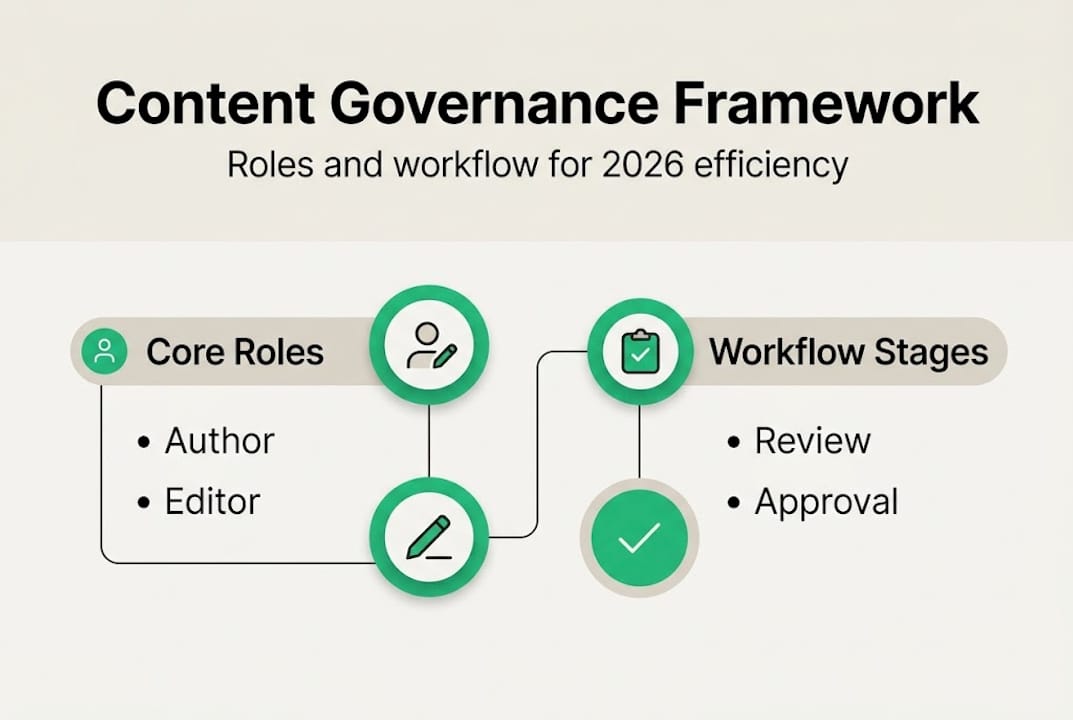
The typical lifecycle stages and responsible roles look like this:
| Stage | Description | Responsible role |
|---|---|---|
| Planning | Define content goals, audience, and format | Marketing strategy, content leads |
| Creation | Draft and develop content assets | Authors, subject matter experts |
| Review and approval | Quality, compliance, and brand checks | Editors, legal, approvers |
| Publishing | Deploy content to live environment | Editors, IT (for technical deployment) |
| Maintenance | Update for accuracy, performance, and relevance | Content owners, editors |
| Archiving | Remove or archive outdated content | Content managers, IT |
A practical example: a financial services organization publishes regulatory guidance pages. Those pages must be reviewed annually, updated when regulations change, and archived when superseded. Without lifecycle governance, outdated guidance stays live, creating compliance and reputational risk.
Key benefits of lifecycle management include:
- Reduced legal exposure: Outdated or non-compliant content is identified and removed on schedule.
- Lower operating costs: Teams spend less time hunting for outdated pages or fixing avoidable errors.
- Better SEO performance: Fresh, accurate content outperforms stale pages in search rankings.
- Cleaner content architecture: Scaling enterprise CMS platforms perform better when content is well-organized and regularly pruned.
Solid content architecture best practices are foundational to lifecycle management. If your content structure is unclear, lifecycle governance becomes exponentially harder to enforce.
A fresh perspective: Why real governance empowers, not restricts, your team
Conventional wisdom frames governance as bureaucracy. More approvals. More delays. More IT tickets. This framing is not just inaccurate. It is expensive.
Organizations that treat governance as a constraint build workarounds. Marketers publish directly to avoid slow approval chains. IT locks everything down to compensate. Both sides lose.
The organizations that get governance right treat it as an enabling infrastructure. Transparent roles mean marketers know exactly what they can do without asking IT. Automated workflows mean approvals happen in hours, not days. Audit logs mean IT can troubleshoot fast without interrogating the whole team.
True governance creates autonomy. When empowering content teams is the design goal, governance becomes the system that lets marketing move fast inside safe boundaries. IT retains control without becoming a bottleneck. That is not a compromise. It is the intended outcome of well-designed governance.
The organizations still treating governance as overhead are paying for it in slower launches, higher error rates, and preventable compliance incidents.
How 40Q empowers governance and efficiency in your WordPress ecosystem
Governance strategies only deliver results when the platform underneath them is built to support them. That is where 40Q operates.
40Q builds enterprise-grade WordPress platforms with governance designed in from the start. Our FAS Block System™ gives marketing teams publishing autonomy while IT retains full control over permissions, security, and compliance. We implement custom editorial workflows, lifecycle management tools, and audit infrastructure tailored to your organization’s structure. For teams ready to add AI-assisted content operations, our WordPress AI Suite integrates directly into governed workflows. If your content platform needs to scale without sacrificing control, 40Q delivers the architecture to make that possible.
Frequently asked questions
What is governance in content management?
Governance in content management refers to the policies, roles, workflows, and systems that ensure content is secure, compliant, consistent, and efficiently managed across its lifecycle. Core mechanics include RBAC, granular permissions, editorial workflows, audit logs, and automated policy enforcement.
How does governance improve content management efficiency?
Governance prevents errors, streamlines workflows, and automates compliance, enabling teams to publish faster and with fewer risks. Audit logs and automated policy enforcement are key components that reduce manual oversight and speed up operations.
What are the essential components of a content governance framework?
Core components include role-based access control, granular permissions, defined editorial workflows, lifecycle management processes, audit logs, and automation tools. These core mechanics work together to create a scalable, auditable content operation.
How can large organizations implement governance in WordPress?
Organizations can use plugins for roles and workflow management, adopt lifecycle and audit tools, and define clear policies for permissions and content processes. Editorial workflows and granular permissions are the most critical starting points for structured content management in WordPress.
Recommended
- Enterprise Web Governance: Ensuring Speed and Compliance – 40Q
- Enterprise-grade CMS defined: 17% faster marketing autonomy – 40Q
- Role of IT in Content Management Success – 40Q
- How to Empower Content Teams with a Modern CMS – 40Q
- Document Review and Compliance Support – Legal Filing & Compliance Services

Dec 9, 2025
WordPress
WordPress VIP vs WordPress.com vs Open Source: What’s the Difference?

Aug 28, 2025
WordPress
MCP Made Simple: A Beginner’s Guide for Marketers and WordPress Teams

Nov 7, 2024
WordPress