
WordPress
Content marketing trends 2026: 7 key shifts for CMOs

José Debuchy
April 3, 2026 | 3 min to read
TL;DR:
- Content success in 2026 depends on strategic clarity, governance, and AI-driven infrastructure.
- Zero-click visibility requires optimized, structured, multi-format content designed for AI citations.
- Building agility, security, and autonomy through enterprise WordPress platforms is essential for scaling effectively.
More content is not the answer. That assumption has driven bloated editorial calendars and diminishing returns for years. In 2026, the CMOs pulling ahead are not the ones publishing more. They are the ones publishing smarter, building around AI-driven discovery, and investing in platforms that give marketing teams real autonomy. Enterprise content effectiveness now depends on strategy clarity, governance, and the right infrastructure. This article covers the four shifts reshaping CMO priorities: zero-click and generative search, enterprise strategy fundamentals, AI workflow integration, and the platform decisions that determine speed to market.
Key Takeaways
| Point | Details |
|---|---|
| Zero-click search shift | GEO and AEO strategies are now essential for content discovery as AI surfaces brand content without clicks. |
| Quality over quantity | High-performing enterprises focus on governance, relevance, and skilled teams, not sheer output. |
| AI for workflow, not shortcuts | AI boosts efficiency in content ideation and personalization but cannot replace strong strategy or human oversight. |
| Secure, agile WordPress | Managed enterprise WordPress solutions provide campaign agility, security, and compliance at scale. |
The new reality: Zero-click, GEO/AEO, and the content discovery shift
Visibility no longer means what it used to. Google’s AI Overviews, chatbot interfaces, and featured snippets now answer questions before users ever click a link. For enterprise marketers, this is not a threat. It is a recalibration.
Zero-visit visibility and GEO/AEO are now dominant trends, with AI summaries actively reducing traditional click-through rates. Brands that want to stay visible must optimize for AI citations, not just rankings. That means structured, multi-format content built around intent.
GEO (Generative Engine Optimization) focuses on making your content citable by AI systems like ChatGPT, Gemini, and Perplexity. AEO (Answer Engine Optimization) targets direct answer placement in search features. Both require a shift from keyword-stuffed pages to authoritative, well-structured content that AI engines trust.
The impact is measurable. 97% of CMOs report positive results from GEO and AEO adoption. That is not a marginal signal. It reflects a structural change in how buyers discover brands.
“Brands must optimize for AI citations via structured, multi-media content. Zero-visit visibility is no longer optional for enterprise marketers.”
Actions for enhancing zero-click visibility:
- Implement structured schema markup (FAQ, HowTo, Article types) across all key pages
- Create multimedia content clusters: video, audio, and written formats around the same topic
- Build cited authority by earning backlinks from recognized industry sources
- Use conversational content formats that mirror how users phrase questions to AI tools
- Map content to specific intent stages, not just broad keyword themes
Good WordPress content governance makes this easier. When teams can publish structured, compliant content without developer bottlenecks, GEO/AEO execution becomes a repeatable process.
| Factor | Traditional SEO | GEO/AEO tactics |
|---|---|---|
| Primary goal | Rank on page one | Get cited by AI engines |
| Content format | Keyword-optimized text | Structured, intent-mapped content |
| Success metric | Click-through rate | AI citation frequency, brand mentions |
| Schema use | Optional | Essential |
| Content depth | Moderate | High authority, well-sourced |
The table above captures the core shift. Traditional SEO optimized for human search behavior. GEO/AEO optimizes for machine comprehension and trust signals.
What works at scale: Enterprise strategy, tools, and the quality mandate
Enterprise organizations consistently outperform midmarket peers in content effectiveness. The gap is not accidental. It reflects deliberate investment in strategy, skills, and governance.

68% of enterprise marketers rate themselves as highly or somewhat effective, compared to 59% across the broader B2B average. The top drivers: content relevance (cited by 64%), skilled teams (54%), and ongoing strategy refinement. Volume is not on that list.
The B2B trends data reinforces this. Organizations that review and adjust their content strategy at least twice per year show significantly stronger ROI than those running static annual plans. Agility at the strategy level matters as much as agility at the publishing level.
Three steps for scaling governance and quality:
- Conduct a strategy audit every six months. Identify which content types are generating pipeline, not just traffic. Retire formats that do not convert.
- Invest in team skill-building. AI tools only amplify the capabilities already present. Weak writers with AI assistance produce weak content faster.
- Choose tools that enforce quality standards. Platforms with built-in workflow approvals and editorial controls reduce the risk of off-brand or non-compliant publishing.
The right enterprise WordPress tools support all three steps. They give marketing teams publishing autonomy while preserving the governance guardrails IT teams require.
| Investment area | Priority level | Expected impact |
|---|---|---|
| AI ideation and editing tools | High | Faster content cycles |
| Personalization infrastructure | Medium-High | Improved engagement rates |
| Team upskilling programs | High | Sustained quality at scale |
| Workflow and compliance tooling | High | Reduced publishing risk |
For scalable WordPress strategies, the platform layer and the strategy layer must align. One without the other creates friction.
Pro Tip: Track content outcomes, not content output. The number of articles published per quarter is a vanity metric. Pipeline influence, engagement depth, and AI citation frequency are the metrics that reflect real effectiveness in 2026.
AI in action: Workflow transformation and the (realistic) role of automation
AI adoption in content marketing is no longer a differentiator. It is a baseline. The question is no longer whether to use AI, but where it adds the most value without eroding quality.
97% of large marketers use AI, primarily for ideation and editing. Budgets are rising, with 31% of enterprise teams spending between $15,000 and $45,000 per month on content operations. Yet the median output remains 11 to 20 blog posts per quarter. That number signals a deliberate choice: quality over volume.
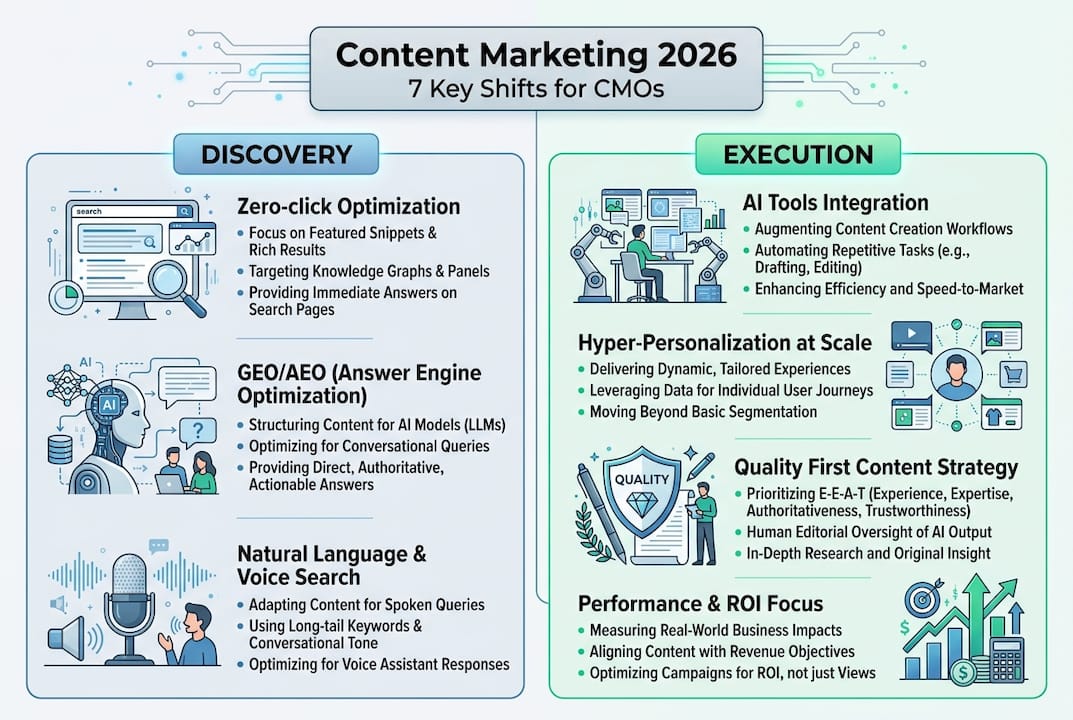
AI currently supports 60 to 70% of ideation and editing steps across high-performing content teams. But it does not replace the strategic layer. Intent mapping, audience segmentation, and editorial judgment remain human responsibilities.
High-impact AI use cases for enterprise content teams:
- Rapid asset generation: First drafts, content briefs, meta descriptions, and social variants produced in minutes
- Workflow automation: Routing drafts through approval stages without manual handoffs
- Personalization at scale: Dynamic content variants for different audience segments or regional markets
- Content repurposing: Converting long-form articles into video scripts, email sequences, or FAQ modules
- Performance analysis: AI-assisted reporting that surfaces underperforming content and recommends updates
Explore how WordPress AI tools integrate directly into editorial workflows for faster, more consistent publishing.
For content ops leaders, the real gain from AI is not speed alone. It is the ability to maintain consistent output quality while reducing the manual burden on senior writers and strategists.
Pro Tip: Do not over-invest in automation for automation’s sake. The highest-performing teams pair AI tools with structured human review. Automation handles the repeatable work. Humans handle the judgment calls.
Enterprise WordPress: Driving agility, security, and campaign control at scale
The CMS is not a back-office decision. For CMOs running high-volume, multi-market content programs, the platform determines how fast campaigns launch, how secure customer data stays, and how much developer dependency slows the team down.
Managed platforms like WordPress VIP and WP Engine offer a specific combination that enterprise teams need: agility through AI content tools and block editors, security through managed infrastructure and vulnerability scanning, and compliance features that satisfy legal and IT requirements simultaneously.
The WordPress VIP managed environment is built for high-traffic, content-heavy organizations. Uptime guarantees, automatic scaling, and enterprise-grade access controls are standard. These are not nice-to-have features. They are operational requirements for organizations publishing at scale.
Top benefits for CMOs on enterprise WordPress platforms:
- Publishing agility: Marketing teams launch pages and campaigns without waiting for developer sprints
- Security confidence: Managed vulnerability scanning and patching reduce exposure to content-layer attacks
- Governance controls: Role-based permissions and editorial workflows keep content quality consistent
- Rapid localization: Multi-site architecture supports regional and language-specific content without duplicating infrastructure
- Compliance readiness: Audit trails and access logs support GDPR, CCPA, and internal governance requirements
For teams managing high-traffic WordPress environments, the platform choice directly affects campaign performance under load. And for teams focused on enterprise WordPress optimization, the right managed setup reduces technical debt while increasing marketing velocity.
Pro Tip: When evaluating CMS platforms, include workflow depth and compliance tracking in your RFP checklist alongside performance benchmarks. A fast platform that creates governance gaps is a liability, not an asset.
Our take: Why strategy, not technology, will define 2026 winners
The technology conversation dominates every marketing conference right now. New AI tools, new CMS features, new optimization frameworks. The noise is real. And for most enterprise teams, it is a distraction.
The CMOs who will outperform in 2026 are not the ones who adopted the most tools. They are the ones who built the clearest strategic foundation before touching the technology stack. We have seen this pattern repeatedly across major platform rollouts. When governance is unclear and marketing teams lack autonomy, even the best tools underdeliver.
The overlooked risk is alignment drift. As teams scale and tools multiply, the distance between marketing intent and published output grows. Content starts serving internal processes instead of audience needs. Metrics shift toward activity rather than outcomes.
The fix is not a new platform. It is sharper governance, better cross-team communication, and a content cycle nimble enough to adapt without requiring a full strategy reset. Empowering marketing teams with the right autonomy and guardrails is more durable than any single technology investment. Strategy first. Tools second. Always.
Unlock agility with enterprise WordPress and AI innovation
If 2026’s content marketing trends point to one clear action, it is this: build the foundation before scaling the output. That means the right platform, the right governance model, and the right AI integration.
40Q helps enterprise marketing teams move faster without creating risk. Our FAS Block System™ gives your team full publishing autonomy on WordPress, while IT retains control over security, performance, and compliance. From AI-enabled content marketing workflows to enterprise-grade WordPress infrastructure and enterprise WordPress security, we build platforms that scale with your ambitions. Ready to close the gap between strategy and execution? Let’s talk.
Frequently asked questions
Recommended
Apr 9, 2024
WordPress
Start Using Gutenberg and Convert your Site into a Lead Generation Tool

Nov 11, 2025
WordPress
What Makes a CMS Truly Enterprise-Ready?

Feb 26, 2026
WordPress