
WordPress
Secure Content Publishing: A Guide for Enterprise WordPress

José Debuchy
April 14, 2026 | 3 min to read
TL;DR:
- Properly architected WordPress platforms focus on governance, role-based access, auditability, and rapid updates.
- Plugin sprawl and unmanaged ecosystems are primary security risks, but community patching accelerates fixes.
- Combining immutable infrastructure, headless delivery, and automation enables secure, fast enterprise content publishing.
Enterprise WordPress has a reputation problem. Marketing leaders hear “WordPress” and picture plugin-heavy sites that get hacked. IT leaders hear “marketing autonomy” and picture ungoverned content flying out the door. Both instincts are understandable, but neither reflects what a properly architected WordPress platform actually delivers. 91% of WordPress vulnerabilities trace back to plugins, not the core platform itself. That single fact changes the entire conversation. This guide breaks down what secure content publishing really means for enterprises, where the real risks live, and how to build a publishing environment that gives marketing teams speed without giving IT teams nightmares.
Key Takeaways
| Point | Details |
|---|---|
| Secure publishing defined | It means safeguarding digital content from unauthorized changes and vulnerabilities while supporting speed and compliance. |
| WordPress risk, managed | Most WordPress vulnerabilities come from plugins, but enterprise practices like audits and immutable setups reduce exposure. |
| Balance autonomy and control | Strategic design allows marketing teams freedom and IT oversight without compromising security or business agility. |
| Adopt expert-backed frameworks | Successful enterprises combine headless architecture, automated scanning, and strong governance for secure publishing at scale. |
What is secure content publishing in the enterprise?
Secure content publishing is the process of creating, approving, and distributing digital content with controls in place to guard against vulnerabilities, unauthorized changes, and data leaks. It is not just about locking down a CMS. It is about building a publishing pipeline where the right people can act fast, and the wrong actors cannot act at all.
For enterprise organizations, this definition carries real weight. A single unauthorized content change on a high-traffic site can damage brand reputation, trigger compliance violations, or expose customer data. The stakes are not theoretical.
Modern enterprises typically require four things from a secure publishing environment:
- Governance: Clear policies defining who can publish, edit, or approve content at every stage.
- Role-based access: Granular user permissions that limit exposure without slowing down legitimate workflows.
- Auditability: A full record of who changed what, when, and why. Essential for regulated industries.
- Rapid update capability: The ability to patch vulnerabilities or push corrections without waiting on a development queue.
WordPress, when implemented correctly, satisfies all four. The platform’s content compliance for enterprise capabilities are often underestimated by organizations that only know WordPress from its consumer reputation.
“Open-source WordPress powers sites like WhiteHouse.gov and NASA due to its transparency and rapid fix cycle.”
That is not a coincidence. High-profile institutions choose WordPress because the open-source model means vulnerabilities get identified and patched faster than most proprietary systems can manage. Closed-source vendors fix issues on their own schedule. The WordPress community fixes them publicly, rapidly, and at scale.
For marketing and IT leaders, the business case is straightforward. Secure publishing protects revenue, reduces legal exposure, and builds the organizational trust needed for marketing teams to operate with genuine autonomy. Without it, every campaign launch becomes a negotiation between speed and risk.
The unique challenges and risks of WordPress publishing
Understanding the risks requires separating WordPress core from the ecosystem built around it. Core WordPress is lean, well-maintained, and audited by thousands of contributors. The challenge comes from what gets added on top.

Plugin sprawl is the primary attack surface. Every plugin installed is a potential entry point. Organizations that accumulate plugins over years, often without formal review, dramatically expand their exposure. 91% of WordPress vulnerabilities originate in plugins, but the open-source model also means the community patches these issues faster than most proprietary alternatives.
| Risk factor | Open-source WordPress | Proprietary CMS |
|---|---|---|
| Patch speed | Fast, community-driven | Dependent on vendor schedule |
| Transparency | Full code visibility | Limited or none |
| Plugin ecosystem | Large, variable quality | Smaller, more controlled |
| Attack surface | Broad if unmanaged | Narrower by default |
| Customization | Extensive | Often restricted |
The table above shows why the open-source vs. proprietary debate is not black and white. WordPress gives enterprises more control and faster fixes. It also demands more discipline.
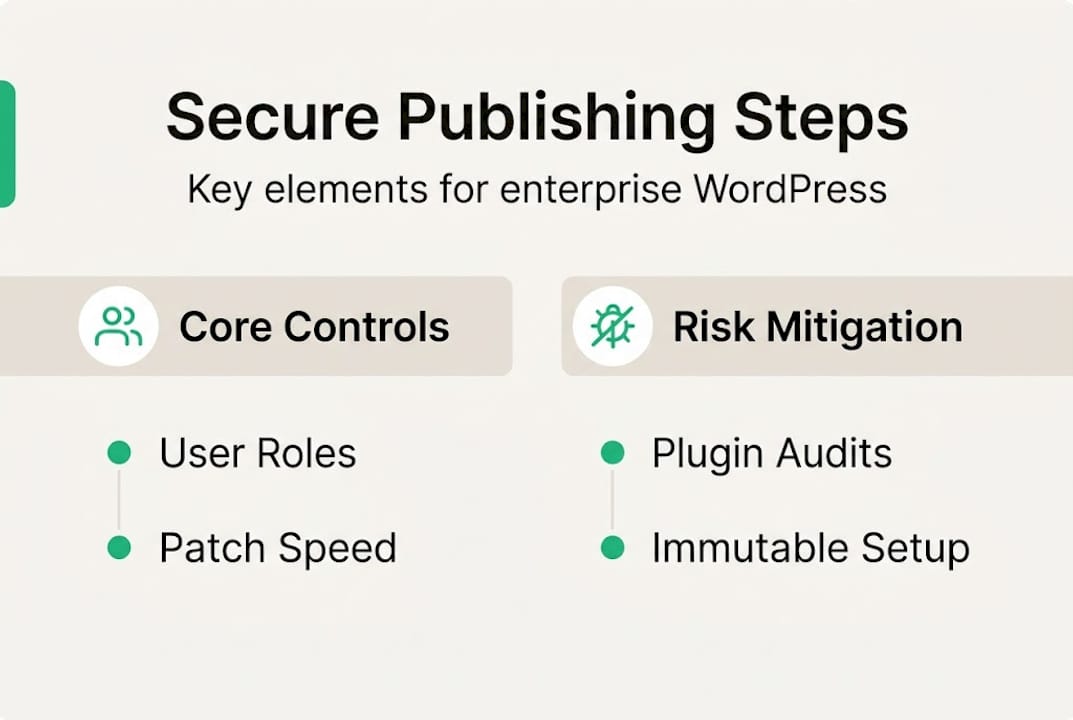
Immutable infrastructure is one of the most effective architectural responses to file-based attacks. In an immutable setup, the server environment cannot be modified at runtime. Content changes go through a defined pipeline, not direct file access. This eliminates an entire category of attack. However, it also requires a publishing workflow redesign, which many teams are not prepared for.
AI-generated content and AI-assisted attacks add a new layer of complexity. Automated content injection, prompt-based exploits, and AI-generated phishing are emerging threats that traditional security models were not built to handle. Securing enterprise WordPress now means accounting for these vectors, not just SQL injections and brute force logins.
Pro Tip: Audit your active plugins quarterly. Remove anything unused or unsupported. Every plugin you eliminate is an attack vector you close permanently. For deeper context on why WordPress security is often better than perceived, WordPress security insights offer a useful starting point.
- Unused plugins still carry vulnerabilities even when deactivated.
- Outdated themes can expose the same risks as outdated plugins.
- Third-party integrations (CRMs, analytics tools) extend the attack surface beyond WordPress itself.
Best practices for secure WordPress content publishing
With risks clearly mapped, the path forward is systematic. Enterprise-grade secure publishing does not happen by accident. It requires deliberate architecture and ongoing operational discipline.
Step-by-step hardening approach:
- Audit and consolidate plugins. Start with a full inventory. Remove plugins that duplicate functionality or lack active maintenance. Fewer plugins mean fewer vulnerabilities.
- Define and enforce user roles. WordPress has built-in role management, but enterprises often need custom roles. Match permissions to actual job functions, not convenience.
- Implement automated vulnerability scanning. Tools like Patchstack monitor your plugin stack continuously and alert teams before exploits become incidents.
- Establish publishing protocols. Two-person review workflows, staging environments, and approval gates prevent unauthorized or erroneous content from reaching production.
- Adopt immutable or CDN-based delivery. Serving content through a CDN with locked server environments reduces runtime attack exposure significantly.
The enterprise website security model for WordPress increasingly favors immutable infrastructure paired with headless delivery. Here is how the two main approaches compare:
| Workflow type | Speed | Security posture | Complexity | Best for |
|---|---|---|---|---|
| Traditional (mutable) | Fast to set up | Moderate | Low | Smaller teams, lower risk |
| Immutable + CDN | Fast at scale | High | Moderate to high | Enterprise, high-traffic |
| Headless WordPress | Very fast delivery | High | High | Content-heavy, distributed teams |
Pro Tip: Automated update systems for WordPress core and plugins reduce the window between vulnerability disclosure and patching. Manual update processes leave organizations exposed for days or weeks. The WordPress security checklist and CMS security controls frameworks provide structured starting points for teams building or auditing their security posture.
Prioritizing plugin audits and automated scanning alongside immutable and CDN architectures delivers both speed and security at enterprise scale. These are not competing priorities. They are complementary when the architecture supports them.
Balancing speed, security, and autonomy: Strategic tradeoffs
Every enterprise faces the same tension. Marketing wants to publish faster. IT wants tighter controls. Security teams want both teams to slow down and think. The organizations that resolve this tension most effectively do not compromise on any front. They redesign the workflow so the tension disappears.
Typical tradeoffs that create friction:
- Fast release cycles vs. governance gates: Requiring IT approval for every content change creates bottlenecks. But removing all gates creates risk.
- Developer dependency vs. marketing autonomy: When marketing teams need a developer to update a landing page, speed suffers and costs rise.
- Customization vs. maintainability: Highly customized WordPress environments can be powerful but difficult to secure and update over time.
Advanced WordPress architectures address these directly. Headless WordPress separates the content layer from the presentation layer, allowing marketing teams to publish freely while IT controls the delivery infrastructure. Atomic block systems, like the FAS Block System™, give marketers pre-approved, pre-secured building blocks for pages and campaigns. Conditional publishing flows allow content to be staged, reviewed, and released on schedule without manual developer intervention.
The business case for getting this right is concrete. Marketing autonomy frameworks can deliver up to 29% higher ROI when paired with robust security and publishing controls. That is not a marginal improvement. It is a strategic advantage.
For IT decision-makers, the argument is equally compelling. A well-governed publishing environment reduces incident response costs, lowers compliance risk, and eliminates the firefighting that comes from ad hoc publishing practices. Security becomes a feature of the platform, not a constraint on the team.
The goal is a system where marketing teams can launch campaigns in hours, not weeks, and IT teams can audit, govern, and secure without becoming a bottleneck. That balance is achievable. It requires the right architecture and the right operational model.
Our take: Secure content publishing as a force multiplier
Most organizations treat security as a tax on speed. Build the feature, then add the security layer. Ship the campaign, then worry about governance. This approach is not just risky. It is expensive. Retrofitting security into a publishing workflow costs far more than building it in from the start.
The enterprises that get this right flip the model. They treat secure publishing infrastructure as the foundation for marketing velocity, not a constraint on it. When governance is built into the platform, marketing teams do not wait for IT approval. They work within a system that is already approved.
Enterprise WordPress hardening now goes beyond baseline security. It is about business acceleration. The organizations we work with that invest in proper publishing architecture consistently outpace competitors on content velocity, campaign frequency, and market responsiveness.
Security, done right, is not a wall. It is the infrastructure that lets teams move fast with confidence. Boosting speed and security simultaneously is not a paradox. It is the expected outcome of intelligent platform design.
Take the next step to secure enterprise publishing
The gap between where most enterprise WordPress environments are and where they need to be is real, but it is closeable. The strategies in this guide are not aspirational. They are operational, and they are being implemented by organizations right now.

40Q builds enterprise-grade WordPress solutions designed specifically for organizations that need marketing speed without sacrificing IT control. From immutable infrastructure to the FAS Block System™, our platforms are built to make secure publishing the default, not the exception. Start with the WordPress enterprise security checklist to benchmark your current posture, or explore how AI-powered publishing security can reduce risk while accelerating content workflows.
Frequently asked questions
Recommended

Feb 11, 2026
WordPress
Role of IT in Content Management Success

Apr 3, 2026
WordPress
Content marketing trends 2026: 7 key shifts for CMOs

Mar 4, 2026
WordPress