
WordPress
Why marketing autonomy matters: boost speed and security

José Debuchy
April 4, 2026 | 3 min to read
TL;DR:
- Marketing autonomy enables faster publishing while maintaining governance through structured guardrails.
- AI tools and modern CMS platforms help reduce approval times and increase content volume.
- Hybrid governance models balance speed, security, and compliance effectively in large organizations.
Most marketing leaders assume that adding more approval layers makes content publishing safer. That assumption is costing organizations time, talent, and competitive ground. In high-traffic, content-heavy enterprises, the real risk is not a rogue blog post. It is the velocity gap: the widening distance between how fast your team needs to publish and how slowly your governance infrastructure allows it. Marketing autonomy, when implemented with the right guardrails, does not trade security for speed. It delivers both. This article breaks down the evidence, the frameworks, and the practical steps CMOs need to act with confidence.
Key Takeaways
| Point | Details |
|---|---|
| Faster speed to market | Marketing autonomy lets teams publish content more quickly by removing unnecessary approval layers. |
| Structured safeguards | Autonomy with strong governance and AI-powered checks maintains brand safety and compliance. |
| Quantifiable business impact | Autonomy boosts sales productivity, lowers costs, and increases satisfaction—when you measure the right metrics. |
| Balance is essential | The best results come from hybrid models that blend central strategy with local execution. |
| Continuous improvement | Regularly monitor outcomes and adapt frameworks to avoid pitfalls and maximize team performance. |
Understanding marketing autonomy: Core concepts and drivers
Marketing autonomy is not the same as letting teams publish whatever they want. It is a structured operating model where marketing teams have the tools, permissions, and defined boundaries to execute content decisions without waiting on developers or legal for every minor update. The distinction matters.
Full decentralization means no central oversight. Ad hoc publishing means no standards at all. Marketing autonomy sits between those extremes. It is empowerment within a framework. Teams move fast because the guardrails are already built in, not because they are absent.
So why is this rising to the top of the CMO agenda in 2026? Three forces are driving it.
First, AI velocity. Generative AI tools can now produce content at a scale no human team can match manually. Organizations that require every AI-assisted asset to pass through a five-step approval chain are neutralizing the speed advantage AI offers.
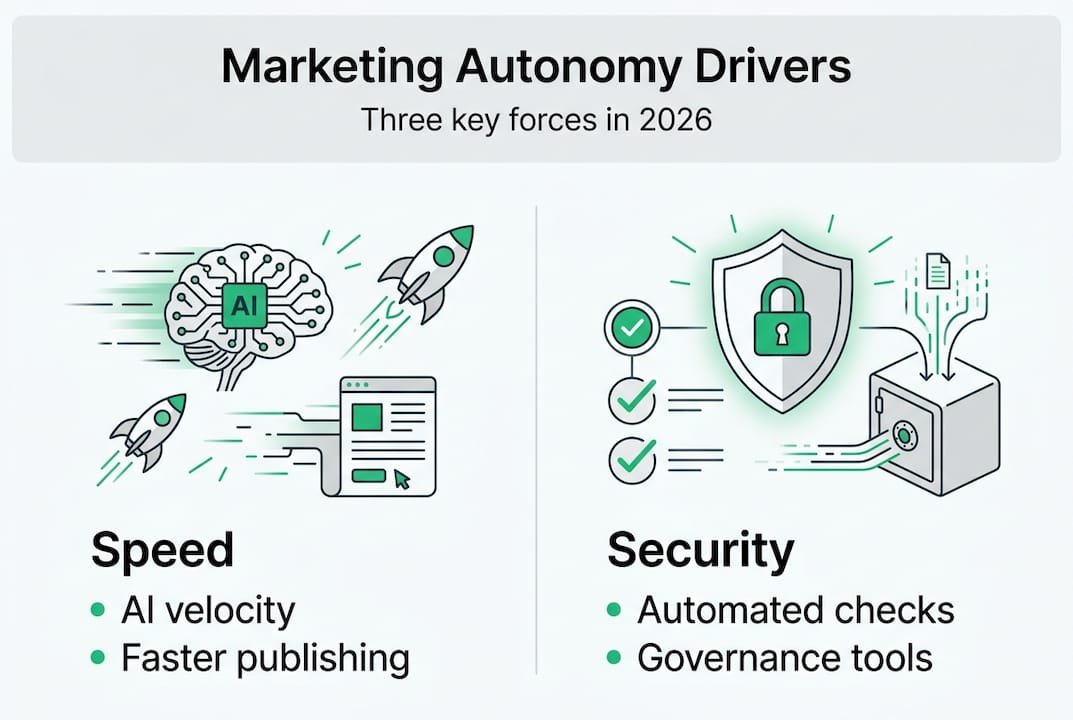
Second, content volume demands. Personalization at scale, localized campaigns, and always-on digital channels require publishing cadences that legacy governance models cannot support.
Third, talent retention. Skilled marketers do not want to wait two weeks for a landing page to go live. Autonomy is increasingly a factor in whether strong teams stay or leave.
“Faster speed to market for content publishing comes from reducing approval bottlenecks and empowering small teams with clear guardrails, leading to measurably higher performance.”
Key autonomy drivers in 2026:
- AI velocity gap: Generative tools outpace manual approval workflows
- Content volume growth: Personalization and localization require higher publishing frequency
- Talent expectations: Marketers expect tools and authority to match their expertise
- Competitive pressure: Faster competitors are capturing audience attention first
- Governance evolution: Modern CMS platforms now make structured autonomy technically feasible
For CMOs ready to see revenue impact data, the business case is increasingly hard to ignore.
The business case: Measurable benefits of marketing autonomy
Autonomy is not a soft benefit. It produces trackable, reportable outcomes that matter to the C-suite. CMO Survey data shows AI adoption is already lifting sales productivity by 8.6%, improving customer satisfaction by 8.5%, and reducing marketing costs by 10.8%. These are not projections. They are current performance shifts.
The challenge is attribution. Sixty-four percent of marketing leaders still cite demonstrating financial impact as their top obstacle. That is a measurement problem, not a results problem. The data on autonomy ROI exists. The gap is in connecting publishing velocity to revenue outcomes.
| Metric | Baseline (centralized) | With autonomy |
|---|---|---|
| Time to publish | 10 to 15 days | 1 to 3 days |
| Marketing cost reduction | Baseline | Up to 10.8% |
| Sales productivity gain | Baseline | Up to 8.6% |
| Customer satisfaction lift | Baseline | Up to 8.5% |
| Team satisfaction | Low | Measurably higher |
The role of the CMS in enabling these gains is direct. Platforms that give marketers structured editing environments, pre-approved templates, and role-based permissions eliminate the bottleneck without removing oversight.
Executives tracking autonomy impact should monitor these metrics:
- Time to publish: Days from brief to live page
- Content output volume: Assets published per sprint or quarter
- Developer dependency rate: Percentage of publishing tasks requiring IT involvement
- Campaign launch cycle: Time from campaign brief to first live asset
- Cost per published asset: Total team cost divided by output volume
For teams just starting out, the autonomy self-assessment is a practical first step to benchmark current state. Empowering content teams with the right CMS architecture is what converts these metrics from aspirational to operational.
Managing risk: Best practices for balancing speed, security, and governance
The concern most IT and legal teams raise about marketing autonomy is legitimate: who is responsible when something goes wrong? The answer is governance architecture, not headcount.

Hybrid central-decentral models are the most effective structure for large organizations. Central teams define brand standards, compliance rules, and approved component libraries. Regional or functional teams execute within those parameters. No one waits. No one goes rogue.
AI-powered compliance checks are making this model dramatically more scalable. Automated governance tools can review content for regulatory language, brand tone, and accessibility standards up to 30X faster than manual review. Phased rollouts let organizations test autonomy in lower-risk content categories before expanding permissions.
| Model | Speed | Control | Risk |
|---|---|---|---|
| Centralized | Slow | High | Low but brittle |
| Decentralized | Fast | Low | High |
| Hybrid | Fast | High | Managed |
Governance best practices for enterprise teams:
- Define role-based permissions at the CMS level, not just in policy documents
- Build compliance checks into the publishing workflow, not after it
- Use pre-approved content blocks and templates to reduce freeform risk
- Establish a clear escalation path for edge cases
- Audit publishing activity quarterly, not annually
The CMS and governance relationship is foundational. A platform that enforces rules at the interface level removes the burden from individual judgment. Scalable CMS solutions built for enterprise environments handle this by design. For teams focused on digital experience optimization, governance and speed are not competing priorities. They are co-dependent.
Pro Tip: In regulated industries like finance or healthcare, map every content type to its compliance requirement before building your permission model. This prevents exceptions from becoming the rule.
WordPress for enterprise teams provides the structural foundation many organizations use to operationalize this hybrid model at scale.
Common pitfalls, edge cases, and how to implement autonomy successfully
Most autonomy initiatives do not fail because the concept is wrong. They fail because implementation skips the hard alignment work upfront.
The most common pitfalls include brand inconsistency when regional teams interpret guidelines differently, KPI fragmentation when teams optimize for local metrics that conflict with global goals, and AI-related risks including content bias and compliance hallucinations. AI-introduced risks like these require human oversight loops and continuous monitoring, not just initial setup.
Startups can often move faster because they have no legacy silos. Enterprise organizations face a different challenge: existing workflows, entrenched tools, and cross-functional inertia. The risk of brand inconsistency and siloed data is real without strong central frameworks. Hybrid models are the recommended path for large organizations precisely because they preserve central authority while distributing execution.
A field-tested implementation sequence:
- Audit current publishing workflows: Identify where bottlenecks occur and who owns each step
- Align marketing, legal, and IT on non-negotiable compliance requirements before any tools are selected
- Pilot with low-risk content: Start with blog posts or internal campaign assets, not regulatory pages
- Build guardrails into the platform: Role-based permissions, approved templates, and automated checks
- Measure time-to-publish from week one and iterate based on real data
- Expand permissions incrementally: Add content types and teams as trust and process mature
For scalable publishing tips specific to enterprise environments, the sequencing above maps directly to how mature organizations have structured their rollouts. Autonomy lessons from organizations that have done this well consistently point to one factor: cross-team alignment before technology selection.
Pro Tip: Assign a dedicated autonomy lead, not an AI tool, to monitor publishing quality during the first 90 days. Human review catches pattern failures that automated systems miss early in the process.
For teams evaluating AI-driven risk management, the key is building monitoring into the workflow from the start, not retrofitting it after problems surface.
A fresh perspective on marketing autonomy for 2026
Here is what most autonomy conversations get wrong: they treat control as the thing being given up. It is not. Control is being redistributed and made smarter.
CMOs who are still debating whether to allow autonomy are focused on the wrong risk. The real threat is not a team member publishing an off-brand headline. It is watching a more autonomous competitor outpublish you three to one while your approval chain processes last quarter’s campaign assets.
The organizations winning on content velocity in 2026 are not the ones with the loosest governance. They are the ones with the most intelligent governance, embedded in the platform itself, invisible to the user, and enforced at the point of creation. Autonomy leadership insights consistently show that the velocity gap is the metric CMOs should be tracking against aspirational competitors, not internal approval cycle times.
Pilot autonomy in a guarded space. Measure the velocity gap. Then scale what works. The risk of moving too slowly is now larger than the risk of moving too fast.
How 40Q empowers secure marketing autonomy at scale
40Q builds enterprise WordPress platforms that give marketing teams real publishing autonomy without removing IT control. Our proprietary FAS Block System™ embeds governance directly into the content editing experience, so teams work within approved structures by default.

For CMOs ready to reduce developer dependency and accelerate content velocity, 40Q’s WordPress AI Suite integrates AI-assisted workflows with enterprise-grade compliance checks. Explore our full enterprise capabilities or start with our marketing automation checklist to identify your highest-impact next steps. Speed and security are not a trade-off. They are the outcome.
Frequently asked questions
Recommended

Nov 11, 2025
WordPress
What Makes a CMS Truly Enterprise-Ready?

Feb 26, 2026
WordPress
Top 8 WordPress Alternatives 2026 for All Needs and Budgets

Feb 3, 2026
WordPress