
WordPress
Web Maintainability: Empowering Enterprise Teams for Growth

José Debuchy
February 20, 2026 | 3 min to read
Every enterprise marketing leader knows the frustration of waiting on developer teams for simple content updates or urgent campaign launches. Web maintainability is not just a technical concern—it is the linchpin for empowering teams, ensuring agility, and maintaining compliance across dynamic, high-traffic platforms. By focusing on web maintainability, you reduce technical debt, improve adaptability to shifting requirements, and support long-term growth without sacrificing security or performance.
Key Takeaways
| Point | Details |
|---|---|
| Web Maintainability is Essential | A maintainable web platform allows marketing teams to operate independently, reducing reliance on developers for updates and adaptations. |
| Invest in Preventive Maintenance | Prioritizing preventive measures helps minimize future issues, reducing emergency fixes and associated costs. |
| Emphasize Automation and Monitoring | Implementing automated testing and continuous monitoring enhances reliability and accelerates deployment processes. |
| Balance Maintenance Types | A healthy distribution of maintenance efforts—corrective, adaptive, perfective, and preventive—optimizes long-term platform performance. |
Defining Web Maintainability for Enterprises
Web maintainability represents far more than keeping your website running smoothly. For enterprise marketing leaders, it’s the operational backbone that determines whether your team can launch campaigns at speed without waiting on developer resources. Web maintainability is the measure of how easily your digital platform can be modified, extended, fixed, and optimized throughout its lifecycle—without sacrificing performance, security, or compliance.
Think of it this way: a poorly maintainable site forces your marketing team into constant dependency on developers for even minor updates. A well-maintained platform empowers your team to publish content, adjust campaigns, and respond to market opportunities independently. This distinction matters enormously when you’re managing high-traffic sites with content-heavy workflows across multiple regions and markets.
The core components of web maintainability include:
- Code quality and clarity – Your codebase should be readable and organized so future changes don’t introduce bugs or performance regressions
- Documentation standards – Clear documentation enables team members to understand system architecture, dependencies, and workflows without constant context switching
- Modular architecture – Breaking your platform into independent, reusable components reduces complexity and makes updates safer
- Performance monitoring – Continuous tracking of metrics like load times and Core Web Vitals ensures changes don’t degrade user experience
- Security protocols – Established security standards prevent vulnerabilities during updates and new feature deployments
- Governance frameworks – Clear approval processes and compliance checkpoints ensure marketing autonomy without creating organizational risk
Software maintainability determines how easily a system can be modified and extended throughout its operational life. This becomes critical for enterprises because every day your team cannot act independently costs money. When developers become bottlenecks for content publishing, localization, or landing page creation, you’re losing competitive advantage.
Consider the real-world challenge: your marketing department identifies an opportunity to launch a localized campaign in a new market by Friday. If your platform requires developer intervention to add pages, adjust content blocks, or configure regional variations, you miss the window. A maintainable platform equipped with the right tools—like intuitive content management systems and flexible templating—enables your team to execute without blockers.
Web maintainability directly impacts your organization’s ability to respond to market demands while reducing technical debt and obsolescence risks.
Enterprise web maintainability also addresses a less obvious but critical issue: technical debt accumulation. Every poorly documented workaround, every hardcoded solution, every “temporary” bypass adds complexity to your system. Over time, this debt compounds. Your platform becomes slower to update, riskier to modify, and increasingly expensive to maintain. A focus on maintainability prevents this spiral by establishing standards that keep your codebase clean and manageable.
The stakes are different for enterprises than for smaller organizations. Your site may handle millions of monthly visitors. Your content workflow might span 15 different markets with localization requirements. Your compliance obligations might include GDPR, CCPA, and industry-specific regulations. A maintainability failure isn’t just inconvenient—it can create security vulnerabilities, compliance violations, or service outages that directly impact revenue.
Here’s a concise summary of enterprise web maintainability components and their business impact:
| Component | What It Enables | Business Impact |
|---|---|---|
| Code Quality & Clarity | Faster, safer updates | Reduces risk and developer bottlenecks |
| Documentation | Easier onboarding and knowledge transfer | Minimizes interruptions and errors |
| Modular Architecture | Independent feature changes | Accelerates campaign launches |
| Performance Monitoring | Real-time health checks | Maintains user experience and uptime |
| Security Protocols | Safe feature deployment | Prevents compliance issues and breaches |
| Governance Frameworks | Clear approval for updates | Balances marketing freedom with control |
This is why understanding enterprise website best practices helps align your platform with both marketing and IT objectives. The goal isn’t to choose between speed and stability. A truly maintainable enterprise platform delivers both: your marketing team moves fast while your IT team maintains full control over security, performance, and governance.
Pro tip: Audit your current platform’s maintainability by measuring three things: how long it takes your marketing team to publish new content, how frequently developers handle “simple” requests, and how many undocumented workarounds exist in your codebase. These metrics reveal whether maintainability is working or becoming a hidden cost center.
Key Principles of Maintainable Web Platforms
Maintainable web platforms aren’t built on luck or wishful thinking. They’re built on deliberate architectural choices and established principles that make your system easier to modify, test, and scale as your business grows. For enterprise marketing leaders, understanding these principles means recognizing which platform decisions will empower your team versus which ones will create future bottlenecks.
The foundation of maintainability rests on three critical pillars: modularity, testability, and clear separation of concerns. Modularity means breaking your platform into independent, reusable components that can be updated without cascading failures across your entire system. When your content management system, authentication layer, and publishing workflow exist as separate modules, your developers can fix issues in one area without touching everything else. Testability ensures each component can be validated independently before deployment, catching errors before they reach production. Separation of concerns prevents your marketing workflows from tangling with your security protocols or performance optimization—each handles its specific responsibility.

These principles work together to solve a real problem enterprises face: rapid feature deployment without stability risk. Your marketing team needs to launch a new landing page template, update user permissions, or configure a regional variation. If your platform is monolithic (everything tightly connected), any change introduces risk. If it’s modular and well-tested, changes are isolated and safe.
Consider how microservices architecture supports independent deployment and scalability. Rather than one monolithic codebase, services are broken into smaller, specialized components that communicate with each other. Your content delivery service, for example, operates independently from your user authentication service. This separation makes debugging faster, scaling more efficient, and updates safer.
Key principles that drive maintainability include:
- Independent deployability – Services can be updated and deployed without requiring changes to unrelated components
- Clear interfaces – Well-documented APIs and contracts between modules prevent hidden dependencies and miscommunications
- Simplified debugging – When something breaks, a modular system narrows the search space significantly faster than monolithic alternatives
- Efficient resource utilization – Components scale independently based on actual demand, not blanket upgrades to the entire system
- Resilience to change – Your platform handles business requirement shifts without architectural rewrites
Platforms designed for modularity and testability adapt to evolving enterprise requirements while maintaining stability and performance.
One often-overlooked principle is documentation as code. Not the sprawling 300-page manuals nobody reads, but clear, embedded documentation that explains why decisions were made, how components interact, and what guardrails exist. When your next developer (or your marketing team using self-service tools) needs to understand system behavior, they shouldn’t have to reverse-engineer it from obscure code comments or tribal knowledge from departing team members.
Another critical principle: designing for observable systems. Your platform should emit clear signals about its health. Load times, error rates, cache hit ratios, deployment success rates—these metrics tell you whether maintainability is working or deteriorating. Without observability, you can’t distinguish between a platform that’s genuinely well-maintained and one that merely appears stable while technical debt accumulates invisibly.
These principles become especially important when your organization uses scalable publishing systems that empower enterprise teams. Your marketing team shouldn’t need developer intervention for routine tasks like publishing content, adjusting campaigns, or configuring landing pages. This requires a platform built with clear separation between the marketing interface layer and the core system infrastructure—a modular, testable design that isolates changes to one domain without affecting others.
The business impact of these principles is substantial. Platforms built on modularity and testability reduce time-to-market for campaigns, decrease the cost of updates, and minimize the risk of production outages. Your IT team maintains governance while your marketing team moves fast. Development teams ship features with confidence rather than apprehension.
Pro tip: Assess your platform’s adherence to these principles by documenting your current architecture: map out how many components must change for a typical content update, identify which systems are tightly coupled, and measure how long debugging takes when errors occur. These diagnostics reveal whether your platform is truly maintainable or merely stable by luck.
Common Types and Levels of Maintainability
Not all maintenance work is equal. Your platform needs different types of upkeep depending on what problem you’re solving. Understanding these categories helps your team prioritize resources, set realistic expectations, and build a comprehensive maintenance strategy that keeps your platform healthy without constant firefighting. For enterprise leaders managing complex digital platforms, recognizing these distinctions means making smarter decisions about where your budget and developer time actually go.
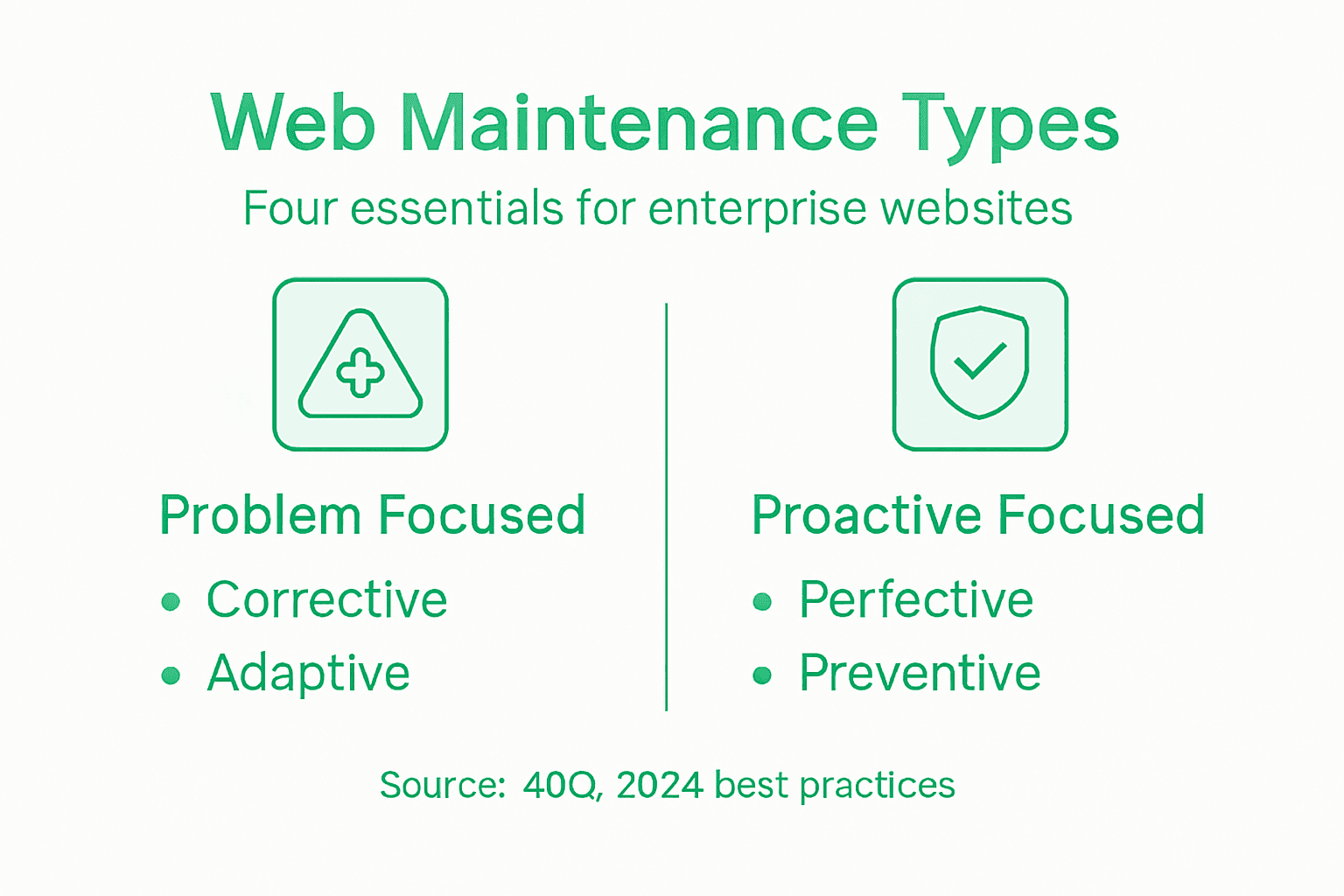
There are four primary types of maintenance, each addressing different aspects of your platform’s lifecycle:
Corrective maintenance fixes problems that already exist. A security vulnerability discovered in production, a bug causing publishing failures, or a broken payment integration—these are corrective issues. They’re reactive, often urgent, and demand immediate attention. While necessary, spending 80 percent of your maintenance budget here indicates your platform has underlying stability issues.
Adaptive maintenance adjusts your platform to changing environments or business requirements. Your organization expands to a new market requiring different compliance rules, your hosting infrastructure upgrades with new capabilities, or regulatory changes demand modified workflows. Adaptive work keeps your platform synchronized with the world around it rather than gradually falling out of sync with operational reality.
Perfective maintenance improves how your platform performs or functions. This includes optimizing database queries to reduce load times, refactoring code to improve readability, upgrading dependencies to their latest stable versions, or redesigning workflows to be more intuitive. Perfective work makes your platform better without changing what it fundamentally does.
Preventive maintenance stops problems before they occur. Regular security audits, dependency updates before vulnerabilities are discovered, code quality improvements that reduce future bugs, and documentation that prevents misunderstandings—these investments prevent crisis situations. The best-maintained platforms invest heavily in preventive work, reducing the constant pressure of corrective firefighting.
The following table compares the four maintenance types and their strategic value for enterprise platforms:
| Maintenance Type | Main Purpose | Example Task | Long-Term Benefit |
|---|---|---|---|
| Corrective | Fix existing issues | Patch critical vulnerability | Restores operational stability |
| Adaptive | Respond to changes | Implement new compliance rules | Sustains platform relevance |
| Perfective | Optimize system | Refactor slow database queries | Improves performance and usability |
| Preventive | Prevent problems | Conduct code quality audits | Reduces emergencies, saves costs |
A mature maintenance strategy balances corrective, adaptive, perfective, and preventive work. Platforms spending most budget on corrective maintenance are struggling; those investing in preventive work are thriving.
Beyond types, understanding levels of maintainability involves measuring code complexity, documentation quality, and test coverage. These metrics reveal not just whether your platform works, but how easily it can evolve. High code complexity makes changes risky and slow. Poor documentation forces developers to reverse-engineer intent from the code itself. Low test coverage means changes introduce uncertainty and regressions.
You can assess your platform’s maintainability level using specific measurable factors:
- Code complexity metrics – Cyclomatic complexity, lines of code per function, and nesting depth indicate whether code is easy to understand and modify
- Documentation completeness – Does someone new to your team understand system architecture, component relationships, and design decisions within hours or weeks?
- Test coverage percentages – What percentage of your codebase is validated by automated tests? Industry standards suggest 70-80 percent minimum for enterprise platforms
- Deployment frequency – How often can you safely release changes? Daily deployments suggest high confidence; monthly or quarterly releases suggest risk management is restricting velocity
- Mean time to recovery – When production breaks, how quickly do you understand the problem and deploy a fix? This reveals whether your system is observable and maintainable
These measurements matter because they directly impact your team’s ability to move. A platform with high code complexity takes weeks to safely implement a simple feature. A platform with strong test coverage and low complexity takes days. The difference compounds over months and years, affecting whether your marketing team feels empowered or perpetually blocked.
Balancing Maintenance Types
Most enterprises begin with excessive corrective maintenance—responding to emergencies instead of preventing them. Your team patches vulnerabilities after exploits are discovered rather than conducting regular security reviews. You fix broken workflows after they cause support tickets rather than monitoring system health proactively.
The shift toward mature maintainability means gradually rebalancing. You invest in preventive work: automated testing that catches regressions before production, security scanning in your development pipeline, and regular code quality reviews. You invest in perfective work: paying down technical debt, improving documentation, and optimizing performance bottlenecks. This reduces the corrective firefighting that consumes so much time and energy.
Your IT team’s goal should be moving your maintenance spending distribution toward roughly 20 percent corrective, 20 percent adaptive, 20 percent perfective, and 40 percent preventive. This distribution means your team spends most time stopping problems rather than fixing them, and emergencies are genuinely rare rather than your default state.
Pro tip: Calculate your current maintenance spending distribution by reviewing your development team’s work over the last three months: how much time went to fixing bugs versus preventing them, improving code quality versus emergency patching, and documentation versus reactive problem-solving? This distribution reveals your platform’s true maintainability level and where to focus improvement efforts.
Critical Risks and Long-Term Implications
Ignoring web maintainability doesn’t feel like a crisis in year one. Your platform works. Your marketing team publishes content. Campaigns launch and convert. But the costs compound silently, accumulating in ways that only become visible when they’re already catastrophic. For enterprise leaders, understanding these long-term implications means recognizing why maintainability investment today prevents existential problems tomorrow.
The risks of poor maintainability manifest across multiple dimensions:
Extended development cycles represent one of the most visible costs. A feature that should take two weeks takes six because developers must navigate tangled code, undocumented dependencies, and unexpected side effects. Every change requires extensive testing because no one fully understands the system’s behavior. Your marketing team waits. Competitors move faster. Market windows close. What starts as a minor slowdown compounds—by year three, your organization can’t ship features at competitive velocity.
Increased error rates create another compounding problem. When code is complex and poorly tested, changes introduce regressions. Your team fixes one bug and breaks another. Production incidents spike. Support teams are overwhelmed. Your reliability reputation suffers with customers and internal stakeholders alike. The worst part: the more errors you accumulate, the more cautious your team becomes, further slowing development velocity.
System obsolescence creeps in when your platform can’t adapt to changing requirements. Your organization needs to launch in a new market with different compliance rules, but your architecture is so inflexible that modification requires a complete rebuild. Technologies your platform depends on reach end-of-life, but upgrading is too risky because no one understands the codebase well enough to do it safely. Your platform becomes increasingly out of sync with both business needs and technological reality.
Technical debt compounds relentlessly. Ignoring maintainability leads to extended development cycles, increased error rates, and compounding technical debt that reduces adaptability. Each undocumented shortcut, each hardcoded workaround, each “we’ll refactor this later” decision adds complexity. This debt doesn’t get easier to repay over time—it gets harder. The system becomes increasingly fragile, expensive to modify, and risky to change. Eventually, you face a choice: rebuild the platform from scratch or accept permanent operational drag.
The longer you delay maintainability investment, the more expensive it becomes to recover. A six-month refactoring project in year two costs less than the ongoing drag of poor maintainability in years three through five.
Business Continuity Risks
These operational costs have direct business implications. Consider scaling problems in rapidly evolving environments. Your organization grows, your traffic increases, your feature requirements expand—but your platform architecture can’t scale efficiently because it wasn’t designed for flexibility. You hit performance walls, security vulnerabilities become harder to patch, and compliance becomes increasingly difficult. Growth, which should be celebrated, becomes a source of operational stress.
Critical security patches become nightmares in poorly maintained systems. A vulnerability is discovered. Your team needs to deploy a fix immediately, but your codebase is so complex and undocumented that the change is risky. Do you deploy quickly and risk breaking something? Do you test extensively and risk staying vulnerable? This impossible choice emerges because maintainability was never prioritized.
The strategic agility problem is perhaps the most dangerous. Successful enterprises adapt to market changes. They pivot when necessary. They capitalize on opportunities. But if your platform is a tangle of technical debt, every pivot is expensive and slow. Your competitors can respond to market shifts in weeks. You need months. Over time, this lag costs market share, revenue, and competitive position.
These aren’t hypothetical risks—they’re patterns visible across enterprises that deprioritized maintainability. Platforms that started well-maintained gradually became unmaintainable as teams cut corners to meet deadlines. Suddenly, five years in, they’re spending 70 percent of development capacity on maintenance and only 30 percent on new features. Growth stalls. Innovation stops. The platform becomes a cost center rather than a business enabler.
The Prevention Path
Sustainable maintainability practices prevent this trajectory. They don’t eliminate maintenance work, but they ensure maintenance is predictable, preventive, and productive rather than chaotic, reactive, and expensive. Your team invests in practices that keep the codebase clean, documentation current, and testing comprehensive. Over time, this investment pays dividends: faster feature development, fewer production incidents, easier scaling, and strategic agility when market conditions shift.
The key insight: maintainability investment is not optional overhead. It’s the foundation of sustainable competitive advantage. Platforms built for maintainability move faster, adapt better, and cost less to operate long-term.
Pro tip: Quantify the true cost of poor maintainability by calculating your development team’s “velocity tax”—the gap between how quickly they should deliver features in a well-maintained system versus how slowly they actually deliver them in your current environment. Multiply this by your average developer salary. This number, often shocking, makes the business case for maintainability investment undeniable.
Best Practices for Sustainable Web Success
Sustainable web success isn’t about perfection. It’s about deliberately choosing practices that compound over time, reducing friction and risk while enabling your team to move faster. For enterprise marketing leaders, these aren’t theoretical ideals—they’re operational decisions that directly affect your team’s autonomy, your platform’s reliability, and your organization’s competitive position.
The foundation of sustainable success begins with automation at every layer. Manual testing slows releases and introduces human error. Automated testing catches regressions before they reach production. Manual deployments are error-prone and slow. Automated pipelines deploy safely dozens of times per day. Manual security scanning catches vulnerabilities weeks after they’re introduced. Continuous security monitoring catches threats in real time. Your team’s productivity multiplies when humans focus on strategy and creativity while machines handle repetitive validation.
Second, establish clear ownership and accountability structures. When everyone is responsible for code quality, no one is. Assign specific teams to maintain specific components. Document who owns which systems. Create runbooks that specify exactly who responds when something breaks and what they should do. This clarity prevents finger-pointing during crises and enables faster problem resolution. Your incident response time drops dramatically when the responsible team is immediately activated rather than buried in communication threads.
Third, implement continuous monitoring and observability. You can’t improve what you don’t measure. Your platform should emit signals about its health: application performance metrics, error rates, deployment success rates, security events, and user experience metrics. These signals tell you whether changes are improving or degrading your system. Without observability, you’re flying blind—changes feel safe until production breaks and you realize something went wrong hours ago.
Fourth, prioritize code review discipline. Code review isn’t bureaucratic gate-keeping—it’s knowledge transfer and quality insurance. When experienced developers review changes before they’re deployed, they catch bugs early, share knowledge about system architecture, and prevent shortcuts from becoming permanent fixtures. Teams with strong code review practices ship safer code and onboard new developers faster because the codebase knowledge lives in review discussions rather than one person’s head.
Fifth, maintain clear, current documentation. Not sprawling manuals that nobody reads, but focused documentation that explains: how to deploy changes, how major components interact, what decisions have been made and why, and what runbooks exist for common problems. When your documentation is current, your team stays aligned. When it’s outdated, different people operate with different mental models of how your system works, creating misunderstandings and mistakes.
These practices work together to solve the core problem: scaling without chaos. Your organization grows. Feature requests multiply. Security requirements tighten. Compliance obligations expand. A well-practiced team with good automation, clear ownership, strong observability, disciplined code review, and current documentation handles this growth smoothly. A team without these practices gets buried under the complexity.
Sustainable success means investing in practices that save time over months and years, not tools that save time over days.
Implementation Strategy
Don’t implement everything simultaneously. Start with the biggest pain point—usually automated testing if your team constantly fights regressions, or continuous deployment if manual deployments are your bottleneck. Master that practice. Then add the next one. Over 12-18 months, you build a culture and capability foundation that makes everything faster and safer.
When implementing scalable web architecture for enterprise sites, ensure your infrastructure design supports these practices. Your architecture should enable independent component deployment, support comprehensive monitoring, and make testing isolated components straightforward. Architecture decisions made today determine whether these practices are friction-free or frustrating.
One often-missed element: building feedback loops with your marketing team. Your developers aren’t your only users—your marketing team depends on your platform daily. When developers understand marketing workflows, pain points, and time pressures, they make better architectural decisions. When marketing leaders understand technical constraints and the cost of specific requests, they prioritize more effectively. Regular communication between these teams aligns incentives and prevents misunderstandings.
Another critical practice: budgeting for maintainability explicitly. Don’t hope your team finds time to refactor technical debt. Allocate a percentage of development capacity—typically 15-25 percent—specifically for maintainability work: upgrading dependencies, improving documentation, optimizing slow systems, and paying down technical debt. This investment directly enables the speed improvements your business depends on.
Finally, celebrate maintainability wins. When your deployment time drops from three days to three hours, acknowledge the teams involved. When production incidents decrease because of improved monitoring, share the data. When code review catches a critical bug before production, highlight the process working as intended. Culture follows celebration. When your organization celebrates reliability and sustainable practices, people prioritize them.
Pro tip: Start a “health dashboard” that tracks metrics revealing your platform’s maintainability: deployment frequency, deployment success rate, mean time to recovery when incidents occur, and percentage of time your team spends on new features versus maintenance. Review this monthly in leadership meetings. Over time, you’ll see measurable improvements as practices compound, and you’ll have data to justify continued investment in maintainability.
Unlock True Marketing Autonomy with Maintainable Enterprise Web Platforms
The challenge of maintaining a complex, high-traffic website while empowering marketing teams to move fast and independently is clear. Your organization needs a platform that reduces developer bottlenecks and prevents costly technical debt growth. This means embracing concepts like modular architecture, clear governance, and preventive maintenance to ensure your site stays secure, scalable, and compliant. 40Q’s enterprise WordPress solutions, including our proprietary FAS Block System™, are designed exactly for this challenge — giving marketing teams the freedom to launch landing pages, campaigns, and localized content quickly without sacrificing control.
Experience the difference a maintainable platform makes. Visit 40Q’s website to discover how we help enterprises adopt best practices in web maintainability while preserving enterprise-grade security and performance. Learn more about how our approach supports sustainable web success and fosters true marketing autonomy. Don’t let technical debt and developer dependency slow your growth — take the next step to empower your teams today.
Frequently Asked Questions
Recommended

Feb 23, 2026
WordPress
Why Decouple Marketing and IT: Boost Speed and Control
Oct 28, 2025
WordPress
The True Cost of Adobe Experience Manager

Jun 4, 2025
WordPress