
WordPress
Lead Generation Process Guide for Enterprise WordPress Success

José Debuchy
February 8, 2026 | 3 min to read
Reaching the right decision-makers in major organizations often feels like navigating a complex maze, especially when every marketing dollar counts. Large enterprises face longer sales cycles, multi-layered buying teams, and pressure to deliver measurable results with each campaign. By integrating AI-assisted content workflows on WordPress with focused goal-setting and advanced audience targeting, you can transform fragmented efforts into a strategic engine for high-quality lead generation.
Quick Summary
| Key Insight | Explanation |
|---|---|
| 1. Define specific lead generation goals | Establish clear, strategic objectives that guide marketing efforts and directly impact business growth and performance. |
| 2. Implement AI-assisted content workflows | Use AI tools in WordPress for content creation, ensuring quality while increasing efficiency and scalability in marketing tasks. |
| 3. Optimize landing pages for conversion | Design landing pages that address audience needs with compelling calls-to-action to maximize conversion rates and user engagement. |
| 4. Integrate advanced tracking and analytics | Set up robust tracking systems to analyze user behavior and refine marketing strategies based on actionable insights. |
| 5. Continuously refine marketing campaigns | Use data-driven evaluations to improve campaigns by adjusting strategies based on performance assessments and market dynamics. |
Step 1: Define key lead generation goals for your enterprise
Defining lead generation goals sets the strategic foundation for your enterprise’s digital marketing success. Your objectives will drive every subsequent marketing effort, ensuring targeted, measurable outcomes that directly impact business growth.
To craft precise lead generation goals, you need a comprehensive approach that aligns marketing strategies with enterprise-level expectations. Effective enterprise lead generation strategies require deep market research and targeted segmentation across multiple dimensions:
- Audience Segmentation
- Define target industries
- Identify company sizes
- Map key decision-maker job roles
- Performance Metrics
- Qualified lead volume
- Conversion rate targets
- Customer acquisition cost
- Sales pipeline velocity
Enterprise lead generation demands a nuanced strategy that goes beyond traditional volume-based approaches. Instead, focus on attracting high-value prospects through personalized marketing efforts that demonstrate deep understanding of their specific business challenges.
Successful enterprise lead generation prioritizes quality engagement over raw lead numbers.
Your goals should incorporate multiple marketing channels, including content marketing, SEO, paid advertising, and targeted landing pages. Each channel must be precisely calibrated to filter and nurture potential leads through increasingly sophisticated interactions.
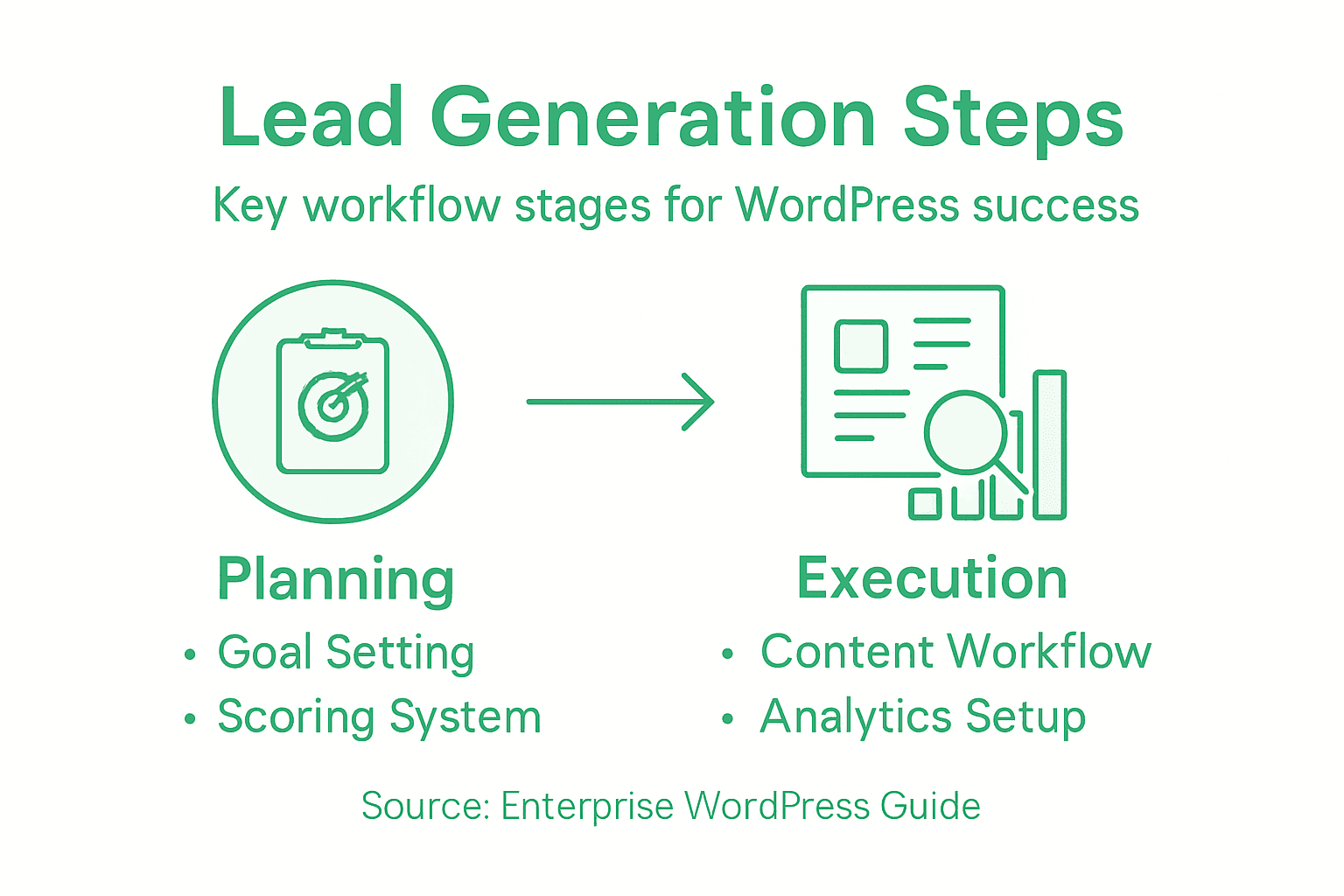
Pro tip: Develop a dynamic lead scoring system that evolves with your understanding of ideal customer profiles, allowing more sophisticated lead qualification over time.
Step 2: Set up AI-assisted content workflows on WordPress
Streamlining your enterprise content creation process requires implementing sophisticated AI-assisted workflows within WordPress. WordPress AI tools now enable automated content generation and optimization, transforming how marketing teams approach digital publishing.
To establish an effective AI-powered content workflow, focus on these critical implementation strategies:
- Workflow Integration
- Select compatible AI content generation plugins
- Configure AI assistance settings
- Establish content quality checkpoints
- AI Collaboration Protocols
- Define human editing requirements
- Set brand voice consistency guidelines
- Create review and approval processes
Enterprise teams should approach AI content workflows as collaborative systems that enhance human creativity rather than replace it. This means configuring AI tools to generate initial drafts, suggest improvements, and streamline repetitive tasks while maintaining strategic human oversight.
Successful AI content workflows balance technological efficiency with human creativity and brand integrity.
Your WordPress AI content strategy must include robust mechanisms for maintaining content quality, ensuring SEO optimization, and preserving your unique brand voice. This requires careful plugin selection, precise configuration, and ongoing refinement of your AI-assisted processes.
Pro tip: Implement a staged rollout of AI content tools, starting with low-risk content types to build team confidence and refine your workflow gradually.
See how AI-assisted workflows differ from traditional content creation in an enterprise setting:
| Aspect | Traditional Workflow | AI-Assisted Workflow |
|---|---|---|
| Speed | Slow, manual | Rapid, automated |
| Consistency | Varies by contributor | Standardized by automation |
| Human Input | High, every step | Strategic, mainly review |
| Scalability | Limited by team size | Easily scales output |
| Cost Efficiency | Labor intensive | Reduces operational costs |
Step 3: Create optimized landing pages targeting your audience
Crafting high-converting landing pages requires a strategic approach that combines precise audience targeting with compelling design. Gutenberg tools can transform your site into a powerful lead generation platform, enabling rapid and precise page creation.
To develop landing pages that resonate with your target audience, implement these key design and targeting strategies:
- Audience Segmentation
- Define precise demographic characteristics
- Map specific pain points and challenges
- Identify unique value propositions
- Conversion Optimization
- Create clear, compelling headlines
- Design minimal, focused form fields
- Develop trust-building social proof elements
- Implement strong call-to-action buttons
Successful landing pages function as strategic conversion instruments, carefully engineered to guide potential leads through a specific journey. This means every visual element, headline, and interaction point must be intentionally designed to address your audience’s specific needs and motivations.
Effective landing pages speak directly to the visitor’s most pressing challenges and offer a clear, compelling solution.
Your landing page strategy should prioritize personalization, ensuring that each design element feels tailored to the specific audience segment you’re targeting. This requires continuous testing, refinement, and a deep understanding of your potential customers’ decision-making processes.

Pro tip: Implement A/B testing for your landing pages, systematically experimenting with different headlines, images, and form layouts to incrementally improve conversion rates.
Step 4: Implement tracking and analytics for lead capture
Effective lead generation demands sophisticated tracking mechanisms that transform raw data into actionable insights. SEO basics provide critical analytics foundations for understanding and optimizing your lead capture strategies.
Develop a comprehensive tracking approach with these essential components:
- Data Collection Methods
- Install Google Analytics tracking
- Configure conversion event tracking
- Set up goal tracking for lead interactions
- Key Performance Indicators
- Track conversion rates
- Monitor lead source attribution
- Analyze user engagement metrics
- Measure content interaction times
Enterprise marketing teams must move beyond surface-level metrics, implementing deep analytical frameworks that reveal nuanced user behaviors. This means tracking not just how many leads you generate, but understanding the precise journey each potential customer takes through your digital ecosystem.
Sophisticated analytics transform raw data into strategic intelligence for lead generation.
Your tracking strategy should integrate multiple data sources, creating a holistic view of user interactions across landing pages, content assets, and conversion points. This comprehensive approach enables continuous refinement of your lead generation processes, ensuring maximum efficiency and return on marketing investments.
Pro tip: Configure advanced segmentation in your analytics platform to create dynamic audience profiles that evolve with your lead generation strategies.
Step 5: Verify campaign quality and refine ongoing strategies
Successful lead generation requires continuous evaluation and strategic refinement of your marketing campaigns. Digital marketing checklists help maintain comprehensive campaign oversight by providing structured frameworks for performance assessment.
Implement a rigorous campaign verification process through these critical evaluation methods:
- Performance Assessment
- Compare actual results against initial goals
- Identify high and low-performing campaign elements
- Analyze lead quality and conversion rates
- Strategic Refinement Techniques
- Conduct detailed performance retrospectives
- Adjust targeting parameters
- Optimize messaging and content
- Reallocate marketing resources
Enterprise marketing teams must adopt a data-driven approach to campaign management, treating each marketing initiative as a dynamic, evolving system. This means moving beyond static reporting and embracing a culture of continuous improvement and adaptive strategy.
Effective campaign verification transforms historical data into future marketing intelligence.
Your refinement strategy should create a feedback loop that systematically captures insights from each campaign iteration, allowing for increasingly precise targeting and more efficient lead generation processes. This approach ensures your marketing efforts remain agile and responsive to changing market dynamics.
Pro tip: Establish a quarterly campaign performance review process that includes cross-functional input from sales, marketing, and product teams to gain comprehensive insights.
Here’s a summary comparing lead generation strategies across the enterprise marketing workflow:
| Step | Main Focus | Key Business Value |
|---|---|---|
| Goals | Strategic alignment | Ensures target-driven marketing |
| AI Workflows | Content efficiency | Scales creation, maintains quality |
| Landing Pages | Audience targeting | Maximizes conversions from traffic |
| Analytics | Performance tracking | Enables data-based optimization |
| Campaign Refinement | Continuous improvement | Boosts ROI through adaptive tactics |
Empower Your Enterprise WordPress Lead Generation with 40Q
The article highlights critical challenges such as defining strategic lead generation goals, setting up AI-assisted content workflows, crafting optimized landing pages, and implementing deep tracking for continuous campaign refinement. Marketing teams often struggle with developer dependency, slow content creation, and balancing brand consistency while scaling their lead generation efforts. Your goal is to attract high-value prospects through personalized, data-driven strategies that align with enterprise expectations.
At 40Q, we address these exact pain points by providing enterprise-grade WordPress solutions designed to give marketing teams full autonomy without sacrificing security or performance. Our proprietary FAS Block System™ accelerates landing page creation and campaign launches, perfectly complementing AI-powered content workflows while ensuring IT retains control over compliance and scalability. Discover how to streamline your lead generation process effectively at 40Q and embrace the power of marketing autonomy with enterprise reliability.
Looking for faster, smarter lead generation on WordPress?
Explore how 40Q’s expert solutions can help your marketing teams eliminate developer bottlenecks, implement AI-assisted workflows, and build data-driven landing pages that convert. Visit our website today to start transforming your enterprise WordPress platform for measurable growth. Don’t wait — unlock the true potential of your lead generation process now by partnering with a WordPress VIP leader who understands your business demands like no other.
Frequently Asked Questions
Recommended

May 7, 2025
WordPress
How Enterprise Content Teams Are Adopting AI Tools in 2025
May 29, 2024
WordPress
Unleash WordPress Power: Handling High Traffic Like a Pro

Nov 7, 2024
WordPress