
WordPress
Role of marketing operations: boost efficiency in 2026

José Debuchy
March 17, 2026 | 3 min to read
Marketing operations is often misunderstood as a tactical, execution-only function relegated to managing spreadsheets and coordinating campaigns. In reality, marketing operations has evolved into a strategic leadership role that drives marketing autonomy, technology integration, and enterprise CMS performance. This guide reveals how marketing operations leaders in mid-sized and large enterprises can enhance team efficiency, accelerate campaign delivery, and ensure robust security and governance. You’ll discover actionable frameworks, collaboration strategies, and proven approaches to maximize your marketing operations impact in 2026.
Key takeaways
| Point | Details |
|---|---|
| Marketing operations drives strategic alignment | Marketing operations integrates technology and processes to align marketing execution with business goals. |
| Enhanced autonomy accelerates campaigns | Organizations with marketing autonomy see 60% faster campaigns, improving responsiveness and ROI. |
| CMS security and governance are critical | Robust security protocols protect enterprise marketing assets and ensure seamless platform performance. |
| Data-driven frameworks optimize efficiency | Marketing operations leaders use proven frameworks to measure and improve team productivity. |
| IT collaboration boosts martech effectiveness | Close partnership between marketing operations and IT accelerates technology adoption and innovation. |
Understanding the evolving role of marketing operations
Marketing operations in 2026 encompasses far more than campaign coordination and project management. It represents a strategic leadership function responsible for orchestrating marketing technology, optimizing processes, and enabling teams to execute at scale. Marketing operations has evolved from a tactical role to a strategic leadership function driving efficiency and autonomy across the entire marketing organization.
The modern marketing operations leader manages the intersection of strategy, technology, and execution. You oversee the marketing technology stack, establish governance frameworks, and create systems that empower marketing teams to work independently while maintaining enterprise standards. This expanded role positions marketing operations as a critical bridge between marketing strategy and technology execution.
Key strategic responsibilities extend well beyond traditional execution. Marketing operations leaders now drive marketing technology integration, lead process optimization initiatives, and establish data governance frameworks that support decision making across the organization. You enable marketing agility by removing bottlenecks, automating repetitive tasks, and creating scalable systems that grow with business needs.
Marketing operations supports business goals by aligning marketing execution with revenue targets, customer acquisition strategies, and brand objectives. You enhance team efficiency through standardized workflows, clear documentation, and technology that reduces manual work. Marketing autonomy becomes possible when you establish governance frameworks that give teams freedom to execute within defined guardrails.
Critical marketing operations functions in 2026 include:
- Data management and analytics infrastructure that powers marketing insights
- Campaign enablement through templates, workflows, and automation
- Martech governance ensuring platform security, performance, and compliance
- Process documentation and optimization for repeatable marketing execution
- Vendor management and technology roadmap planning
- Training and enablement programs that build team capabilities
These functions create the foundation for marketing teams to operate efficiently, respond quickly to market opportunities, and deliver measurable business results. Marketing operations transforms from a support function into a strategic enabler that multiplies the impact of every marketing initiative.
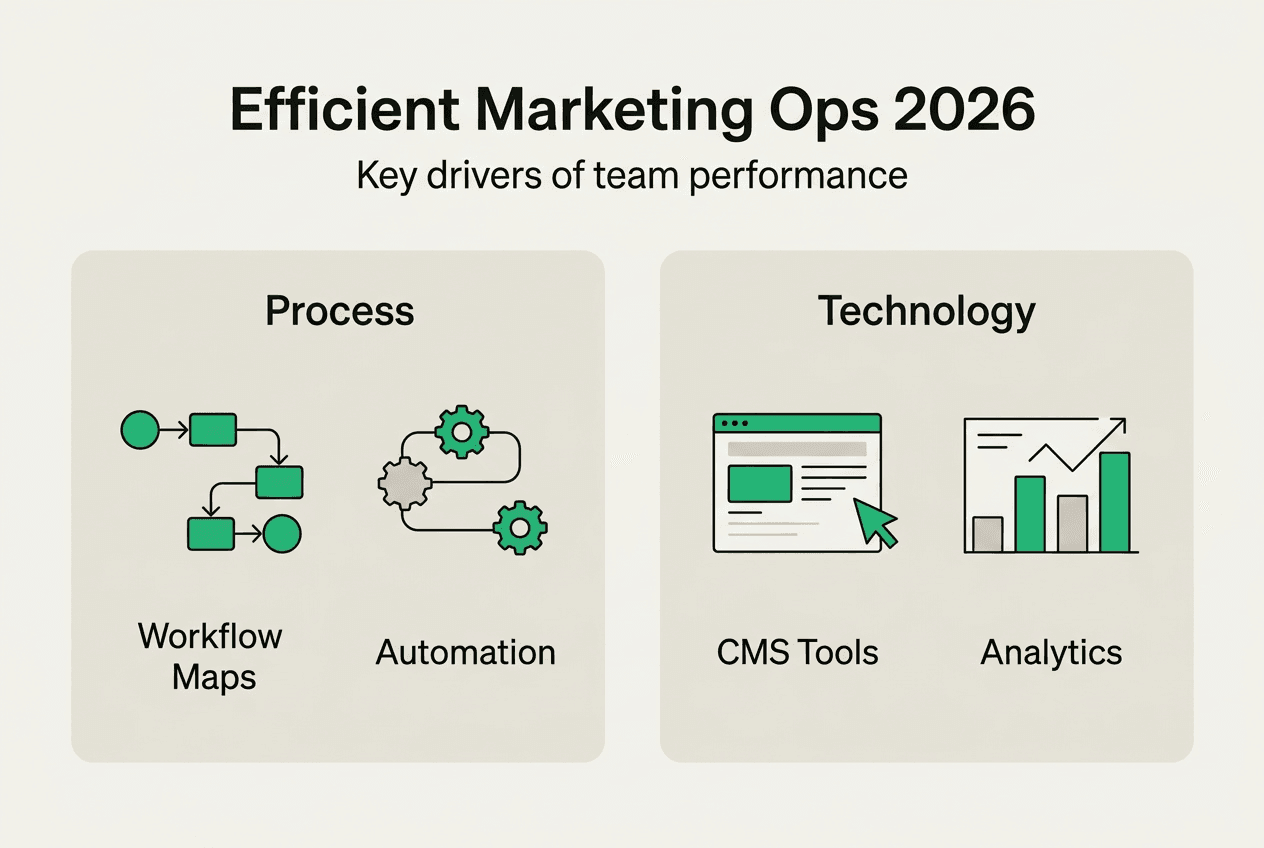
How marketing operations drives marketing autonomy and efficiency
Marketing autonomy represents the ability of marketing teams to execute campaigns, launch content, and respond to market opportunities without constant dependency on developers or IT resources. Organizations with enhanced marketing autonomy see campaign speeds increase by 60%, dramatically improving responsiveness and ROI. Marketing operations leaders enable this autonomy through strategic technology choices, process design, and governance frameworks.
The framework for enabling marketing autonomy follows a systematic approach. First, you assess current bottlenecks by identifying where teams wait for technical resources or approvals that slow execution. Second, you establish governance boundaries that define what teams can do independently versus what requires oversight. Third, you implement technology platforms that empower self-service within those boundaries. Fourth, you create training programs that build team capabilities to use new tools effectively. Fifth, you measure autonomy gains through metrics like campaign launch time, developer dependency rates, and team satisfaction scores.
Real-world efficiency gains from autonomy adoption are substantial. Marketing teams reduce campaign launch times from weeks to days when they can build landing pages without developer support. Content localization accelerates when regional teams access approved templates and components. A/B testing frequency increases when marketers control experiment setup and deployment. These improvements compound over time as teams build confidence and expertise in autonomous execution.
Technology and process integration tactics support sustained autonomy. You implement content management systems with visual page builders that eliminate coding requirements. You create component libraries with pre-approved, brand-compliant modules that teams assemble into custom pages. You establish workflow automation that routes approvals efficiently without manual coordination. You integrate analytics platforms that surface insights directly to marketing teams without data team intervention.

Pro Tip: Prioritize cross-functional alignment between marketing operations and IT to sustain autonomy gains. Regular sync meetings, shared roadmaps, and collaborative problem solving prevent autonomy from creating security risks or technical debt. When marketing operations and IT work as partners rather than adversaries, autonomy flourishes within appropriate guardrails.
Measuring autonomy requires tracking both quantitative and qualitative indicators. Campaign velocity metrics show how quickly teams move from concept to launch. Developer dependency rates reveal what percentage of marketing tasks still require technical resources. Team satisfaction surveys capture whether marketers feel empowered or frustrated. The marketing autonomy scorecard provides a structured framework for assessing current state and identifying improvement opportunities.
Sustaining autonomy demands ongoing investment in training, technology updates, and process refinement. You create documentation that captures best practices and troubleshooting guides. You establish office hours where marketing operations experts support team questions. You continuously evaluate new martech capabilities that expand what teams can accomplish independently. This commitment to enablement ensures autonomy grows rather than stagnates over time.
Ensuring enterprise CMS performance and security through marketing operations
Enterprise content management systems serve as the foundation for marketing execution, making CMS performance and security critical priorities for marketing operations leaders. Robust CMS security protocols are essential to protect enterprise marketing assets and ensure seamless performance. Marketing operations plays a central role in CMS governance, coordinating security policies, performance monitoring, and vendor collaboration.
Your responsibility extends beyond simply using the CMS to actively managing platform health. You establish governance frameworks that define who can access what functionality, ensuring teams have necessary permissions without exposing security vulnerabilities. You coordinate with IT and security teams to implement patches, updates, and security hardening measures. You monitor platform performance metrics to identify bottlenecks before they impact campaign delivery or user experience.
Common security threats facing enterprise CMS platforms include unauthorized access attempts, plugin vulnerabilities, data breaches, and distributed denial of service attacks. Mitigation strategies require layered defenses. You implement role-based access controls that limit permissions to necessary functions. You establish plugin governance that vets third-party code before installation. You require multi-factor authentication for all CMS users. You maintain regular backup schedules that enable rapid recovery from incidents.
CMS performance and security practices differ in focus but complement each other:
| Performance Features | Security Practices |
|---|---|
| Content delivery networks for global speed | Web application firewalls blocking malicious traffic |
| Image optimization reducing page load times | SSL certificates encrypting data transmission |
| Caching strategies minimizing server load | Regular security audits identifying vulnerabilities |
| Database optimization improving query speed | Intrusion detection systems monitoring threats |
| Mobile responsiveness ensuring device compatibility | Access logging tracking user activity |
Vendor collaboration becomes essential for maintaining enterprise-ready CMS platforms. You work with CMS providers to understand roadmap priorities, report bugs, and request features that support marketing needs. You coordinate with hosting vendors to optimize server configurations for marketing workloads. You partner with security vendors to implement threat monitoring and incident response capabilities.
Pro Tip: Regular CMS audits help preempt security risks and performance bottlenecks. Schedule quarterly reviews that assess plugin health, user permissions, performance metrics, and security configurations. These proactive audits catch issues before they escalate into emergencies, maintaining platform stability and team productivity.
Performance monitoring requires tracking metrics that matter to marketing outcomes. Page load times affect conversion rates and search rankings. Uptime percentages determine whether campaigns reach audiences reliably. Content publishing speeds influence how quickly teams respond to market opportunities. You establish dashboards that surface these metrics and alert you to degradation before it impacts business results.
Security governance demands clear policies and consistent enforcement. You document acceptable use policies that define appropriate CMS activities. You establish incident response procedures that guide teams when security events occur. You conduct regular training that keeps users aware of phishing threats, password hygiene, and social engineering tactics. This combination of technology controls and human awareness creates robust defense against evolving threats.
Collaborating with IT and martech teams to maximize marketing operations impact
Marketing operations success depends on productive partnerships with IT and martech teams who share responsibility for technology platforms, data infrastructure, and digital experiences. Effective collaboration between marketing operations and IT accelerates martech adoption and optimizes platform performance. These partnerships transform potential friction points into opportunities for innovation and mutual value creation.
Why marketing operations must partner closely with IT and martech stems from interdependent responsibilities. IT teams manage infrastructure, security, and enterprise architecture that marketing platforms depend upon. Martech specialists bring deep expertise in specific platforms and integration patterns. Marketing operations understands business requirements, user workflows, and marketing strategy. No single team possesses all necessary knowledge, making collaboration essential for success.
Best practices for productive collaboration start with establishing shared goals and success metrics. You align on objectives like platform uptime, user satisfaction, and business impact rather than narrow technical specifications. You create regular communication rhythms through weekly syncs, monthly planning sessions, and quarterly strategy reviews. You document decisions and rationale in shared repositories that build institutional knowledge. You celebrate wins together and conduct blameless post-mortems when issues arise.
Benefits of strong collaboration manifest across multiple dimensions:
- Faster issue resolution when teams understand each other’s constraints and capabilities
- Technology innovation through cross-functional brainstorming and experimentation
- Reduced friction in change management when stakeholders align early
- Better vendor relationships when unified teams negotiate and manage contracts
- Improved employee satisfaction as teams feel supported rather than blocked
Shared responsibilities in governance and roadmap planning create alignment and accountability. You jointly define technology standards that balance marketing flexibility with IT security requirements. You collaborate on vendor selection processes that evaluate both business fit and technical feasibility. You coordinate roadmap planning that sequences initiatives for maximum impact while managing resource constraints. You establish shared on-call rotations that ensure 24/7 platform support without burning out individuals.
Recommendations for ongoing communication include creating dedicated Slack channels for quick questions, maintaining shared project boards for visibility, and hosting monthly demos where teams showcase recent work. You establish clear escalation paths for urgent issues and decision frameworks for routine choices. You invest in relationship building through team lunches, cross-functional training sessions, and collaborative problem-solving workshops.
Conflict resolution strategies acknowledge that disagreements will arise and prepare teams to navigate them constructively. You establish decision-making frameworks that clarify who has authority over different choices. You create forums for airing concerns before they escalate into major conflicts. You engage neutral facilitators when teams reach impasses. You focus on interests rather than positions, seeking solutions that address underlying needs rather than defending initial stances.
Measuring collaboration effectiveness requires tracking both process and outcome metrics. Survey teams quarterly about collaboration quality, communication clarity, and mutual respect. Monitor shared success metrics like platform uptime, feature delivery velocity, and user satisfaction. Track the ratio of collaborative projects to siloed initiatives. These measurements reveal whether partnerships strengthen or deteriorate over time, enabling course corrections before relationships fracture.
Explore expert solutions for marketing operations success
Marketing operations leaders face complex challenges balancing team autonomy, CMS security, and martech effectiveness. 40Q specializes in helping enterprises navigate these challenges with proven frameworks and enterprise-grade technology solutions. Our marketing autonomy guide provides detailed strategies for empowering marketing teams while maintaining governance and security.
We partner with mid-sized and large organizations to implement enterprise-grade WordPress platforms that eliminate developer dependency for day-to-day publishing. Our proprietary FAS Block System gives marketing teams the autonomy to launch campaigns quickly while IT retains full control over performance, security, and compliance. Explore our enterprise website security guide to learn how we protect high-traffic marketing platforms from evolving threats.
FAQ
What is the primary responsibility of marketing operations?
Marketing operations manages the marketing technology stack, optimizes processes, and enables marketing teams to execute campaigns efficiently. The role bridges marketing strategy and technology execution, ensuring teams have the tools, data, and workflows needed to achieve business goals. Modern marketing operations leaders drive marketing autonomy by removing bottlenecks and establishing governance frameworks that empower independent execution.
How does marketing operations improve marketing team efficiency?
Marketing operations improves efficiency by automating repetitive tasks, standardizing campaign processes, and implementing self-service technology platforms. Teams gain autonomy through clear governance boundaries and integrated tools that eliminate developer dependency. The marketing autonomy scorecard helps leaders assess current efficiency levels and identify improvement opportunities that accelerate campaign delivery.
What role does marketing operations play in CMS security?
Marketing operations leads CMS governance by coordinating security policies, managing user permissions, and conducting regular platform audits. The function collaborates closely with IT teams to implement patches, monitor threats, and maintain enterprise website security protocols. Marketing operations ensures security measures protect assets without unnecessarily restricting team productivity or campaign velocity.
How can marketing operations leaders measure team autonomy?
Measure autonomy through campaign launch velocity, developer dependency rates, and team satisfaction surveys. Track how quickly teams move from concept to published campaigns, what percentage of marketing tasks require technical resources, and whether marketers feel empowered to execute independently. Quantitative metrics combined with qualitative feedback provide a comprehensive view of autonomy progress and remaining barriers.
Why is collaboration between marketing operations and IT essential?
Collaboration accelerates martech adoption, optimizes platform performance, and prevents security risks from autonomous marketing execution. IT brings infrastructure expertise and security knowledge while marketing operations understands business requirements and user workflows. Neither team succeeds alone, making partnership essential for balancing marketing speed with enterprise governance and technical excellence.
Recommended

Feb 7, 2026
WordPress
Why Scalable Website Architecture Drives Growth

Jun 18, 2026
WordPress
Is WordPress Good Enough for Enterprise?

Jun 11, 2025
WordPress