
WordPress
Custom CMS solutions for enterprise growth in 2026

José Debuchy
March 14, 2026 | 3 min to read
Many organizations assume WordPress alone can meet their enterprise content management needs. After all, WordPress powers 43% of the web, making it the dominant platform for websites globally. However, this widespread adoption masks critical limitations that become apparent at enterprise scale. Marketing leaders and IT directors face mounting pressure to deliver faster content, tighter security, and greater autonomy without sacrificing compliance or performance. Custom CMS solutions address these challenges by offering tailored architectures designed specifically for enterprise requirements. This shift represents more than a technology upgrade. It’s a strategic response to evolving digital demands.
Key takeaways
| Point | Details |
|---|---|
| Enhanced security | Custom CMS platforms reduce vulnerabilities by 40% through bespoke security frameworks tailored to compliance requirements. |
| Superior scalability | Purpose-built systems handle 10x more traffic and content volume without performance degradation during growth periods. |
| Performance advantages | Faster page loads from optimized architecture improve conversion rates and search rankings for competitive advantage. |
| Long-term ROI | Despite higher initial costs, custom solutions deliver better total cost of ownership through reduced maintenance and flexibility. |
| Marketing autonomy | Tailored workflows eliminate developer dependency for routine publishing while maintaining IT governance and control. |
Why WordPress and off-the-shelf CMS options fall short for enterprises
WordPress dominates the web, but this popularity doesn’t translate to enterprise readiness. The platform’s architecture, designed for blogs and small sites, struggles with modern enterprise demands for performance, security, and integration flexibility. Over 13,000 WordPress sites are hacked daily due to vulnerabilities in plugins and themes. This security risk alone creates compliance nightmares for organizations handling sensitive customer data or operating in regulated industries.
Performance bottlenecks compound these security concerns. Traditional WordPress installations generate pages server-side for each request, creating latency that damages user experience and search rankings. While big media publishers use WordPress successfully, they invest heavily in custom infrastructure and caching layers that most enterprises lack. The platform’s architectural design limits how much optimization is possible without fundamental rebuilds.
Off-the-shelf solutions present different but equally challenging limitations:
- Rigid content models that force business processes to adapt to software constraints rather than the reverse
- Limited API capabilities that make integrating with existing enterprise systems complex and expensive
- Vendor lock-in that restricts migration options and increases long-term costs
- Generic security models that fail to address industry-specific compliance requirements
These platforms work well for standard use cases. Enterprises rarely fit standard molds. Organizations with complex workflows, multiple brands, international operations, or strict regulatory requirements quickly discover that inflexible CMS architectures sabotage marketing velocity and strategic initiatives.
“The hidden cost of generic CMS platforms isn’t just licensing fees. It’s the accumulated technical debt from workarounds, the delayed campaigns waiting for developer resources, and the security incidents that could have been prevented with proper architecture.”
Marketing teams lose autonomy when every content update requires developer intervention. IT teams inherit maintenance burdens from plugin conflicts and security patches. The result is a system that serves neither group effectively while consuming resources from both.
Key advantages of custom CMS solutions for medium to large enterprises
Custom CMS platforms address enterprise challenges through purpose-built architecture designed for specific organizational needs. Security stands as the most compelling advantage. Custom-built security solutions reduce data breaches by 40% compared to generic platforms because they eliminate unnecessary attack surfaces and implement compliance frameworks from the foundation up. Organizations in healthcare, finance, or government sectors gain precise control over data handling, access controls, and audit trails that off-the-shelf systems struggle to provide.

Scalability represents another critical benefit. Custom CMS platforms handle 10x more traffic and content volume without performance degradation because their architecture anticipates growth patterns specific to the organization. A media company publishing thousands of articles daily has different scaling needs than a financial services firm managing product documentation across 40 countries. Generic platforms force both into the same infrastructure model. Custom solutions optimize for actual usage patterns.
Performance improvements directly impact business outcomes:
- Faster page loads reduce bounce rates and improve conversion metrics across all digital properties
- Optimized content delivery through CDN integration ensures consistent experience regardless of geographic location
- Efficient caching strategies reduce server costs while improving response times during traffic spikes
- Clean code architecture without plugin bloat creates faster, more maintainable systems
Marketing autonomy transforms how organizations execute digital strategy. Custom CMS platforms implement workflow tools, content templates, and governance rules that let marketing teams launch campaigns, create landing pages, and publish localized content without developer involvement. IT teams maintain control over scalability, security, and compliance through the underlying platform architecture while marketing gains the speed to market that competitive environments demand.
Pro Tip: Calculate total cost of ownership over five years when evaluating CMS options. Include hidden costs like developer time for workarounds, security incident response, performance optimization, and delayed campaign launches. Custom solutions often deliver better ROI despite higher initial investment.
The financial case for custom CMS extends beyond direct cost comparisons. Organizations gain strategic advantages through differentiated digital experiences, faster innovation cycles, and reduced technical debt. A comparison of key metrics illustrates these differences:
| Metric | Off-the-Shelf CMS | Custom CMS |
|---|---|---|
| Time to launch new features | 8-12 weeks | 2-4 weeks |
| Security vulnerabilities | High (plugin dependent) | Low (controlled architecture) |
| Scalability ceiling | Limited by platform | Designed for growth |
| Marketing autonomy | Low (developer dependent) | High (purpose-built workflows) |
| Long-term maintenance cost | High (technical debt accumulation) | Lower (clean architecture) |
These advantages compound over time. Organizations that invest in custom CMS platforms position themselves for sustained competitive advantage through superior digital capabilities.
Emerging trends favoring custom and headless CMS adoption in 2026
The enterprise CMS landscape is experiencing rapid transformation driven by changing business requirements and technological capabilities. Headless CMS adoption increased 200% over the past two years as organizations seek flexibility to deliver content across multiple channels and devices. This architectural approach separates content management from presentation, enabling teams to use modern frameworks while maintaining centralized content governance.
Performance gains from modern architectures create measurable business impact. Next.js sites deliver pages in 15-40ms from CDN edge networks, dramatically faster than WordPress’s typical 100ms+ time to first byte. These millisecond improvements translate to better search rankings, higher conversion rates, and superior user experience. Google’s Core Web Vitals make performance a direct ranking factor, giving organizations with optimized CMS infrastructure a competitive edge.
AI integration represents the next frontier for enterprise content management. Organizations need CMS platforms that support:
- Automated content tagging and metadata generation for improved discoverability
- Personalization engines that deliver relevant content based on user behavior and preferences
- Workflow automation that reduces manual tasks and accelerates publishing cycles
- Content quality analysis that maintains brand standards across large distributed teams
Generic platforms bolt AI capabilities on as afterthoughts. Custom solutions integrate these features into core workflows from the beginning. The difference matters for organizations trying to scale content production while maintaining quality and consistency.
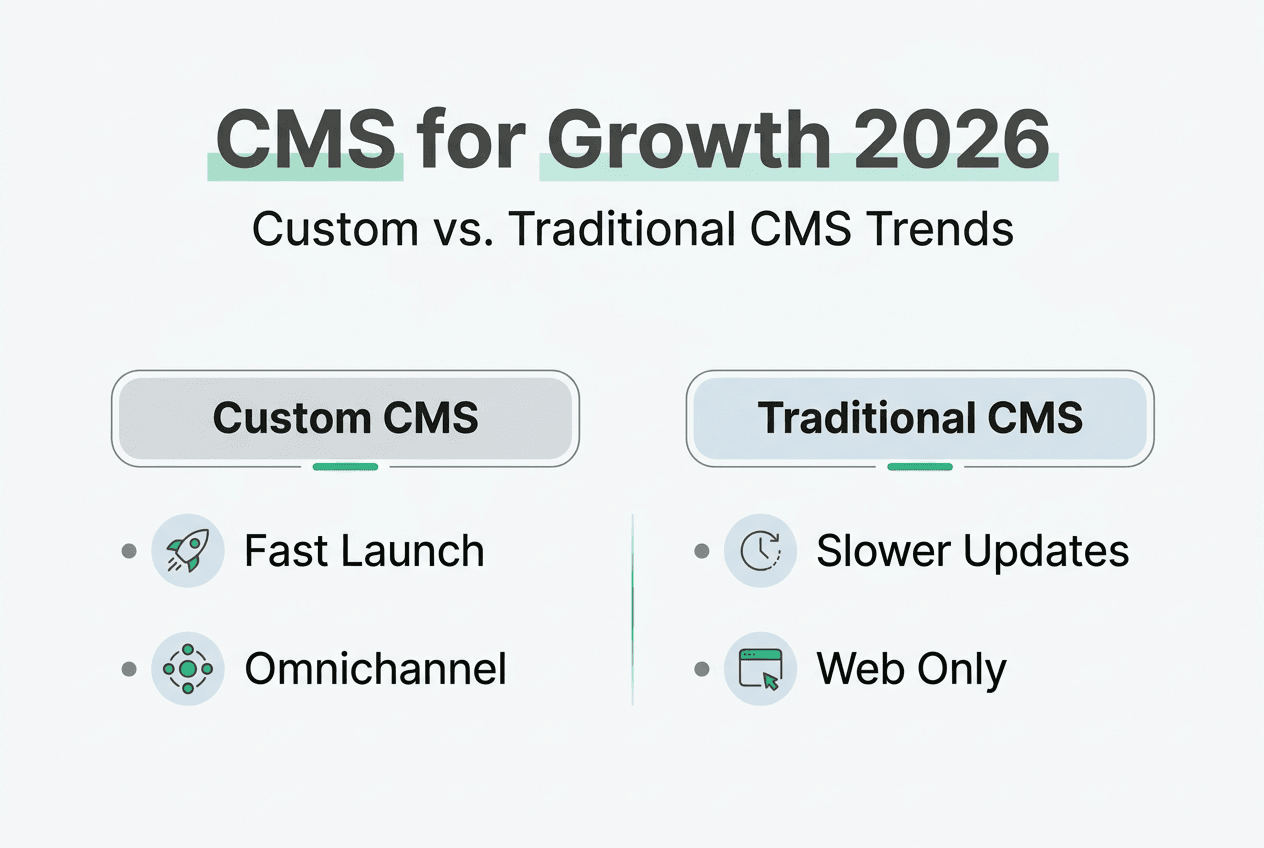
Multichannel content delivery drives custom CMS adoption across industries. Organizations need to publish once and distribute everywhere: websites, mobile apps, digital signage, voice assistants, and emerging channels. Traditional CMS platforms assume web-first publishing. Headless and custom architectures treat all channels equally, enabling flexible content delivery that adapts to changing consumption patterns.
| Feature | Traditional CMS | Headless/Custom CMS |
|---|---|---|
| Content delivery | Web-focused | Omnichannel native |
| Frontend flexibility | Coupled to backend | Complete freedom |
| Performance optimization | Limited by platform | Fully customizable |
| AI integration | Plugin-based | Native architecture |
| Developer experience | Constrained | Modern tooling |
Pro Tip: Evaluate CMS options based on their role in your digital strategy, not just feature checklists. The best CMS enables your specific business model, workflows, and growth plans rather than forcing you into generic patterns.
The shift toward headless WordPress for enterprise combines familiar content management with modern delivery capabilities. Organizations leverage WordPress’s mature editing experience while gaining performance and flexibility benefits from decoupled architecture. This hybrid approach offers a practical migration path for enterprises with existing WordPress investments who need enterprise-grade capabilities.
Evaluating and implementing custom CMS solutions for your enterprise
Selecting the right CMS approach requires careful analysis of organizational needs, technical requirements, and strategic goals. Start by mapping your content workflows, integration requirements, and growth projections. Organizations with complex approval processes, multiple brands, or international operations typically benefit most from custom solutions. Those with simpler needs might find headless platforms built on existing CMS foundations provide sufficient flexibility.
Total cost of ownership extends far beyond initial development expenses. Long-term ROI often favors custom solutions despite higher upfront costs because they eliminate ongoing expenses for workarounds, security patches, and developer time spent managing technical debt. Calculate five-year costs including:
- Initial development and implementation
- Hosting and infrastructure at projected scale
- Ongoing maintenance and feature development
- Security monitoring and incident response
- Developer time for integrations and customizations
- Opportunity cost of delayed campaigns or limited marketing autonomy
Security and compliance frameworks must be foundational, not afterthoughts. Organizations in regulated industries should involve legal and compliance teams early in the evaluation process. Custom CMS platforms enable precise implementation of data handling requirements, access controls, and audit capabilities that generic solutions struggle to match. Document your specific compliance needs and evaluate how each CMS option addresses them architecturally rather than through configuration or plugins.
Implementation strategy significantly impacts success:
- Start with a detailed discovery phase that maps existing workflows, pain points, and future requirements across marketing and IT teams
- Develop a phased rollout plan that delivers value incrementally while managing risk and allowing for course corrections
- Prioritize features that provide immediate business impact such as marketing autonomy tools or critical integrations
- Build in training and change management to ensure teams adopt new capabilities effectively
- Establish governance models that balance marketing speed with IT control over security and performance
Pro Tip: Look for signs your current CMS is holding you back such as campaigns delayed waiting for developer resources, security incidents from outdated plugins, or performance issues during traffic spikes. These symptoms indicate architectural problems that configuration changes won’t solve.
Collaboration between marketing and IT teams determines whether custom CMS implementations succeed or fail. Marketing needs autonomy to execute campaigns quickly. IT needs confidence that security, performance, and scalability won’t be compromised. Successful implementations create shared ownership through:
- Joint requirement gathering that surfaces needs from both perspectives
- Governance frameworks that define clear boundaries and approval processes
- Training programs that build marketing competency with new tools
- Monitoring dashboards that give IT visibility into system health and usage patterns
- Regular feedback loops that enable continuous improvement
The right partner brings expertise in both CMS technology and enterprise implementation challenges. Look for organizations with experience in your industry, proven track records with similar scale projects, and approaches that prioritize future-proofing through flexible architecture rather than rigid solutions.
Discover custom CMS solutions tailored for enterprises
Navigating the shift from generic platforms to enterprise-grade CMS requires specialized expertise and proven frameworks. At 40Q, we partner with medium and large organizations to build WordPress-based platforms that deliver marketing autonomy without sacrificing IT control. Our work focuses on eliminating developer dependency for routine publishing while maintaining the security, performance, and governance that enterprises demand.
Our WordPress VIP services combine the flexibility of custom development with the reliability of enterprise infrastructure. We implement our proprietary FAS Block System™ that gives marketing teams powerful page-building capabilities while IT teams retain full control over code quality and system architecture. Organizations choosing WordPress VIP for enterprise gain scalability, security, and support designed for high-traffic, mission-critical applications. Explore what makes a CMS truly enterprise-ready and discover how purpose-built platforms accelerate your digital strategy.
Frequently asked questions
Recommended
Jun 17, 2026
WordPress
Marketing Autonomy Platforms vs. Alternatives: A Complete Comparison
May 14, 2025
WordPress
Why the Future of Enterprise CMS is Open, Headless, and AI-Enabled

Apr 3, 2026
WordPress