
WordPress
Enterprise-grade CMS defined: 17% faster marketing autonomy

José Debuchy
March 5, 2026 | 3 min to read
Marketing leaders know the frustration of waiting weeks for developers to launch a simple landing page or regional campaign. This bottleneck crushes speed to market and limits your team’s ability to respond to opportunities. An enterprise-grade CMS solves this by giving marketing teams autonomy to publish independently while IT maintains governance, security, and scalability. You get speed without chaos.
Key takeaways
| Point | Details |
|---|---|
| Enterprise CMS empower marketing teams | Enable autonomous content creation and publishing while maintaining IT governance and security controls. |
| Core capabilities differentiate enterprise platforms | Scalability, security, multi-channel support, and workflow governance separate enterprise from standard CMS. |
| Modern architectures provide flexibility | Hybrid and headless options support integration needs and omnichannel delivery strategies. |
| Strategic selection framework drives success | Evaluate scalability, security, autonomy balance, and total cost of ownership before implementation. |
What makes a CMS enterprise-grade?
An enterprise-grade CMS differs fundamentally from standard content management systems in scale, governance, and capability. These platforms are built for medium to large U.S. enterprises managing thousands of pages, supporting simultaneous users across multiple sites and channels. The distinction matters because your marketing and IT challenges require solutions that handle complexity without breaking.
Enterprise CMS provides centralized governance across multiple channels supporting complex workflows and multi-site management, eliminating the content silos that slow you down. You get a centralized content repository that feeds websites, mobile apps, and regional markets from one source of truth. This architecture ensures consistency while allowing localization and customization where needed.
The key features that define what makes a CMS truly enterprise-ready include:
- Centralized content repository with structured workflow governance
- Multi-site and multi-channel management from a unified interface
- High-performance architecture supporting traffic spikes and large content volumes
- Role-based access control with approval chains and audit trails
- Integration capabilities with CRM, DAM, analytics, and marketing automation platforms
These capabilities directly address the developer bottleneck by giving marketing teams tools to create and publish content independently. IT teams retain control over security, performance, and compliance while marketing gains the speed they need to compete.
Core characteristics of enterprise-grade CMS
Understanding the technical and operational features that separate enterprise platforms helps you evaluate solutions effectively. These characteristics form the foundation for both marketing autonomy and IT governance.
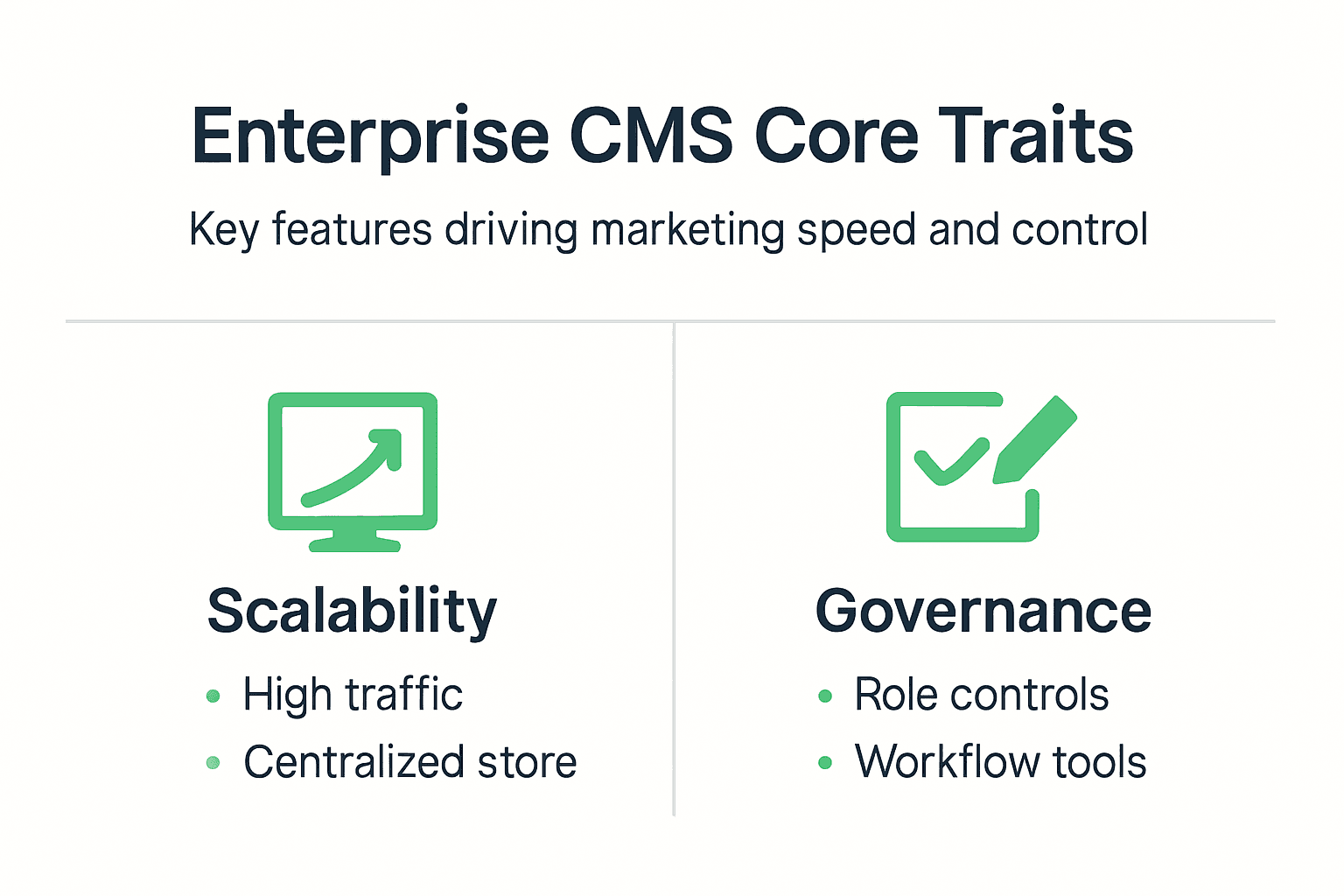
A centralized content repository acts as your single source of truth across all digital properties. This eliminates duplicate content, reduces maintenance overhead, and ensures brand consistency whether you’re publishing to your main website, regional microsites, or mobile applications. The repository structure supports reusable content blocks and templates that marketing can assemble without coding.
Scalability and performance become critical when you’re managing high-traffic sites with complex content needs. Enterprise platforms handle traffic spikes during product launches or seasonal campaigns without slowdowns. They support thousands of concurrent users, process large media libraries efficiently, and maintain sub-second page load times that keep visitors engaged and search engines satisfied.
Security and compliance features protect your organization from risk. Enterprise CMS offer advanced workflows with role-based permissions and compliance features like SSO and audit trails, ensuring only authorized users access sensitive content. You get encryption for data at rest and in transit, compliance certifications for GDPR, HIPAA, and SOC 2, plus integration with enterprise SSO systems.
Governance through structured editorial workflows separates enterprise platforms from basic CMS. You define who can create, edit, approve, and publish content based on roles and responsibilities. Approval chains ensure legal and brand review before publication. Version control and audit trails track every change, meeting regulatory requirements and enabling quick rollback if needed.
Multi-channel support delivers content consistently across touchpoints. Your content flows from the CMS to websites, mobile apps, digital signage, and IoT devices through APIs and connectors. This omnichannel capability lets marketing coordinate campaigns across channels while managing content in one place.
Pro Tip: When evaluating scaling with confidence, test your CMS under realistic traffic loads with your actual content structure and user count before making a final decision.
Here’s how enterprise capabilities compare across key dimensions:
| Capability | Standard CMS | Enterprise CMS |
|---|---|---|
| User capacity | Up to 50 concurrent users | Thousands of concurrent users |
| Content volume | Hundreds of pages | Tens of thousands of pages |
| Security | Basic authentication | SSO, encryption, compliance certifications |
| Workflow | Simple approval | Multi-stage governance with audit trails |
| Multi-site | Limited or plugin-based | Native multi-site architecture |
| Integration | Basic APIs | Enterprise integration hub with pre-built connectors |
These features work together to create platforms that support enterprise-grade WordPress CMS implementations. The investment in enterprise capabilities pays off through reduced risk, faster time to market, and improved operational efficiency across both marketing and IT teams.
Enabling marketing autonomy with enterprise CMS
The real value of enterprise CMS emerges when marketing teams can move at the speed of opportunity without waiting for developer resources. This autonomy transforms how organizations compete in digital channels.

User-friendly authoring tools put publishing power in marketing hands. Modern CMS empower marketing teams to launch campaigns independently, reducing developer bottlenecks through visual editors and pre-built component libraries. You drag and drop content blocks, adjust layouts, and preview results without touching code. The interface feels familiar, like the productivity tools your team already uses.
Campaign launch capabilities accelerate time to market dramatically. Marketing can create landing pages for product launches, seasonal promotions, or regional campaigns in hours instead of weeks. You test variations, personalize content for segments, and publish when the timing is right. This responsiveness gives you competitive advantage in fast-moving markets.
Reducing developer dependency frees IT teams to focus on strategic initiatives instead of routine publishing requests. The backlog of marketing requests shrinks as teams self-serve for standard content needs. Developers concentrate on building new features, optimizing performance, and maintaining security rather than formatting text and swapping images.
Localization and regional campaign support becomes practical at scale. Marketing teams in different geographies can adapt global campaigns to local markets, translating content and adjusting messaging while maintaining brand guidelines. The CMS enforces templates and governance rules, so regional variations stay on-brand even as local teams work independently.
Operational efficiency improves across your organization when marketing autonomy with enterprise CMS eliminates handoffs and waiting time. Campaign planning cycles compress, testing happens faster, and you can respond to market changes while competitors are still scheduling developer meetings. This agility translates directly to revenue opportunity.
The key is balancing autonomy with governance. Enterprise CMS let you define guardrails that give marketing freedom within approved frameworks. Templates and component libraries ensure consistency. Approval workflows catch issues before publication. IT and marketing collaboration improves because both teams get what they need.
Pro Tip: Start with a pilot team when rolling out marketing autonomy features. Document their workflow, identify friction points, and refine your templates and training before expanding to the full organization.
Enterprise CMS architectures and integration
Choosing the right architectural approach determines how well your CMS supports current needs and adapts to future requirements. Understanding the trade-offs helps you make informed decisions.
Traditional monolithic CMS bundle content management, presentation, and delivery in one integrated system. This simplicity makes them easier to implement and maintain for teams without deep technical resources. You get everything you need in one package. However, this tight coupling limits flexibility when you want to deliver content to mobile apps, IoT devices, or other digital touchpoints beyond websites.
Headless CMS decouple the backend content repository from frontend presentation layers. Content is managed in the CMS and delivered through APIs to any channel or device. This API-first architecture provides maximum flexibility for omnichannel strategies and lets developers use modern frontend frameworks. The trade-off is increased complexity, as you need developer expertise to build and maintain frontend experiences for each channel.
Hybrid CMS combine the best of both approaches, offering traditional authoring and preview capabilities while also exposing content through APIs. Marketing teams get familiar tools and visual editing, while developers can pull content into custom applications when needed. This middle ground works well for organizations transitioning to omnichannel delivery without abandoning proven workflows.
Integration capabilities determine how well your CMS fits into your broader technology ecosystem. Enterprise platforms must connect seamlessly with CRM systems for personalization, DAM systems for media management, analytics platforms for insights, and marketing automation tools for campaign orchestration. Evaluation of CMS architectures is essential to balance flexibility, integration needs, and complexity for enterprises, ensuring your choice supports both current and future digital strategies.
Here’s how architectures compare:
| Architecture | Best For | Complexity | Marketing Autonomy | Developer Flexibility |
|---|---|---|---|---|
| Monolithic | Single-channel websites | Low | High | Low |
| Headless | Multi-channel, API-driven | High | Low | High |
| Hybrid | Balanced omnichannel needs | Medium | High | High |
The future of enterprise CMS points toward hybrid architectures that balance ease of use with technical flexibility. You can start with traditional authoring and add API-driven channels as your digital strategy evolves. This approach minimizes disruption while maximizing long-term capability.
Key integration requirements include:
- Single sign-on for unified access control across platforms
- Bi-directional data sync with CRM for personalization and lead capture
- DAM integration for centralized media asset management
- Analytics integration for content performance insights
- Marketing automation connectors for campaign workflows
Your architecture choice should align with your team’s technical capabilities and digital channel strategy. Consider where you are today and where you need to be in three years.
Governance, compliance, and security in enterprise CMS
Protecting your organization from risk while enabling marketing speed requires robust governance frameworks built into your CMS. These controls ensure content quality, regulatory compliance, and security without creating bottlenecks.
Governance through role-based access control defines precisely who can do what within your CMS. Marketing coordinators create drafts, senior marketers review and edit, legal approves claims, and managers publish. Each role has appropriate permissions. Role-based access, audit trails, and regulatory compliance are fundamental in enterprise CMS governance, creating accountability and preventing unauthorized changes.
Audit trails and version control track every content change with timestamps and user IDs. You can see who made what change when, compare versions, and restore previous content if needed. This visibility proves essential during compliance audits and helps diagnose issues quickly. Version control also supports A/B testing by letting you maintain multiple content variations simultaneously.
Compliance with regulations protects your organization from fines and reputational damage. GDPR requirements for data privacy, HIPAA rules for healthcare information, and SOC 2 standards for data security all demand specific CMS capabilities. Enterprise platforms build these requirements into workflows, ensuring proper consent management, data encryption, and access controls by default.
Security protocols defend against threats through multiple layers:
- Encryption for data at rest and in transit prevents unauthorized access
- SSO integration centralizes authentication and simplifies access management
- Regular security updates and patches close vulnerabilities quickly
- Penetration testing and security audits identify weaknesses before attackers do
- DDoS protection and web application firewalls block malicious traffic
Structured approval processes reduce risk by catching errors before publication. Your governance framework might include:
- Content creator drafts and submits for review
- Department editor reviews for accuracy and brand alignment
- Legal reviews claims and compliance requirements
- Marketing manager approves and schedules publication
- Automated checks verify links, images, and metadata before going live
This multi-stage process catches issues early while keeping content moving. Escalation procedures handle urgent requests without bypassing necessary controls. The result is consistently high-quality content that meets legal and brand standards.
Pro Tip: Document your governance policies clearly and train users on approval workflows. Many governance and compliance challenges stem from unclear expectations rather than inadequate technology.
Overcoming common misconceptions about enterprise CMS
Myths about enterprise CMS complexity and rigidity prevent organizations from adopting solutions that would solve real problems. Understanding what’s true and what’s outdated helps you evaluate options fairly.
Myth: Enterprise CMS are too complex for marketers to use effectively. Reality: Modern enterprise CMS platforms balance usability for marketers with strong governance controls, debunking misconceptions of excessive complexity. Visual editors, drag-and-drop interfaces, and component libraries make content creation intuitive. The complexity exists in the backend architecture, where it belongs, while marketing sees clean, simple tools.
Myth: Enterprise CMS are IT-only tools that exclude marketing input. Reality: Modern platforms explicitly enable collaboration between marketing and IT teams. Marketing gets autonomy for day-to-day content work within governance frameworks IT defines. Both teams contribute their expertise where it adds most value. The platform facilitates partnership rather than creating silos.
Myth: Enterprise CMS are inflexible monoliths that lock you into one way of working. Reality: Today’s enterprise platforms offer modular architectures, open APIs, and extensive integration capabilities. You can customize workflows, add new channels, and adapt the platform as your needs evolve. The flexibility comes from strong foundations rather than loose, fragile configurations.
Myth: Only massive enterprises with huge budgets can afford enterprise CMS. Reality: Many mid-market organizations successfully implement enterprise platforms when the ROI justifies the investment. The cost of developer bottlenecks, security incidents, or compliance failures often exceeds CMS licensing and implementation costs. Calculate your true cost of the status quo before dismissing enterprise solutions.
Real-world examples demonstrate how misconceptions about enterprise CMS fade when teams experience the actual platforms:
- A financial services company reduced campaign launch time from six weeks to three days while improving compliance tracking
- A healthcare system enabled regional marketing teams to publish locally relevant content while maintaining HIPAA compliance
- A manufacturing firm consolidated 12 separate websites into one managed platform, cutting maintenance costs by 60%
Fears about IT lock-in can be addressed by choosing platforms with open standards, documented APIs, and active developer communities. You maintain optionality while gaining enterprise capabilities. The key is selecting vendors committed to interoperability rather than proprietary ecosystems.
Selecting the right enterprise CMS: a strategic framework
A structured approach to CMS evaluation helps you match platform capabilities to your organization’s specific needs. This framework guides you through key decision points.
Define your business goals and digital content strategy first. What outcomes do you need from your CMS? Faster campaign launches, improved personalization, better compliance, reduced IT burden? Your goals determine which features matter most. Align stakeholders on priorities before evaluating vendors to avoid endless debates about nice-to-have features.
Assess technical requirements systematically:
- Document current and projected content volume, user count, and traffic levels
- Map your integration needs with existing CRM, DAM, analytics, and marketing automation systems
- Define your security and compliance requirements based on industry regulations and company policies
- Identify multi-site and multi-channel delivery needs across geographies and touchpoints
- Establish performance benchmarks for page load time and system responsiveness
Evaluating scalability, security, integration, workflow, and cost is critical to matching enterprise CMS to organizational needs. Create a scorecard that weights criteria by importance to your organization.
Evaluate the balance between marketing autonomy and IT governance. How much independence do marketing teams need? What guardrails must remain in place? The right answer varies by organization. Some industries require tight controls due to regulations. Others prioritize speed and experimentation. Your enterprise CMS selection criteria should reflect your culture and risk tolerance.
Consider total cost of ownership beyond licensing fees:
- Initial implementation and migration costs
- Ongoing hosting and infrastructure expenses
- Annual licensing and support fees
- Training and change management investment
- Customization and integration development
- Long-term maintenance and upgrade costs
Vendor evaluation should examine not just product capabilities but also:
- Financial stability and long-term viability
- Customer support responsiveness and expertise
- Community size and ecosystem maturity
- Upgrade path and backward compatibility
- Training resources and documentation quality
Pilot solutions with cross-functional teams before committing. Select 2-3 finalists and run structured pilots with real content, actual users, and realistic workflows. Marketing and IT should both participate in evaluation. Document what works, what frustrates users, and what gaps exist. This hands-on experience reveals issues that spec sheets miss.
Plan your migration and governance rollout carefully. Content migration is complex and time-consuming. Budget adequate time and resources. Define your governance model, train users thoroughly, and phase the rollout to manage risk. Start with a pilot team, learn from their experience, and refine your approach before expanding organization-wide.
Driving digital content success with enterprise CMS
Enterprise-grade CMS form the foundation for scalable, secure, and autonomous digital content operations. The platforms we’ve examined deliver marketing teams the speed they need while giving IT the governance and security they require. This balance is not a compromise but a strategic advantage.
The core capabilities that define enterprise platforms, including scalability, security, workflow governance, and multi-channel support, directly address the challenges facing marketing leaders and IT teams today. You eliminate developer bottlenecks without sacrificing control. You accelerate campaign launches without increasing risk. You enable regional autonomy while maintaining brand consistency.
Architectural choices and integration capabilities shape how well your CMS adapts to evolving digital strategies. Whether you choose monolithic, headless, or hybrid approaches, the key is matching the architecture to your team’s capabilities and channel strategy. Scalable web publishing requires platforms that grow with your needs.
As digital content becomes more central to business success, your CMS evolves from a publishing tool to a strategic platform. Organizations that invest in enterprise-grade solutions position themselves to compete effectively in fast-moving markets. The time to evaluate your current platform and future needs is now.
Unlock enterprise marketing autonomy with 40Q
You’ve seen how enterprise CMS can transform your content operations. Now see how 40Q makes it happen for organizations like yours. We specialize in Enterprise WordPress content and compliance solutions that give marketing teams publishing autonomy while IT maintains full governance control.
Our proprietary FAS Block System™ delivers the structured flexibility that enterprise marketing teams need to launch campaigns fast without breaking brand guidelines or security protocols. You get Enterprise-grade WordPress marketing empowerment with the scalability, security, and compliance capabilities your IT team demands. As a WordPress VIP partner, we bring enterprise-proven expertise to every implementation.
We build platforms for high-traffic, content-heavy organizations that need speed to market without compromising reliability or governance. Our WordPress solutions for enterprise eliminate the developer bottleneck while ensuring performance, security, and long-term maintainability. Ready to empower your marketing team? Contact us to discuss your enterprise CMS needs.
Frequently asked questions
Recommended

Mar 13, 2026
WordPress
Why prioritize website security for WordPress in 2026

Feb 23, 2026
WordPress
Why Decouple Marketing and IT: Boost Speed and Control

Jan 4, 2024
WordPress