WordPress
Enterprise-Grade WordPress: Empowering Marketing Teams

José Debuchy
February 3, 2026 | 3 min to read
Every large organization faces the challenge of delivering high-impact digital content at scale while safeguarding compliance and security. As WordPress transforms from a basic publishing tool into a complex enterprise solution, digital marketing leaders are looking for ways to balance marketing agility with strict IT governance. This article clarifies what truly sets enterprise-grade WordPress apart, offering practical insights for those ready to harness its full power without exposing their brand to unnecessary risk.
Key Takeaways
| Point | Details |
|---|---|
| Enterprise-Grade Features | Enterprise WordPress offers advanced capabilities like granular user management and robust security frameworks designed for large organizations. |
| Deployment Flexibility | Diverse deployment models, such as multisite networks and headless architectures, allow enterprises to tailor their WordPress solutions to their specific needs. |
| Governance and Compliance | A comprehensive governance model is essential for maintaining security and regulatory compliance within enterprise environments. |
| Holistic Risk Management | Enterprises must assess all cost factors and risks, including security vulnerabilities and infrastructure challenges, to ensure a successful implementation of WordPress. |
Defining enterprise-grade WordPress for organizations
Enterprise-grade WordPress represents a sophisticated content management platform designed to meet the complex technological requirements of large organizations. WordPress has evolved dramatically from its origins as a simple blogging system into a robust, secure, and scalable solution for high-performance digital content strategies.
At its core, enterprise-grade WordPress delivers several critical capabilities that distinguish it from standard implementations:
- Advanced User Role Management: Granular permission controls enabling precise access governance
- Scalable Architecture: Infrastructure supporting high-traffic websites with consistent performance
- Robust Security Frameworks: Multi-layered protection against cybersecurity threats
- Compliance-Ready Configuration: Built-in features supporting regulatory standards
- Custom Workflow Integration: Flexible systems matching unique organizational processes
The platform addresses core enterprise challenges by providing comprehensive solutions that balance marketing agility with IT governance. Unlike traditional CMS platforms, enterprise WordPress enables marketing teams to create and manage content rapidly while maintaining strict organizational controls.
Here’s a summary of core enterprise WordPress features and their organizational impact:
| Capability | What It Enables | Why It Matters |
|---|---|---|
| Advanced Role Management | Control over user access | Prevents unauthorized changes |
| Scalable Architecture | Reliable high-traffic support | Maintains site speed and uptime |
| Security Frameworks | Protection against cyber risks | Reduces breach and data loss risk |
| Compliance Configuration | Support for regulations | Avoids legal and audit issues |
| Workflow Integration | Tailored business processes | Increases operational efficiency |
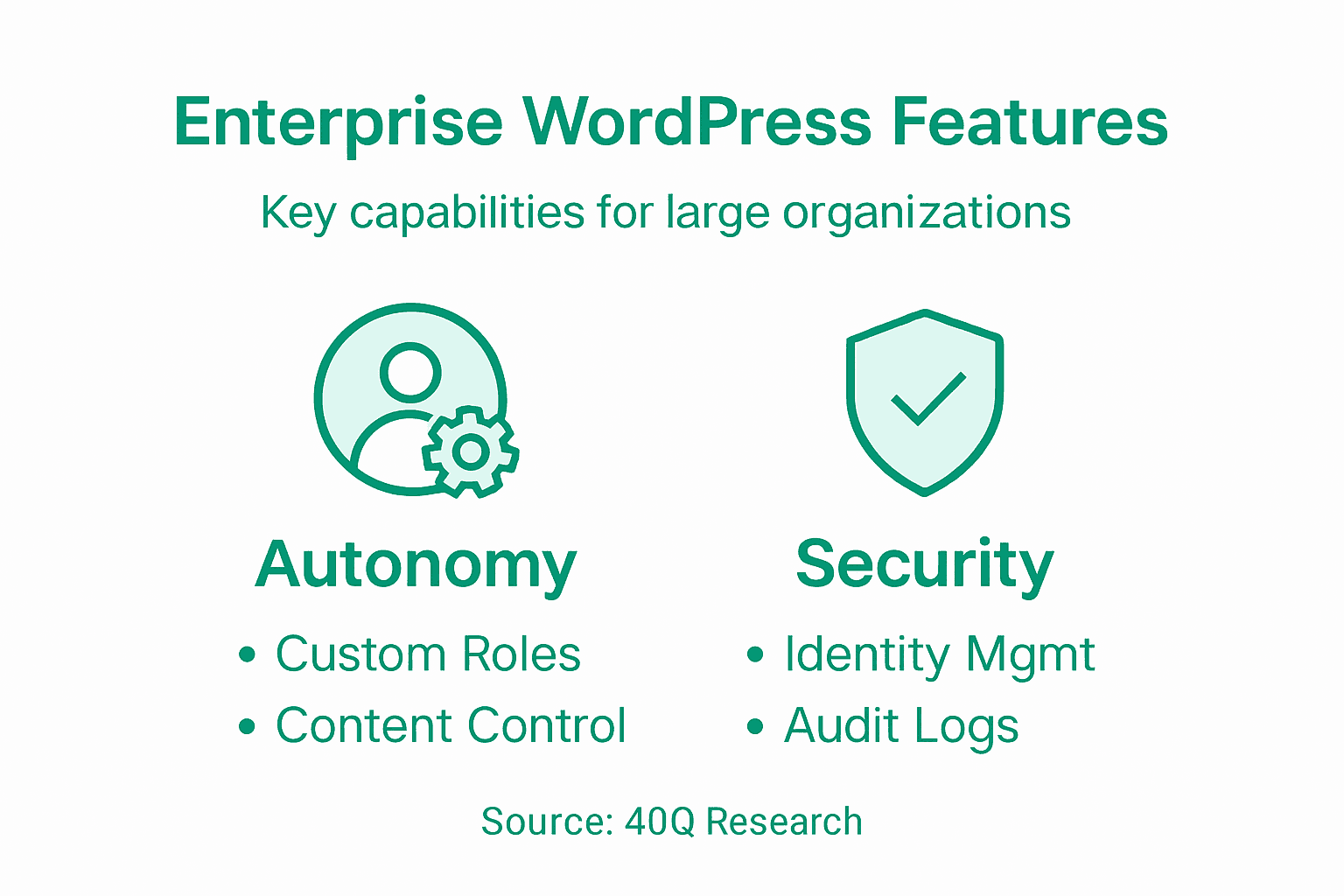
Governance and Security become paramount in enterprise environments. Modern WordPress implementations include identity management systems, single sign-on capabilities, and detailed audit trails that meet stringent corporate compliance requirements.
Pro tip: Conduct a comprehensive WordPress security and scalability assessment before enterprise deployment to identify potential customization needs.
Types of enterprise WordPress deployments
Enterprise WordPress offers a diverse range of deployment strategies tailored to meet complex organizational needs. Enterprise WordPress deployments span multiple critical business domains, including media and publishing, e-commerce, content marketing, higher education, and internal communication platforms.
The primary deployment models for enterprise WordPress environments include:
- Multisite Networks: Centralized management of multiple websites under a single WordPress installation
- Decentralized Deployments: Independent WordPress instances with centralized governance
- Hybrid Configurations: Combining centralized control with localized content management
- Cloud-Based Implementations: Scalable infrastructure supporting distributed digital experiences
- Headless WordPress Architectures: Separating content management from presentation layers
Each deployment model offers unique advantages for organizations seeking flexible, secure digital content strategies. Multisite configurations, for instance, enable large enterprises to manage complex brand portfolios while maintaining consistent technological governance and design standards.
This table compares common enterprise WordPress deployment models by control and scalability:
| Deployment Model | Centralized Control | Content Flexibility | Scalability Perspective |
|---|---|---|---|
| Multisite Networks | High | Moderate | Suited for large organizations |
| Decentralized | Moderate | High | Good for independent teams |
| Hybrid Configuration | Balanced | High | Enables local innovation |
| Cloud-Based | High | High | Supports global expansion |
| Headless | High (backend) | Maximum | Advanced integration options |
The selection of a WordPress deployment strategy depends on several critical factors, including organizational size, content complexity, regulatory requirements, and technological infrastructure. Enterprises must carefully evaluate their specific needs to determine the most appropriate WordPress implementation approach.
Pro tip: Conduct a comprehensive infrastructure assessment to match your WordPress deployment strategy with your organization’s specific technological and operational requirements.
Key features: autonomy, security, scalability
Enterprise WordPress platforms are designed to deliver three critical capabilities that transform digital content management: marketing autonomy, robust security frameworks, and enterprise-grade scalability. Scalable web architectures represent the foundation of modern digital experiences that can adapt to rapidly changing organizational needs.
The key features that define an enterprise-grade WordPress implementation include:
-
Marketing Team Autonomy
- Flexible content creation tools
- Customizable role-based permissions
- Rapid campaign and landing page deployment
- Minimal developer dependency
-
Advanced Security Capabilities
- Multi-layer authentication protocols
- Comprehensive access control systems
- Regular automated security patches
- Detailed user activity tracking
-
Scalability Features
- High-performance cloud infrastructure
- Distributed content delivery networks
- Elastic resource allocation
- Performance optimization tools
Marketing teams require platforms that provide maximum operational flexibility while maintaining strict technological governance. This delicate balance allows organizations to accelerate digital initiatives without compromising institutional security or technological standards.
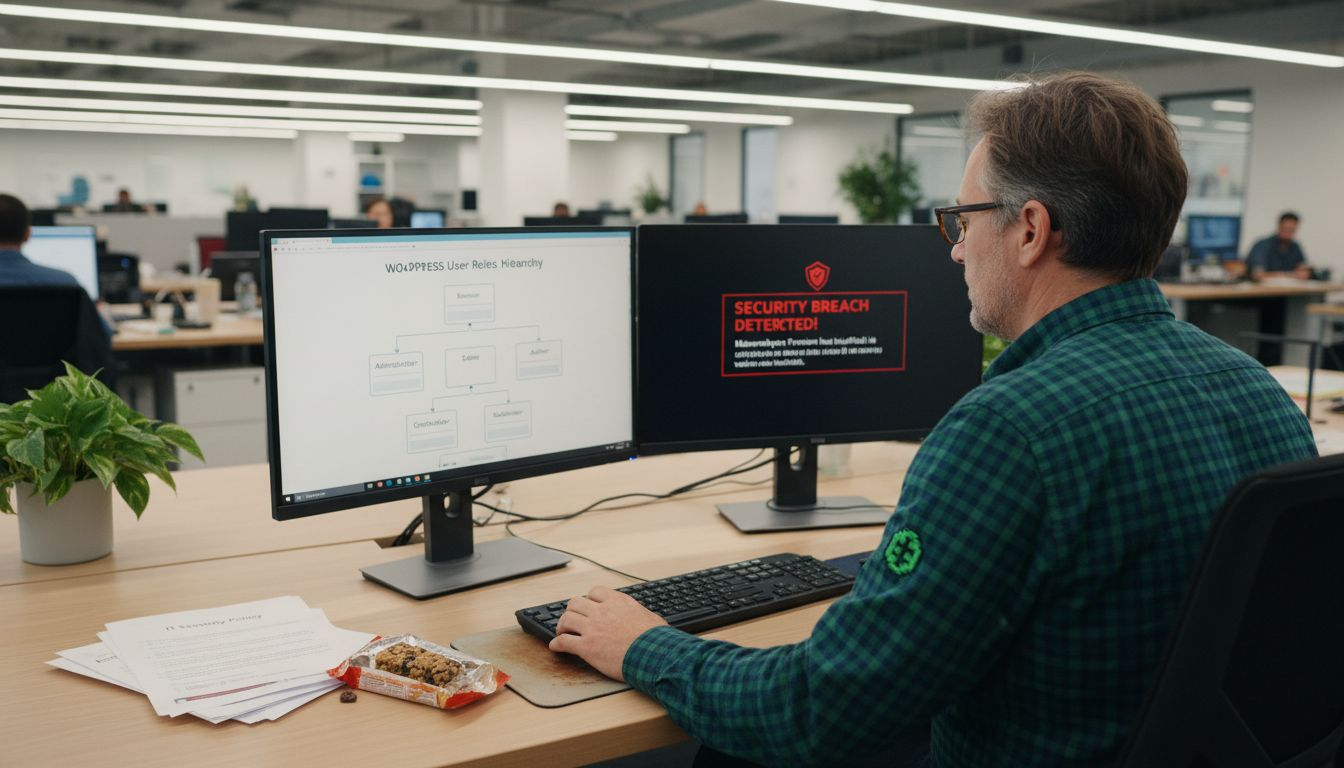
Complex enterprise environments demand WordPress implementations that can seamlessly integrate with existing technological ecosystems, providing robust APIs, comprehensive identity management, and granular control mechanisms that support both innovation and compliance.
Pro tip: Implement a comprehensive WordPress governance framework that balances technological control with marketing team creativity and operational speed.
Critical compliance and governance requirements
Enterprise organizations require robust governance frameworks that ensure technological consistency, security, and regulatory alignment. Enterprise WordPress compliance demands comprehensive strategies that address complex organizational needs through systematic control mechanisms and detailed monitoring protocols.
The critical governance requirements for enterprise WordPress implementations include:
-
Editorial Governance
- Structured content approval workflows
- Role-based publishing permissions
- Content review and validation processes
- Audit trail documentation
-
Security Compliance
- Plugin vulnerability assessments
- Enterprise identity management integration
- Multi-factor authentication protocols
- Encryption of sensitive content
-
Operational Governance
- Defined update and maintenance schedules
- Performance and uptime service level agreements
- Centralized configuration management
- Comprehensive access control systems
Successful enterprise WordPress governance requires a delicate balance between technological control and operational flexibility. Organizations must develop frameworks that enable marketing teams to innovate while maintaining strict security and compliance standards.
Implementing a comprehensive governance model involves creating detailed policies that address technological, legal, and operational requirements. These policies must be flexible enough to adapt to changing business needs while providing robust protection against potential security risks.
Pro tip: Create a cross-functional governance committee that includes representatives from IT, legal, marketing, and security teams to develop holistic WordPress management strategies.
Risks, cost factors, and mistakes to avoid
Enterprise WordPress implementations involve complex strategic considerations that extend far beyond basic platform selection. WordPress enterprise risks encompass technological, financial, and operational challenges that require comprehensive planning and proactive management.
Key risk categories and associated cost factors include:
-
Security Vulnerabilities
- Potential plugin compatibility issues
- External attack surface management
- Ongoing security monitoring costs
- Vulnerability assessment expenses
-
Infrastructure Challenges
- Hosting platform reliability
- Performance scalability limitations
- Network redundancy requirements
- Cloud infrastructure investments
-
Governance Complexity
- Custom development overhead
- Compliance management costs
- Access control implementation
- Workflow standardization expenses
Enterprises frequently underestimate the total cost of ownership for WordPress platforms. The misconception that WordPress is a simple, turnkey solution can lead to significant unexpected expenses and operational disruptions.
Successful enterprise WordPress strategies require a holistic approach that balances technological capabilities, security requirements, and budgetary constraints. Organizations must develop comprehensive implementation plans that account for ongoing maintenance, security hardening, and potential scalability challenges.
Pro tip: Conduct a comprehensive total cost of ownership assessment that includes direct platform costs, security investments, and potential productivity implications before finalizing your WordPress enterprise strategy.
Unlock Marketing Autonomy with Enterprise-Grade WordPress Solutions
The article highlights the challenge enterprise organizations face balancing marketing autonomy, security, and scalability within complex WordPress environments. Many marketing teams struggle with developer dependency that slows content launches. IT departments worry about maintaining strict governance, compliance, and performance. At 40Q, we bridge this gap by empowering marketing teams to rapidly deploy landing pages, campaigns, and localized content without sacrificing control or security.
Our proprietary FAS Block System™ built on enterprise WordPress platforms ensures your organization achieves true marketing autonomy while IT retains full oversight on security and compliance. We specialize in scalable, high-traffic architectures designed for organizations that demand speed to market and operational reliability. Learn how our AI-assisted content workflows simplify publishing and enforce governance at 40Q.
Ready to eliminate developer bottlenecks and accelerate your digital initiatives?
Explore how our enterprise WordPress solutions can transform your marketing and IT strategies. Visit 40Q to discover the power of tailored enterprise-grade WordPress platforms built for growth and compliance. Connect with us today to start your journey toward optimized content management and governance.
Frequently Asked Questions
What is enterprise-grade WordPress?
Enterprise-grade WordPress is a sophisticated content management platform designed to meet the complex technological requirements of large organizations, providing features like advanced user role management, scalable architecture, and robust security frameworks.
How does enterprise-grade WordPress support marketing teams?
Enterprise-grade WordPress enables marketing teams to create and manage content rapidly while ensuring strict organizational control, allowing for marketing autonomy and efficient workflow integration that supports agile digital strategies.
What are the key features of enterprise WordPress?
Key features of enterprise WordPress include advanced role management, scalable architecture, enhanced security capabilities, compliance-ready configurations, and customizable workflows that help organizations maintain efficiency and governance.
What deployment models are available for enterprise WordPress?
Common deployment models for enterprise WordPress include multisite networks, decentralized deployments, hybrid configurations, cloud-based implementations, and headless WordPress architectures, each catering to different organizational needs for content management and governance.
Recommended
Nov 18, 2025
WordPress
Why Enterprises Are Ditching AEM in 2025

Mar 30, 2026
WordPress
Enterprise WordPress Content Scalability: 7 Proven Tips
Aug 21, 2024
WordPress