
WordPress
How to optimize content for SEO: steps for maximum visibility

José Debuchy
April 6, 2026 | 3 min to read
TL;DR:
- Effective enterprise SEO depends on strategic planning, proper tools, and disciplined content management.
- Focus on intent-based content mapping and structured, utility-driven content for long-term visibility.
- Continuous content auditing and adaptation are essential for maintaining high search rankings in AI-driven search environments.
Even well-written content can struggle to rank without the right optimization framework behind it. For enterprise marketing teams managing high volumes of content on WordPress, the gap between publishing and performing is rarely about writing quality. It’s about structure, intent, and process discipline. This guide walks through the exact steps to optimize content for SEO on WordPress, from setting up the right tools to maintaining long-term visibility. Every recommendation here is grounded in real data and built for teams operating at scale.
Key Takeaways
| Point | Details |
|---|---|
| Intent-first strategy | Focusing on topic clusters and user intent leads to better SEO results than chasing individual keywords. |
| Content structure matters | Frequent subheadings, clear questions, and well-organized lists improve both rankings and retrievability. |
| Continuous refresh | Regular content audits and updates every 3-6 months are essential for long-term SEO success. |
| Plugins are helpers | SEO plugins offer useful guidance, but manual oversight and strategic alignment are critical. |
| AI-driven optimization | Structure, citations, and content quality now matter as much as traffic for visibility in AI-powered search. |
What you need before optimizing: SEO essentials and tools
Effective SEO optimization starts before you write a single word. You need the right infrastructure, clear team roles, and a measurement baseline. Without these, even the best content strategy will stall.
Core tools every enterprise team needs:
- Analytics platform: Google Analytics 4 (GA4) for traffic, engagement, and conversion tracking
- WordPress SEO plugin: Yoast SEO, Rank Math, or All in One SEO, each configured for your specific site architecture
- Rank tracking: Tools like Semrush or Ahrefs to monitor keyword positions and visibility trends
- Technical audit tools: Screaming Frog or Sitebulb for crawl analysis, broken links, and indexation issues
Plugin setup is a common sticking point. WordPress SEO myths persist in many teams, including the belief that installing a plugin is enough. It is not. Plugins guide but don’t guarantee SEO success. Proper configuration, including XML sitemap settings, canonical tags, and schema markup, requires deliberate setup by someone who understands your site’s structure.
Team roles that matter:
| Role | Responsibility |
|---|---|
| SEO lead | Strategy, keyword research, audit oversight |
| Content writers | Intent-aligned drafting and formatting |
| Editors | Quality, E-E-A-T compliance, readability |
| Developer | Plugin config, technical fixes, schema |
Before you start optimizing, establish a baseline. Pull your current organic traffic, average ranking positions, and engagement rates (time on page, scroll depth, bounce rate). These numbers are your benchmark. Without them, you cannot measure what is working.
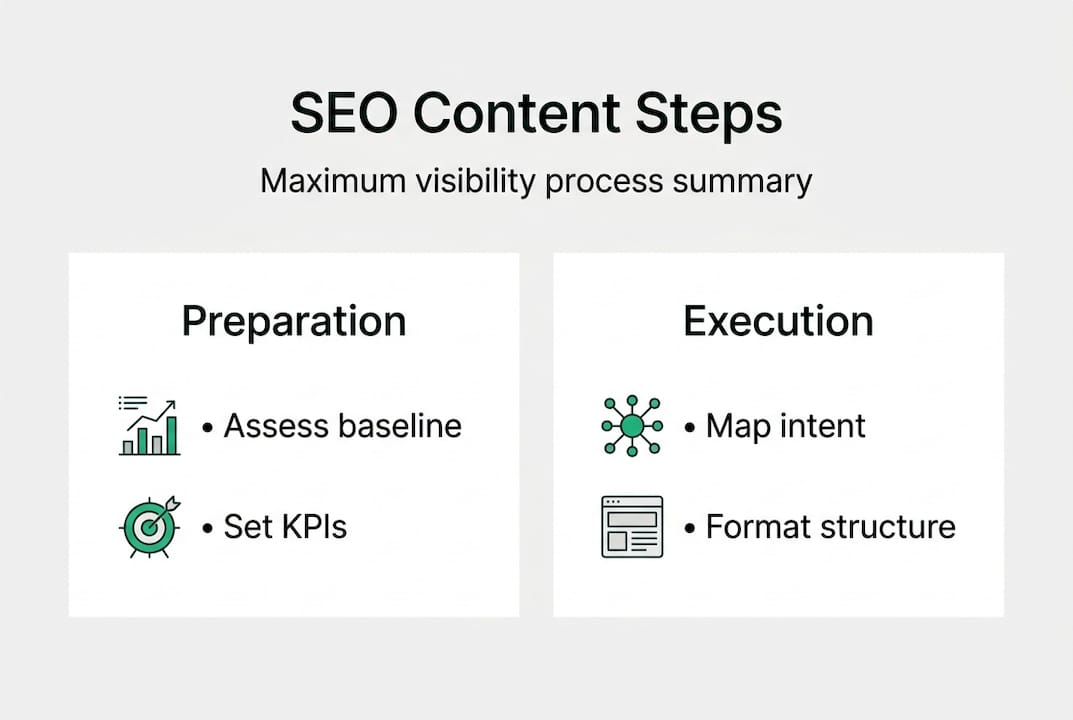
Pro Tip: Define your KPIs before touching a single page. Track at minimum: organic traffic, keyword visibility, and goal conversions. Teams that skip this step often optimize in the wrong direction for months.
The business case for getting this right is significant. Technical and content audits have driven a 121% increase in visibility and a 28% revenue boost for e-commerce sites. For enterprise SEO programs, the compounding effect of a well-configured foundation is even greater.
Step 1: Research topics and map user intent
With a solid foundation in place, your first optimization task is strategic topic and intent research. This is where most enterprise teams underinvest, and where the biggest ranking gains are hiding.
The shift from keyword-first to intent-first strategy is not just a trend. Intent clustering now drives greater ranking and retrievability than targeting isolated keywords. The difference is significant in practice.
Keyword-first vs. intent-first: a direct comparison
| Approach | Focus | Outcome |
|---|---|---|
| Keyword-first | Search volume, exact match terms | Short-term rankings, fragmented content |
| Intent-first | User goals, topic clusters, questions | Topical authority, durable visibility |
Intent-first strategy means building content around what your audience is trying to accomplish, not just what they type into a search bar. This leads to pillar pages supported by cluster content, which signals topical authority to search engines.
How to execute topic and intent research:
- Start with your core service or product areas. List the top five to ten topics your audience cares about most.
- Use tools like Semrush’s Topic Research or Google’s People Also Ask to identify related questions and subtopics.
- Group related queries into clusters. Each cluster should have one pillar page and three to six supporting articles.
- Map each piece of content to a specific user intent: informational, navigational, commercial, or transactional.
- Prioritize clusters where you already have some visibility. Quick wins come from reinforcing existing strength.
For large organizations managing hundreds of pages, content scalability tips become critical here. You need a repeatable process, not a one-time project.
Pro Tip: Use questions and list-format content as your cluster anchors. AI-driven search features reward question-based headings and structured answers. This future-proofs your content for both traditional search and AI retrieval.
Solid content architecture is the backbone of this step. How you organize and interlink your cluster content directly affects how search engines understand your site’s authority on any given topic. Build the map before you build the content.
Step 2: Structure, write, and format for SEO performance
With topics and intent mapped, it’s time to execute SEO-optimized content writing and formatting. Structure is not a finishing touch. It is a core ranking factor.

Readability standards for SEO include a Flesch readability score above 60, subheadings every 300 words, questions used as headings, and structured lists and tables throughout. These practices serve both human readers and AI retrieval systems.
On-page SEO checklist for every piece of content:
- Title tag: Primary keyword near the front, 50 to 60 characters
- Meta description: Clear value statement, 150 to 160 characters, includes keyword
- H1: One per page, matches or closely mirrors the title tag
- H2/H3 structure: Logical hierarchy, questions where appropriate
- Internal links: Three to five contextual links per article
- External links: Two to three authoritative citations
- Image alt text: Descriptive, keyword-relevant where natural
- CTA: Clear, relevant, placed at logical decision points
E-E-A-T (Experience, Expertise, Authoritativeness, Trustworthiness) is now a concrete ranking signal for enterprise brands. Author bios and citations build the trust signals that Google’s quality raters and AI systems look for. Every article should have a named author with credentials, and every factual claim should link to a credible source. For guidance on building E-E-A-T at scale, this is an area where process matters as much as content quality.
Never rely solely on a plugin’s green light as your quality signal. A green checkmark means the plugin’s basic rules are met. It does not mean the content is well-structured, intent-aligned, or competitive for your target query.
Content audits and clustered strategies have delivered a 390% traffic growth outcome in documented case studies. That result does not come from keyword stuffing or plugin compliance. It comes from depth, structure, and genuine utility. For teams building landing page SEO into their campaigns, these formatting principles apply equally to conversion-focused pages.
Step 3: Refine, verify, and maintain: keeping content SEO-strong
Even carefully structured content can erode in value. Here’s how to keep it performing post-publishing.
Search rankings are not static. Algorithm updates, new competitors, and shifting user intent all affect your content’s performance over time. Monthly monitoring is the minimum for enterprise sites. Content should be refreshed every three to six months, with thin and archive pages marked as noindex to protect overall site quality.
Content refresh cycle: step by step
- Pull ranking data for your top 50 pages monthly. Flag any page that has dropped more than five positions.
- Review engagement metrics: time on page, scroll depth, and conversion rate. Declining engagement often precedes ranking drops.
- Update outdated statistics, broken links, and any content that no longer reflects current best practices.
- Add new internal links to recently published content where relevant.
- Re-submit updated URLs via Google Search Console to accelerate re-crawling.
- Check for duplicate content and verify that thin or archive pages carry a noindex tag.
Content audit tracking table:
| Page | Last audit | Refresh date | Ranking position | Action needed |
|---|---|---|---|---|
| Pillar page A | Jan 2026 | Mar 2026 | 4 | Update stats |
| Cluster post B | Nov 2025 | Feb 2026 | 18 | Rewrite intro |
| Archive page C | Dec 2025 | Jan 2026 | N/A | Apply noindex |
For enterprise website best practices, governance around content maintenance is as important as the initial optimization. Assign ownership. Set calendar reminders. Treat content like a product that needs regular updates.
Pro Tip: Schedule semiannual full-site audits and set automated alerts in your rank tracking tool for any page dropping out of the top 20. Catching a slide early costs far less than recovering from a significant ranking loss.
Regular SEO rank checks are not optional for high-traffic sites. They are a core operational practice.
Why most SEO guides miss what actually drives content growth
Most SEO advice focuses on checklists. Install the plugin. Add the keyword. Get the green light. That approach is not wrong, but it is incomplete, especially for enterprise teams operating in competitive verticals.
The real differentiator is process discipline. Teams that consistently outperform their competitors are not necessarily producing more content. They are running tighter audit cycles, mapping intent more precisely, and treating content as a living asset rather than a published artifact.
AI and LLM-driven search is accelerating this shift. Snippet wins, retrievability, and citation-driven credibility now matter as much as traditional ranking positions. A page that earns a featured snippet or gets cited by an AI answer engine can drive significant traffic even without a top-three organic ranking.
Conventional checklist SEO misses this entirely. It optimizes for yesterday’s signals. The teams winning in 2026 are the ones building for AI in content workflows, structuring content for retrieval, and earning trust through depth and citation. Shift your focus from plugin compliance to content utility. That is where growth actually lives.
Take your enterprise SEO strategy further with 40Q
If you’re ready to move from optimization theory to measurable execution, 40Q builds the infrastructure that makes it possible. Our enterprise WordPress platforms are designed for marketing teams that need content velocity without sacrificing performance or governance.
From enterprise WordPress performance to AI-assisted publishing with our WordPress AI Suite, we give your team the tools to publish faster, rank higher, and maintain control at scale. Whether you’re starting from scratch or scaling an existing program, master your SEO basics with 40Q’s proven frameworks and move from insight to execution with confidence.
Frequently asked questions
Recommended
- SEO for enterprise WordPress websites – 40Q
- Enterprise SEO Workflows Explained: Enabling Scalable Impact – 40Q
- Landing page optimization tips for enterprises on WordPress 2026 – 40Q
- Enterprise WordPress Content Scalability: 7 Proven Tips – 40Q
- Optimize for Amazon Search: Boost Your Product Visibility
Jan 13, 2026
WordPress
Cloud-Based WordPress: Empowering Enterprise Autonomy

Feb 28, 2026
WordPress
Marketing Automation Checklist: 451% More Leads & ROI

Mar 28, 2026
WordPress