
WordPress
How to localize website content for global marketing success

José Debuchy
March 23, 2026 | 3 min to read
Expanding your brand into global markets reveals a harsh reality: your website content, no matter how compelling in English, often falls flat with international audiences. Marketing leaders quickly discover that direct translation misses cultural nuances, breaks user experience flows, and leaves conversion opportunities on the table. Effective website localization transforms your digital presence into a culturally resonant, technically optimized platform that drives engagement and revenue across diverse markets. This comprehensive guide walks you through every critical step, from strategic preparation and execution methodologies to measuring ROI and avoiding costly pitfalls.
Key Takeaways
| Point | Details |
|---|---|
| Internationalization foundation | Before translating anything, set up full internationalization including UTF eight encoding support, flexible layouts for growing text, and proper language signaling with hreflang. |
| Pilot market focus | Select pilot markets that account for a portion of traffic but show lower conversions to maximize returns from localization. |
| Phased rollout approach | Launch localized content in stages such as the homepage and core product pages to validate the strategy before full site deployment. |
| SEO and URL strategy | Decide on subdirectories, subdomains, or country domains based on resources and brand goals and implement hreflang to signal targets and prevent duplicate content. |
| Accessibility and RTL readiness | Plan for accessibility localization with translated alt text ARIA labels and form messages and ensure layouts accommodate right to left languages. |
Preparing for website localization: prerequisites and strategy
Before translating a single word, you need a solid technical foundation. Website localization requires initial internationalization including UTF-8 support, flexible layouts for text expansion, hreflang tags, and adapting UI elements. This means externalizing all user-facing strings from your codebase, ensuring your database and front-end can handle UTF-8 character encoding, and designing layouts that accommodate text expansion. German translations typically run 30% longer than English, while Finnish can expand up to 60%.

Your URL structure decisions matter enormously for SEO. Choose between subdirectories (example.com/de/), subdomains (de.example.com), or country-code top-level domains (example.de) based on your technical resources and brand strategy. Implement hreflang tags correctly to signal language and regional targeting to search engines, preventing duplicate content penalties and ensuring users land on the right version.
Select your pilot markets strategically. Look for regions generating 10-20% of your current traffic but showing lower conversion rates than your primary market. These audiences are already interested but underserved. Common starting points include German and French for European expansion, or Spanish for Latin American markets. Analyze your analytics data to identify where localization investment will deliver the fastest return.
Develop a phased rollout plan that balances agility with clear milestones. Start with your homepage, key product pages, and conversion paths rather than attempting to localize your entire site at once. This focused approach lets you validate your strategy, gather user feedback, and refine your process before scaling. Budget realistically for both the initial internationalization development work and ongoing translation costs across your chosen languages.
Pro Tip: Investing in proper internationalization architecture upfront can reduce your total localization costs by 50% or more in later expansion phases, as you’ll avoid expensive refactoring and can add new languages with minimal technical work.
Your layouts must flex gracefully to handle right-to-left languages like Arabic and Hebrew. Plan for text overflow scenarios by setting appropriate minimum widths and using responsive design principles that adapt per language. Consider how navigation menus, form fields, and call-to-action buttons will behave when content length varies significantly. Accessibility localization deserves equal attention from the start. Alt text, ARIA labels, and form validation messages all need translation and cultural adaptation. Following enterprise website best practices ensures your foundation supports both current needs and future growth.
Executing website localization: methodologies, tools, and workflows
You face a fundamental choice between waterfall and agile localization methodologies. Waterfall suits projects with fixed deadlines and stable content, where you translate everything upfront before launch. This structured approach works well for initial market entry but struggles with ongoing content updates. Agile or continuous localization integrates translation into your CI/CD pipeline, enabling you to publish updates across all languages simultaneously. This method demands more sophisticated tooling but delivers faster time to market and keeps all language versions in sync.
The step-by-step workflow follows a consistent pattern regardless of methodology. Translation workflows include planning, internationalization, translation, and QA with native speakers, typically 5-9 weeks for 50-page sites. First, audit your content to identify what needs translation and prioritize based on traffic and conversion impact. Second, complete your internationalization work to separate content from code. Third, execute translation using your chosen approach. Fourth, conduct thorough quality assurance with native speakers who understand both the language and your target market’s cultural context.
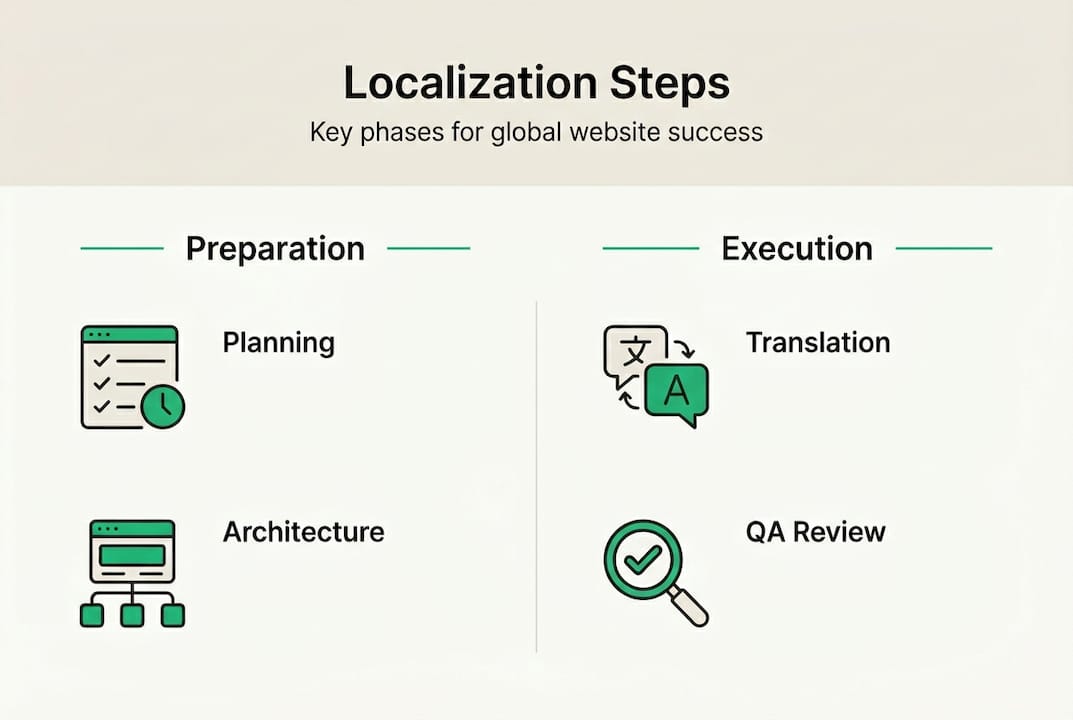
Using agile/continuous localization via TMS integration for faster updates; hybrid AI+human approach balances speed and nuance has become the preferred method for enterprise organizations. Machine translation handles the initial heavy lifting at scale, then human linguists review and refine the output to ensure cultural appropriateness and brand voice consistency. This hybrid approach typically costs 40-60% less than human-only translation while maintaining quality standards.
Prioritize translating your highest-impact pages first. Your homepage, primary product or service pages, pricing information, and key conversion paths deliver the most immediate ROI. Blog content and support documentation can follow in subsequent phases once you’ve validated market response. This focused approach lets you launch faster and start gathering performance data to inform your expansion strategy.
| Methodology | Speed | Cost | Control | Best for |
|---|---|---|---|---|
| Waterfall | Slower initial launch | Higher upfront | Complete pre-launch review | Fixed-scope projects, regulated industries |
| Agile/Continuous | Faster iterations | Lower ongoing | Continuous improvement | Dynamic content, frequent updates |
| Hybrid AI+Human | Fast with quality checks | Moderate | Balanced accuracy | Most enterprise scenarios |
Your technology stack shapes your execution capabilities significantly. WordPress users can leverage plugins like WPML or Polylang for content management, though these require careful configuration to avoid SEO issues. For custom applications, frameworks like next-i18n for Next.js or react-i18next for React provide robust internationalization support. Translation management systems like IntlPull or Crowdin centralize your workflow, track translation progress, and integrate with your development pipeline. Explore multilingual WordPress solutions and mastering multilingual WordPress CMS approaches that align with your technical infrastructure.
Pro Tip: Integrating your TMS directly into your CI/CD pipeline enables automatic translation requests when content changes, eliminating manual handoffs and reducing time to publish across languages from weeks to days.
Avoiding common pitfalls and handling edge cases in localization
Right-to-left language support requires more than flipping your layout horizontally. RTL languages require mirrored layouts, flipped icons/arrows, and BiDi text support; accessibility must include localized alt text and ARIA labels. Navigation elements, directional icons, and reading flow all need careful consideration. Bidirectional text handling becomes critical when mixing RTL languages with English product names or technical terms. Test thoroughly with native speakers using actual RTL content, not placeholder text, to catch layout breaks and usability issues.
Text expansion and overflow present constant challenges across languages. German compound words can break fixed-width designs, while character-based languages like Chinese may condense significantly. Build responsive designs with flexible containers that adapt gracefully. Set appropriate minimum widths for buttons and form fields to prevent text truncation. Use CSS properties like word-wrap and overflow-wrap strategically, but test each language individually to ensure readability.
Geolocation and VPN complications frustrate users when handled poorly. Avoid aggressive auto-redirects that trap users in the wrong language version. Instead, detect their location and suggest the appropriate language with an easy option to override. Remember that business travelers, VPN users, and expatriates often browse from locations that don’t match their language preference. Provide a persistent, obvious language selector that respects user choice across sessions.
Accessibility localization extends beyond translating visible text. Alt text for images must convey the same meaning in each language, not just literal translations. ARIA labels, screen reader announcements, and form error messages all need culturally appropriate adaptations. Test with screen readers in each target language to verify that assistive technology users receive equivalent experiences. Following accessible localization practices ensures compliance and expands your addressable market.
Studies show that 55% of images on localized websites lack properly translated alt text, creating both accessibility barriers and missed SEO opportunities in target markets.
Common localization mistakes stem from treating translation as a purely linguistic exercise rather than a holistic user experience challenge. Poor SEO implementation without proper hreflang tags causes ranking issues and user confusion. Siloed teams where developers, translators, and marketers work independently create inconsistencies and delays. Over-reliance on AI translation without human review produces grammatically correct but culturally tone-deaf content that damages brand perception.
- Implement comprehensive hreflang tags across all language versions to prevent duplicate content penalties
- Establish cross-functional workflows connecting development, translation, and marketing teams
- Use hybrid AI-human translation to balance speed with cultural accuracy
- Test layouts with actual translated content, not placeholder text, to catch expansion issues
- Provide clear language selection options without aggressive auto-redirects
- Localize all accessibility features including alt text, ARIA labels, and error messages
- Validate RTL implementations with native speakers, not just visual inspection
- Monitor for broken layouts caused by unexpected text length variations
Maintaining enterprise website maintenance standards across multiple language versions requires systematic quality assurance processes. Establish review cycles with native speakers for each market. Create style guides that document terminology choices, tone preferences, and cultural considerations. Build feedback loops that capture user-reported issues and incorporate learnings into your translation memory for continuous improvement.
Measuring success and optimizing localization for maximum ROI
Tracking the right metrics reveals whether your localization investment delivers results. Monitor conversion rate lift, organic traffic growth, bounce rate changes, and qualified lead volume for each language version separately. Compare these metrics against your baseline English performance and against each other to identify which markets respond most strongly. Localized websites see +20-70% conversions, +42-150% traffic, with 3-7x ROI; track per-language KPIs post-launch for optimization.
| Industry | Typical conversion lift | Traffic increase | ROI multiple | Payback period |
|---|---|---|---|---|
| SaaS/Technology | 35-55% | 60-120% | 4-6x | 6-9 months |
| E-commerce | 45-70% | 80-150% | 5-8x | 4-7 months |
| B2B Services | 20-40% | 42-85% | 3-5x | 8-12 months |
| Financial Services | 25-45% | 50-95% | 3-6x | 9-14 months |
A/B testing and user feedback loops drive continuous optimization. Test different translation approaches, cultural adaptations, and local payment methods to refine performance. Gather qualitative feedback through user surveys, support tickets, and session recordings to understand how well your localized content resonates. Small refinements based on real user behavior often deliver outsized impact on conversion rates.
Prioritize languages and content that demonstrate strong performance signals. If your German pages show 30% conversion lift while French pages lag at 10%, investigate why and reallocate resources accordingly. Scale from validated pilots rather than committing to full localization across all markets simultaneously. This data-driven approach minimizes risk and concentrates investment where it generates the highest returns.
- Establish baseline metrics for each language version within the first 30 days post-launch
- Set up automated dashboards tracking conversion rates, traffic sources, and engagement by language
- Collect user feedback through surveys, support channels, and usability testing with native speakers
- Analyze performance data monthly to identify optimization opportunities and underperforming content
- Update translations and cultural adaptations based on user behavior patterns and feedback themes
- Retrain AI translation models with validated terminology and style preferences from successful content
- Expand to additional languages only after achieving target ROI thresholds in pilot markets
Multilingual SEO requires dedicated strategy beyond simple translation. Research native keyword preferences for each market rather than directly translating English keywords. Search behavior varies significantly across cultures and languages. Implement proper enterprise SEO workflows that account for local search engines, featured snippet optimization, and regional ranking factors. Build market-specific backlink profiles and local citations to strengthen domain authority in each target region.
Measure customer lifetime value and acquisition cost variations per language to understand true profitability. Some markets may show lower initial conversion rates but higher long-term value, justifying continued investment. Others might deliver quick wins but limited expansion potential. These deeper financial insights guide strategic decisions about market prioritization and resource allocation. Following website localization best practices ensures your measurement framework captures both immediate performance and long-term strategic value.
Explore advanced website localization solutions with 40Q
Implementing effective website localization at enterprise scale demands both technical excellence and strategic insight. 40Q specializes in building WordPress platforms that empower marketing teams to manage multilingual content independently while maintaining the performance, security, and governance standards IT teams require. Our advanced search capabilities ensure users find relevant content regardless of language, while our theme setup services create flexible foundations that adapt gracefully across markets.
Our enterprise-grade WordPress solutions eliminate developer dependency for day-to-day localization tasks, giving your marketing team the autonomy to launch campaigns and localized content quickly. We implement proven internationalization architectures that reduce long-term costs while enabling rapid expansion into new markets. Partner with 40Q to transform your global digital presence with scalable, SEO-optimized, and technically robust website localization that drives measurable business results.
Frequently asked questions
Recommended

Feb 13, 2026
WordPress
Top 8 WordPress Solutions 2026 for Website Growth and Security
Apr 14, 2026
WordPress
Marketing compliance guide: tools, workflows, best practices

Mar 3, 2026
WordPress