
WordPress
What is digital compliance: enterprise guide for 2026

José Debuchy
March 22, 2026 | 3 min to read
Non-compliance penalties reached $5.4 billion globally in 2025, with enterprises facing average fines of $14.8 million per violation. Digital compliance has evolved from a checkbox exercise into a strategic imperative for marketing and IT leaders managing complex regulatory landscapes. This guide breaks down core compliance principles, management systems, strategic approaches, and practical implementation steps to help you navigate GDPR, CCPA, AI transparency rules, and emerging regulations. You’ll learn how to embed compliance into your CMS and marketing technology stack while maintaining the speed and agility your organization demands.
Key Takeaways
| Point | Details |
|---|---|
| Digital compliance scope | Digital compliance covers privacy laws like GDPR and CCPA, cybersecurity standards such as NIST and ISO 27001, AI transparency mandates, and content management regulations as regulations evolve. |
| CMS integration for compliance workflows | CMS should embed compliance workflows with automated reviews, alerts, and jurisdiction specific content flags to enforce regulatory obligations. |
| Core CMS elements | A compliant CMS combines policy management, training, reporting, regulatory mapping, risk assessments, audit trails, and role based access control. |
| AI transparency focus | Emerging AI transparency rules require documenting training data sources explaining algorithmic decisions and classifying systems by risk level. |
| Practical integration steps | Embed compliance into digital workflows and marketing technology while preserving speed and agility. |
Understanding digital compliance: definitions and scope
Digital compliance requires enterprises to follow data privacy laws like GDPR and CCPA, cybersecurity standards including NIST and ISO 27001, AI transparency mandates, and content management regulations across all digital operations. The regulatory landscape expands constantly, with new frameworks emerging for artificial intelligence governance, algorithmic transparency, and cross-border data transfers.
Marketing leaders must ensure campaigns respect consent requirements, data retention policies, and disclosure obligations. IT teams architect systems that maintain audit trails, enforce access controls, and support compliance reporting. Both roles intersect at the content management system, where publishing workflows either enable or obstruct regulatory adherence.
Major frameworks impacting enterprises include:
- GDPR and CCPA for consumer data privacy and consent management
- NIST Cybersecurity Framework and ISO 27001 for information security controls
- EU AI Act and emerging US state laws for artificial intelligence risk classification
- Industry-specific regulations like HIPAA for healthcare or PCI DSS for payment processing
- Accessibility standards including WCAG 2.1 for inclusive digital experiences
The cost of non-compliance extends beyond fines. Reputational damage, customer trust erosion, and operational disruption create long-term business impacts. A single data breach can trigger regulatory investigations across multiple jurisdictions, each with distinct notification requirements and penalty structures.
Emerging regulations focus on AI transparency, requiring enterprises to document training data sources, explain algorithmic decisions, and classify systems by risk level. Content governance rules now mandate clear labeling of AI-generated materials and disclosure of automated decision-making processes. These requirements directly affect marketing technology stacks and publishing platforms.
Core elements of compliance management systems for enterprises
Effective compliance management systems integrate seven components: policy management, training programs, reporting mechanisms, regulatory mapping, risk assessments, audit trails, and role-based access control. These elements work together to create a structured approach for meeting regulatory obligations while supporting operational efficiency.
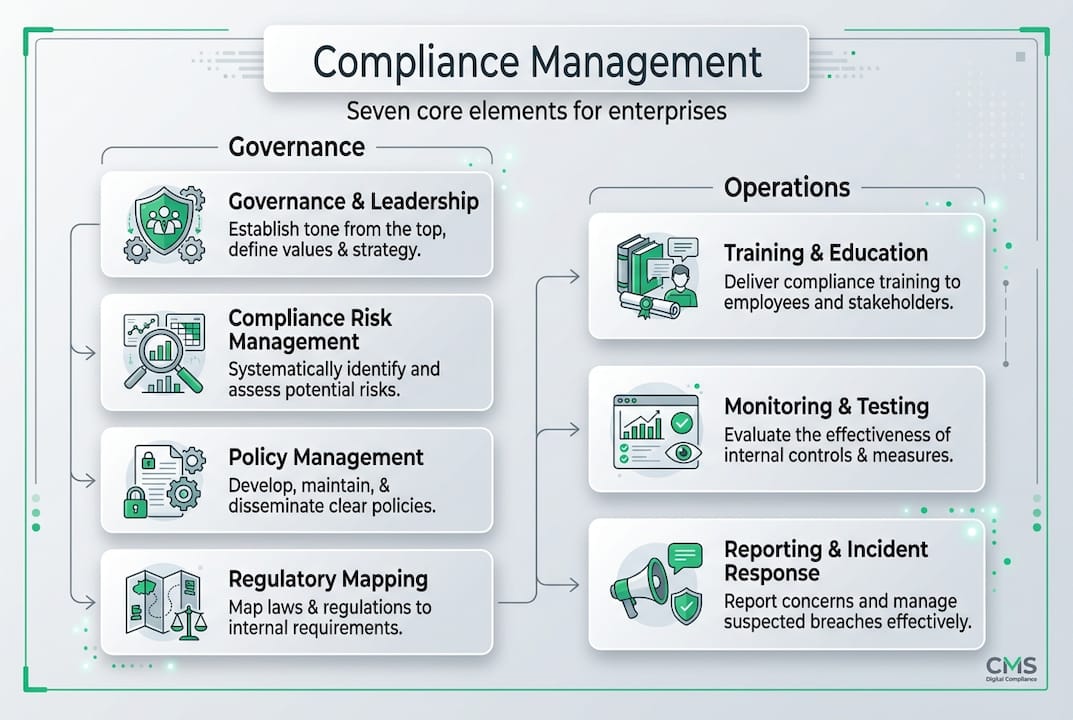
Policy management centralizes documentation of compliance requirements, translating complex regulations into actionable guidelines for marketing and IT teams. Training ensures staff understand their responsibilities and can identify compliance risks in daily workflows. Reporting provides visibility into adherence levels and flags potential violations before they escalate.
Regulatory mapping connects specific business processes to applicable laws, creating a clear view of which activities fall under which frameworks. Risk assessments prioritize compliance efforts based on likelihood and impact of violations. Audit trails capture every content change, approval, and publication event for regulatory review.
Pro Tip: Select CMS platforms with built-in regulatory mapping capabilities to automatically flag content requiring legal review based on jurisdiction, data type, or processing activity.
Enterprise CMS platforms like Drupal and AEM support compliance through versioning systems that track content evolution, role-based access control limiting who can publish or modify materials, and comprehensive logging of user actions. These features create the audit-ready infrastructure regulators expect during investigations.

| CMS Feature | Compliance Benefit | Implementation Complexity |
|---|---|---|
| Version control | Complete content history for audits | Low |
| Role-based access | Enforces least privilege principle | Medium |
| Audit logging | Tracks all user actions and changes | Low |
| Approval workflows | Ensures legal review before publication | Medium |
| Automated archiving | Meets data retention requirements | High |
| Consent management | Integrates privacy preferences | High |
Training programs must extend beyond annual compliance courses to include just-in-time guidance within publishing workflows. Contextual help and automated policy checks embedded in the CMS reduce human error and ensure teams apply current regulations correctly.
Reporting dashboards should surface compliance metrics that matter to both marketing and IT leaders: percentage of content with required disclosures, time to remediate flagged issues, consent opt-in rates, and audit readiness scores. These metrics transform compliance from a reactive burden into a measurable operational capability.
Integrating enterprise content compliance systems with existing marketing technology creates a unified governance layer. This integration enables automated consent synchronization, cross-platform policy enforcement, and centralized reporting across disparate tools. The result is consistent compliance without sacrificing the specialized capabilities each platform provides.
Strategic approaches to digital compliance in medium to large enterprises
Enterprises adopt RegTech tools for scalable regulatory mapping, automate approval workflows, and deploy cross-functional teams combining marketing, IT, and legal expertise to manage compliance risks proactively. The RegTech market will reach $33.51B by 2029, growing at 15.5% annually as organizations recognize technology’s role in sustainable compliance.
A practical 90-day compliance rollout includes:
- Inventory all AI usage across marketing and IT systems, documenting data sources, processing activities, and decision-making algorithms
- Map applicable regulations to each system and workflow, identifying gaps between current state and required controls
- Implement automated approval routing in CMS, ensuring content requiring legal review reaches appropriate stakeholders before publication
- Deploy consent management platform integrated with marketing automation, CRM, and analytics tools for unified preference handling
- Establish compliance dashboards providing real-time visibility into adherence levels and emerging risks
- Conduct training sessions for marketing and IT teams on new workflows and compliance responsibilities
Cross-functional compliance teams break down silos that traditionally fragment regulatory efforts. Marketing brings customer experience and campaign expertise, IT contributes technical architecture and security knowledge, and legal provides regulatory interpretation and risk assessment. This collaboration ensures compliance solutions support business objectives rather than obstruct them.
Technology integration extends beyond CMS to encompass the entire marketing stack. Consent preferences captured on websites must flow to email platforms, advertising systems, and analytics tools. Approval workflows should trigger automatically based on content characteristics like data collection, geographic targeting, or AI generation.
Pro Tip: Begin with a comprehensive gap assessment comparing current capabilities against regulatory requirements to focus implementation efforts on highest-risk areas.
Enterprise web governance frameworks balance compliance requirements with operational speed by establishing clear decision rights, standardized processes, and automated controls. This approach eliminates bottlenecks while maintaining necessary oversight.
IT teams play a crucial role in compliance by architecting systems that enforce policies through technical controls rather than relying solely on user behavior. Automated validation, mandatory approval gates, and real-time policy checking reduce compliance risk without adding manual steps.
RegTech platforms continuously monitor regulatory changes, automatically updating policy libraries and flagging affected business processes. This proactive approach replaces reactive scrambling when new laws take effect, giving enterprises time to adapt systems and train staff.
Common challenges and nuances in digital compliance management
AI classification ambiguities affect 40% of systems under the EU AI Act, with unclear distinctions between high-risk and limited-risk applications creating compliance uncertainty. The Cyber Resilience Act’s treatment of SaaS versus product software adds further confusion, as many marketing and IT tools fall into gray areas requiring legal interpretation.
Unstructured legacy data, supply chain risks, and multi-region consent requirements compound compliance complexity. Content management systems often contain years of untagged materials lacking proper metadata for regulatory classification. Third-party integrations introduce compliance dependencies outside direct organizational control.
| Challenge Type | Enterprise Impact | Mitigation Strategy |
|---|---|---|
| AI risk classification | Regulatory uncertainty, potential misclassification penalties | Conduct formal risk assessments with legal review |
| Legacy unstructured data | Inability to locate or classify regulated content | Implement metadata remediation projects |
| Multi-region consent | Conflicting requirements across jurisdictions | Deploy geo-specific consent management |
| Supply chain compliance | Third-party vendor violations affect enterprise | Establish vendor compliance requirements |
| Regulatory ambiguity | Unclear guidance on emerging technologies | Adopt conservative interpretations |
Multi-region operations face conflicting consent requirements, with some jurisdictions requiring opt-in consent while others permit opt-out approaches. Marketing campaigns targeting multiple regions must navigate these variations, often requiring separate workflows and content versions.
Supply chain compliance extends regulatory obligations to vendors and partners. Marketing technology providers, content delivery networks, and analytics platforms all process enterprise data, creating potential compliance exposure. Vendor assessment and contractual protections become essential risk management tools.
Best practices for addressing complex compliance scenarios:
- Establish clear AI risk classification criteria with legal input before deploying new systems
- Create metadata remediation roadmaps for legacy content, prioritizing high-risk materials
- Implement jurisdiction-based consent routing in marketing automation platforms
- Require vendor compliance certifications and conduct periodic audits of third-party processors
- Document compliance decisions and rationale to demonstrate good faith efforts during regulatory reviews
- Build flexibility into systems to accommodate regulatory changes without complete rebuilds
Regulatory guidance often lags technology adoption, forcing enterprises to interpret requirements without official clarification. Conservative approaches reduce risk but may limit competitive advantage. Balancing compliance caution with business agility requires ongoing dialogue between marketing, IT, and legal stakeholders.
Enterprise CMS implementations must address these challenges through flexible architectures supporting rapid policy updates, granular content classification, and jurisdiction-specific publishing rules.
Practical steps and best practices for embedding digital compliance
Embed compliance into CMS through versioning, role-based access control, and audit logs that create audit-ready infrastructure. Integrate consent management directly within marketing technology stacks to ensure preference synchronization across all customer touchpoints. Automated CMS reduces penalties by 85.7% by improving audit readiness and embedding governance into daily workflows.
Prioritize composable CMS and digital experience platforms offering modular compliance capabilities that adapt to changing regulations without requiring complete platform replacements. This architectural approach supports long-term compliance sustainability as new frameworks emerge.
Consent integration must span the entire marketing stack. Preferences captured on websites should automatically update email platforms, suppress advertising audiences, and filter analytics tracking. Unified consent management eliminates the fragmented approaches that create compliance gaps and customer experience inconsistencies.
RegTech platforms provide scalable regulatory mapping, automatically connecting business processes to applicable laws and flagging activities requiring specific controls. This automation reduces manual compliance tracking and ensures consistent application of requirements across the organization.
Continuous compliance monitoring checklist:
- Conduct quarterly gap assessments comparing current controls against evolving regulations
- Review and update policy documentation to reflect regulatory changes and business evolution
- Audit user access permissions, removing unnecessary privileges and validating role assignments
- Test approval workflows to ensure required reviews occur before content publication
- Analyze compliance metrics identifying trends, recurring issues, and improvement opportunities
- Provide ongoing training addressing new regulations, common mistakes, and best practices
- Validate third-party vendor compliance through certifications, audits, and contractual reviews
Pro Tip: Composable CMS architectures enable faster compliance adaptation by allowing targeted updates to specific capabilities without disrupting the entire platform.
Enterprise-grade CMS platforms balance marketing autonomy with IT governance by providing self-service publishing capabilities within guardrails enforcing compliance policies. This approach eliminates developer bottlenecks while maintaining necessary controls.
Digital publishing platforms supporting compliance offer workflow automation, approval routing, and policy validation that reduce manual oversight requirements. These capabilities scale compliance across high-volume publishing operations without proportional increases in legal and IT resources.
Automated policy checking within publishing workflows catches compliance issues before content goes live. Real-time validation against current regulations, required disclosures, and consent preferences prevents violations rather than detecting them after the fact.
How 40Q supports your digital compliance journey
Navigating digital compliance requires both strategic expertise and technical capabilities that many enterprises struggle to develop internally. 40Q builds enterprise-grade WordPress platforms specifically designed for organizations needing marketing agility without compromising compliance, security, or governance.

Our proprietary FAS Block System™ gives marketing teams self-service publishing capabilities while IT maintains complete control over compliance policies, approval workflows, and audit trails. This architecture eliminates the false choice between speed and control that traditional CMS platforms force.
Our AI Suite accelerates compliant content creation through built-in policy checking, automated metadata tagging, and intelligent workflow routing. Marketing teams work faster while compliance controls operate automatically in the background.
Digital publishing advantages extend beyond compliance to include performance optimization, scalability for traffic spikes, and integration with existing marketing technology. Our platforms support the high-volume, multi-region publishing requirements of content-heavy enterprises while maintaining audit-ready governance.
Frequently asked questions
Recommended
- Enterprise Web Governance: Ensuring Speed and Compliance – 40Q
- Enterprise website maintenance guide for marketing autonomy 2026 – 40Q
- Enterprise WordPress: Empowering Content and Compliance – 40Q
- What Makes a CMS Truly Enterprise-Ready? – 40Q
- The 2026 School Website Compliance Guide: How to achieve DfE Requirements. – eSchools

Jan 4, 2024
WordPress
Revolutionizing Higher Education Marketing with WordPress

Mar 2, 2026
WordPress
Best 6 Website Security Tools 2026

Mar 19, 2026
WordPress