
WordPress
Role of IT in Marketing Technology Success

José Debuchy
February 14, 2026 | 3 min to read
Managing complex technology stacks while supporting marketing innovation often leaves CTOs and IT Directors balancing high expectations with real security concerns. As organizations shift from simple digitalization to true digital transformation, IT’s influence extends far beyond system maintenance. By prioritizing integrated marketing technology ecosystems, technology leaders can drive smarter collaboration, safeguard enterprise data, and empower marketing teams to act decisively amid constant change.
Key Takeaways
| Point | Details |
|---|---|
| IT as a Core Enabler | IT plays a pivotal role in transforming marketing into a data-driven strategy, moving beyond technical support. |
| Dynamic Marketing Technology | Modern enterprises must adopt advanced marketing technologies to drive competitive advantage and make data-driven decisions. |
| Data Governance and Security | Establishing robust data governance frameworks is essential for maintaining data integrity and consumer trust. |
| Continuous Optimization | Regular audits and strategic integration of marketing technologies are crucial for maximizing operational efficiency and adaptability. |
Defining IT’s Role in Marketing Technology
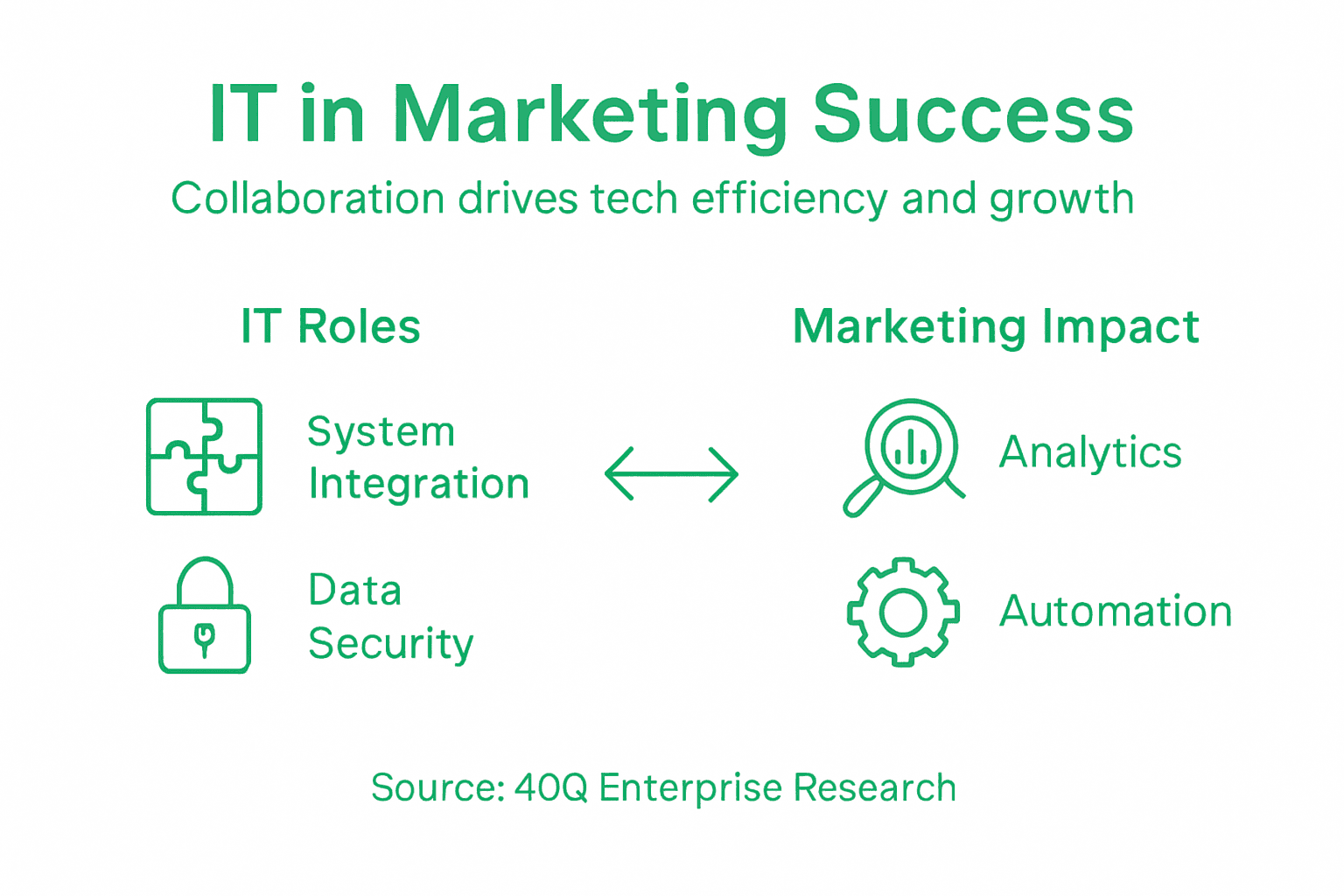
Information Technology (IT) has transformed marketing from a traditional function into a dynamic, data-driven strategic powerhouse. By leveraging digital technologies, IT enables marketing teams to reshape customer relationship management through advanced analytics, communication platforms, and integrated systems.
The evolving role of IT in marketing technology encompasses several critical dimensions:
- Strategic Technology Integration: Connecting marketing tools and platforms seamlessly
- Data Analytics and Insights: Transforming raw data into actionable marketing intelligence
- Security and Governance: Maintaining robust digital infrastructure and compliance standards
- Performance Optimization: Enhancing marketing technology ecosystem efficiency
IT’s strategic involvement goes beyond mere technical support. Modern organizations recognize that IT departments are pivotal in designing marketing technology architectures that enable rapid innovation while maintaining enterprise-grade security and scalability.
IT is no longer just a support function but a core enabler of marketing’s digital transformation strategy.
Marketers now depend on IT professionals to create flexible, intelligent technology ecosystems that can adapt quickly to changing market demands. This requires deep collaboration, shared objectives, and a mutual understanding of business goals.

Here’s a summary of how IT strengthens enterprise marketing technology:
| Strategic Role | Description | Business Impact |
|---|---|---|
| Tech Architecture | Designs scalable marketing systems | Enables rapid innovation |
| Data Intelligence | Builds analytics infrastructures | Informs smarter decisions |
| Security Leadership | Implements robust digital safeguards | Protects brand reputation |
| Collaboration | Fosters IT-marketing partnerships | Drives business agility |
Pro tip: Establish cross-functional workshops between IT and marketing teams to align technological capabilities with strategic marketing objectives.
Marketing Technology Landscape for Enterprises
The modern marketing technology landscape represents a complex ecosystem of interconnected digital tools and platforms that enable enterprises to transform digital marketing strategies. This dynamic technological environment has evolved far beyond traditional marketing approaches, integrating advanced capabilities across multiple domains.
Key components of the enterprise marketing technology landscape include:
- Artificial Intelligence (AI) Platforms: Enabling predictive analytics and personalized customer experiences
- Data Management Systems: Consolidating customer insights and marketing performance metrics
- Automation Tools: Streamlining repetitive marketing workflows and communication processes
- Customer Relationship Management (CRM) Solutions: Tracking and enhancing customer interactions
- Digital Experience Platforms: Creating seamless omnichannel engagement strategies
Enterprises are increasingly adopting sophisticated marketing technologies that support complex business objectives. These technologies go beyond simple communication tools, providing strategic intelligence that drives competitive advantage through data-driven decision-making.
Modern marketing technology is not just about tools, but about creating intelligent, adaptive ecosystems that respond dynamically to market changes.
The rapid evolution of digital platforms demands continuous investment in technological infrastructure. Successful organizations recognize that marketing technology is not a static investment but a constantly expanding strategic capability requiring ongoing refinement and integration.
Pro tip: Conduct quarterly technology audits to ensure your marketing technology stack remains aligned with emerging digital trends and organizational goals.
Stack Integration and Data Governance Essentials
Successful enterprise marketing technology strategies depend on robust stack integration and comprehensive data governance frameworks. Organizations can address technology stack challenges through strategic approaches that minimize complexity and maximize operational efficiency.
Key considerations for effective marketing technology stack integration include:
- Compatibility Assessment: Evaluating existing tools and potential integration points
- Middleware Solutions: Implementing integration platforms to connect disparate systems
- Data Standardization: Creating uniform data formats and protocols
- API Management: Ensuring seamless communication between different technology platforms
- Security Protocols: Maintaining robust protection across integrated systems
Data governance plays a critical role in maintaining the integrity and usefulness of marketing technology ecosystems. This involves establishing clear protocols for data collection, storage, sharing, and utilization across different organizational departments and technological platforms.
Effective data governance transforms fragmented information into a strategic organizational asset.
Enterprises must develop comprehensive strategies that balance technological flexibility with stringent data management practices. This requires ongoing collaboration between IT, marketing, and other key stakeholders to create adaptive, secure, and efficient technology infrastructures.
Pro tip: Develop a cross-functional data governance committee that meets quarterly to review and refine integration strategies and technological alignment.
Ensuring Security, Compliance, and Autonomy
Enterprise marketing technology demands a sophisticated approach to protecting consumer data privacy while maintaining organizational agility. Balancing technological innovation with ethical considerations requires a multifaceted strategy that addresses security, regulatory compliance, and individual user autonomy.
Key strategic dimensions for maintaining security and autonomy include:
- Data Protection Protocols: Implementing robust encryption and access controls
- Transparency Frameworks: Establishing clear communication about data usage
- Consent Management: Providing granular user control over personal information
- Regulatory Compliance: Adhering to regional and international data protection standards
- Ethical AI Governance: Developing responsible algorithmic decision-making processes
Modern enterprises must recognize that security is not merely a technical challenge but a comprehensive organizational responsibility. This requires continuous monitoring, adaptive security strategies, and a proactive approach to potential technological vulnerabilities.
Consumer trust is the most critical asset in the digital marketing ecosystem.
Successful organizations develop holistic approaches that integrate technological capabilities with ethical considerations, ensuring that marketing technology platforms remain both powerful and principled. This balance requires ongoing collaboration between IT, legal, marketing, and compliance teams.
Pro tip: Conduct biannual comprehensive privacy impact assessments to identify and mitigate potential data governance risks.
Common Challenges and Optimization Strategies
Enterprises face significant hurdles in developing effective marketing technology ecosystems, with martech stack fragmentation impeding growth strategies. Understanding and addressing these challenges requires a comprehensive, strategic approach that transforms marketing technology from a cost center into a dynamic growth engine.
Key optimization strategies for resolving marketing technology challenges include:
- Vendor Consolidation: Reducing technological complexity by streamlining tool ecosystems
- Data Integration: Eliminating information silos and creating unified data perspectives
- ROI Measurement: Developing clear metrics for technology investment effectiveness
- AI and Automation: Leveraging intelligent technologies to enhance operational efficiency
- Cross-Functional Collaboration: Fostering communication between marketing, IT, and technology teams
Successful marketing technology optimization demands more than technical solutions. Organizations must develop a holistic approach that aligns technological capabilities with strategic business objectives, ensuring that each technological investment delivers measurable value.
Marketing technology is not about implementing tools, but about creating an integrated, intelligent ecosystem.
Continuous evaluation and adaptation are critical. Enterprises must remain agile, regularly auditing their technology stack, removing redundant tools, and investing in solutions that provide genuine competitive advantages.
This table highlights common marketing technology stack challenges and recommended solutions:
| Challenge | Solution | Expected Result |
|---|---|---|
| Stack Fragmentation | Vendor consolidation | Simplified ecosystem |
| Data Silos | Unified data integration | Consistent insights |
| Poor ROI Visibility | Advanced measurement tools | Clear investment value |
| Security Gaps | Regular privacy assessments | Stronger data protection |
Pro tip: Implement a quarterly technology stack review process that systematically assesses tool performance, integration effectiveness, and alignment with organizational goals.
Empower Your Marketing Technology with 40Q’s Enterprise WordPress Solutions
The article highlights how IT-driven marketing technology demands seamless integration, robust security, and marketing autonomy for business agility and growth. If your organization struggles with maintaining control over marketing platforms while ensuring performance, scalability, and compliance, you are not alone. Key pain points include eliminating developer bottlenecks, enabling rapid campaign launches, and upholding data governance without compromising security.
At 40Q, we address these exact challenges by delivering enterprise-grade WordPress platforms tailored for high-traffic, content-heavy organizations. Our proprietary FAS Block System™ empowers your marketing teams to launch landing pages and localized content swiftly while giving IT full control over underlying performance and governance. This unique balance lets your enterprise innovate faster and secure digital assets effectively.
Explore how 40Q can transform your marketing technology ecosystem into an agile, secure, and autonomous powerhouse. Visit our homepage to learn more. Ready to optimize your tech stack with proven WordPress innovation? Contact us today to start building marketing platforms that truly serve both IT and Marketing. Discover enterprise solutions that meet the demands of modern marketing technology success at 40Q.
Frequently Asked Questions
Recommended

Nov 7, 2024
WordPress
Why Big Media Publishers Are Using WordPress

Feb 13, 2026
WordPress
Top 8 WordPress Solutions 2026 for Website Growth and Security

Apr 3, 2026
WordPress