
WordPress
Enterprise Web Governance: Ensuring Speed and Compliance

José Debuchy
February 9, 2026 | 3 min to read
Every CMO and Head of Digital Experience faces the pressure to balance rapid content deployment with rigorous security and compliance demands. The shift from traditional IT control to a comprehensive digital governance framework has made accountability, coordination, and trust essential in managing digital assets at scale. This article reveals how flexible, strategic web governance empowers enterprises to achieve both speed and control, keeping you ahead of regulatory and organizational challenges.
Key Takeaways
| Point | Details |
|---|---|
| Web Governance Transformed | Enterprise web governance now integrates strategic frameworks for managing digital assets, emphasizing speed, security, and compliance. |
| Accountability is Crucial | Clear roles and processes for digital content decisions are essential for maintaining organizational standards and regulatory compliance. |
| Choose the Right Governance Model | Selection of a governance model—centralized, decentralized, federated, or collaborative—should align with an organization’s size, regulatory needs, and digital strategy. |
| Address Common Challenges | Overcoming silos, resource constraints, and cultural resistance is vital for effective governance; fostering collaboration and commitment from leadership can enable success. |
What Enterprise Web Governance Means Today
Enterprise web governance has transformed from a technical compliance exercise to a strategic business framework. Modern organizations recognize that digital assets require sophisticated management approaches that balance speed, security, and strategic alignment. Digital governance mechanisms now encompass far more than traditional IT control systems.
At its core, enterprise web governance represents a comprehensive approach to managing an organization’s digital ecosystem. This framework includes multiple critical dimensions:
- Control mechanisms that define who can publish and modify digital content
- Coordination protocols ensuring consistent brand and regulatory compliance
- Trust frameworks that establish accountability and transparency
- Strategic alignment between technology infrastructure and business objectives
The contemporary definition of web governance extends beyond mere technical restrictions. Strategic regulatory frameworks now integrate decision rights, information management, and organizational strategy into a holistic digital architecture. Enterprises must create flexible yet robust systems that enable rapid content deployment without compromising security or regulatory requirements.
Accountability emerges as a central principle in modern web governance. Organizations need clear pathways that define:
- Who makes digital content decisions
- How content complies with internal and external standards
- What processes exist for reviewing and updating digital assets
- How performance and risk are continuously monitored
Pro tip: Develop a cross-functional web governance committee that includes representatives from IT, marketing, legal, and compliance departments to ensure comprehensive digital asset management.
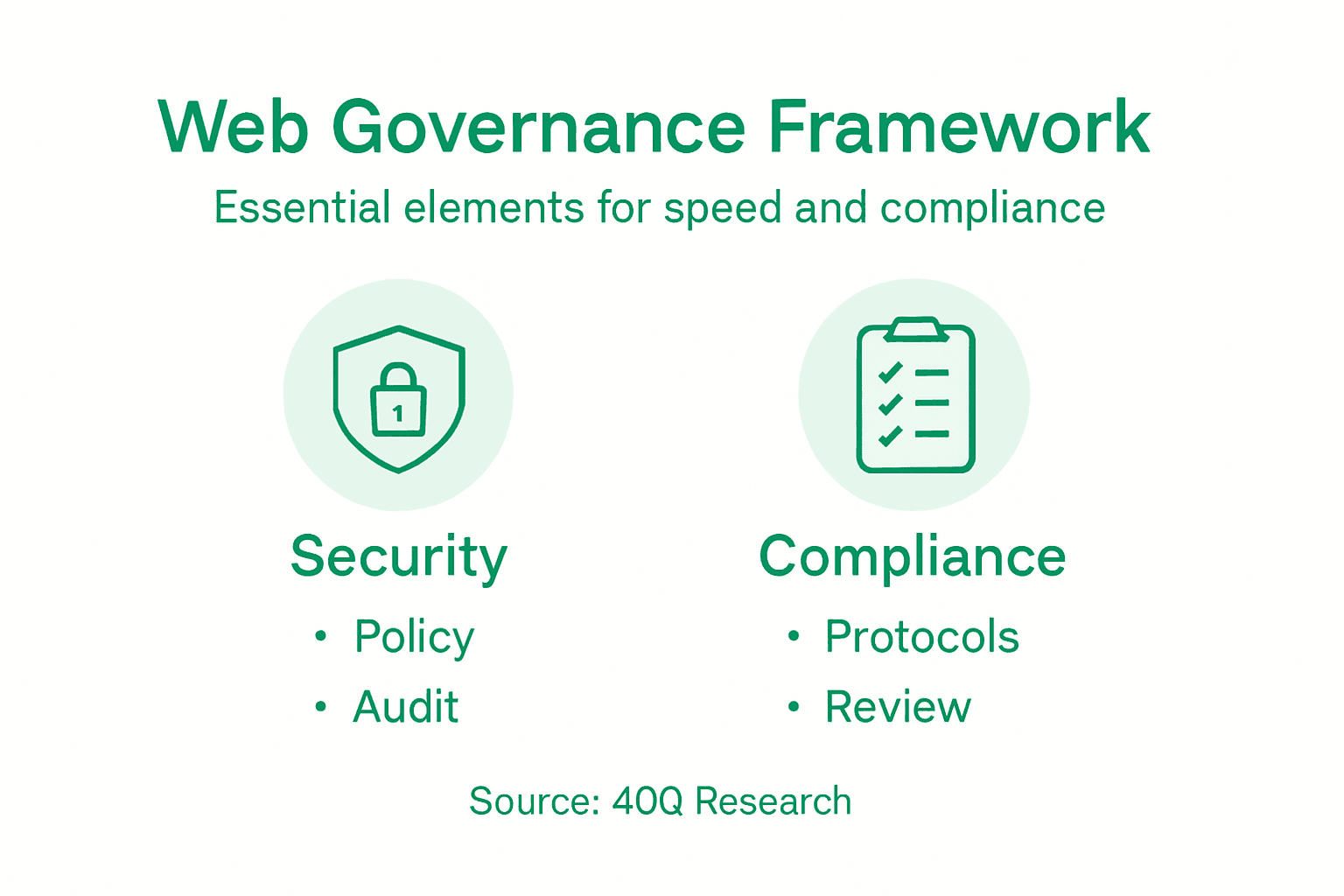
Key Components of Enterprise Web Governance
Enterprise web governance is a multifaceted discipline that requires strategic planning and comprehensive management across digital platforms. Key governance components represent the foundational elements that transform digital asset management from a technical exercise into a strategic business capability.
The core components of enterprise web governance can be categorized into several critical domains:
- Policy Framework: Establishing clear, comprehensive guidelines for digital content creation, publication, and management
- Accountability Mechanisms: Defining roles, responsibilities, and decision-making protocols
- Compliance Protocols: Ensuring alignment with internal standards and external regulatory requirements
- Risk Management: Identifying, assessing, and mitigating potential digital infrastructure vulnerabilities
Successful web governance demands a holistic approach that integrates multiple organizational perspectives. This requires breaking down traditional silos between departments and creating scalable governance frameworks that enable rapid decision-making while maintaining rigorous control standards.
The implementation of effective web governance involves several strategic considerations:
- Developing clear ownership structures
- Creating transparent decision-making processes
- Establishing continuous monitoring mechanisms
- Implementing adaptive compliance strategies
Pro tip: Conduct a quarterly cross-functional governance audit to ensure your web governance framework remains agile and responsive to evolving organizational needs.
Types of Web Governance Models
Web governance models have evolved to address the complex digital challenges facing modern enterprises. Enterprise website governance requires sophisticated frameworks that balance organizational control with technological flexibility.
The primary web governance models can be categorized into several distinct approaches:
- Centralized Governance Model: Concentrates decision-making authority in a single department, typically IT or digital strategy
- Decentralized Governance Model: Distributes digital management responsibilities across multiple organizational units
- Federated Governance Model: Creates a hybrid approach with central guidelines and distributed implementation
- Collaborative Governance Model: Emphasizes cross-functional cooperation and shared digital responsibility
Each governance model presents unique advantages and challenges for organizations. The centralized model provides tight control but can limit agility, while decentralized approaches enable faster content deployment but risk inconsistent standards. Security website development becomes particularly critical when selecting an appropriate governance framework.

Here’s a comparison of key enterprise web governance models and their organizational impacts:
| Governance Model | Main Advantage | Potential Challenge | Suitable For |
|---|---|---|---|
| Centralized | Tight content control | Slow decision-making | Large, regulated firms |
| Decentralized | Fast content deployment | Risk of inconsistent standards | Creative teams or agile orgs |
| Federated | Balance of control and flexibility | Complex coordination | Enterprises with multiple units |
| Collaborative | Shared accountability | Requires strong communication | Firms seeking cross-functional synergy |
The selection of a governance model depends on several key organizational factors:
- Organizational size and complexity
- Industry regulatory requirements
- Digital transformation maturity
- Technological infrastructure
- Content publishing frequency
Pro tip: Conduct a comprehensive organizational assessment to determine which governance model aligns most closely with your specific operational dynamics and strategic objectives.
Balancing Marketing Autonomy and IT Control
Balancing marketing autonomy with IT control represents a critical strategic challenge for modern enterprises. Business agility frameworks demonstrate that successful organizations create flexible governance mechanisms that empower marketing teams while maintaining robust technological oversight.
The tension between marketing autonomy and IT control manifests through several key dimensions:
- Content Creation Speed: Marketing needs rapid deployment capabilities
- Security Requirements: IT must protect organizational digital infrastructure
- Compliance Standards: Regulatory adherence cannot be compromised
- Technology Consistency: Standardized platforms ensure operational efficiency
Enterprise governance practices recommend establishing clear decision rights and collaborative frameworks that enable both departments to achieve their strategic objectives. This approach transforms potential conflict into a cooperative relationship focused on organizational success.
Effective autonomy and control integration requires implementing structured collaboration mechanisms:
- Develop shared governance committees
- Create transparent approval workflows
- Establish clear performance metrics
- Design flexible technological platforms
- Implement continuous communication protocols
Pro tip: Create a cross-functional governance team with equal representation from marketing and IT to develop mutually agreeable digital content and deployment standards.
Mitigating Risks: Security, Compliance, and Scalability
Enterprise web governance demands a comprehensive approach to managing digital risks across multiple dimensions. Enterprise security governance requires strategic frameworks that proactively address potential vulnerabilities while maintaining operational flexibility.
The critical risk mitigation strategies encompass multiple interconnected domains:
- Cybersecurity Protocols: Implementing robust defense mechanisms
- Regulatory Compliance: Ensuring adherence to industry-specific standards
- Access Control: Managing user permissions and authentication
- Data Protection: Safeguarding sensitive organizational information
Integrated risk management represents a holistic approach that combines governance, security, and operational resilience. Successful enterprises develop adaptive frameworks that can quickly respond to emerging technological and regulatory challenges while maintaining consistent performance standards.
Effective risk mitigation requires a multi-layered strategic approach:
- Conduct comprehensive risk assessments
- Develop dynamic security policies
- Implement continuous monitoring systems
- Create incident response protocols
- Establish regular compliance audits
Pro tip: Develop a cross-functional risk management team that combines expertise from IT security, legal compliance, and operational management to create a comprehensive and adaptable governance strategy.
Common Governance Challenges and Best Practices
Enterprise web governance presents complex challenges that require strategic, multifaceted approaches. Data governance best practices emphasize the critical importance of overcoming organizational barriers and creating adaptive frameworks.
The most prevalent governance challenges include:
- Organizational Silos: Disconnected departments limiting collaborative efforts
- Resource Constraints: Limited budgets and technological capabilities
- Cultural Resistance: Reluctance to adopt new governance methodologies
- Technological Complexity: Integrating diverse digital platforms and systems
Governance framework effectiveness depends on addressing these challenges through comprehensive strategies that prioritize stakeholder engagement and continuous improvement. Successful organizations develop flexible approaches that balance technological innovation with robust control mechanisms.
The following table summarizes common governance challenges and practical solutions:
| Challenge | Impact | Best Practice |
|---|---|---|
| Organizational Silos | Limits collaboration | Foster cross-department teams |
| Resource Constraints | Reduces implementation speed | Prioritize strategic initiatives |
| Cultural Resistance | Hampers adoption of new policies | Drive change with leadership support |
| Technological Complexity | Creates integration issues | Standardize digital infrastructure |
Implementing effective governance requires a structured approach:
- Secure executive leadership commitment
- Define clear roles and responsibilities
- Develop comprehensive policy frameworks
- Implement continuous monitoring systems
- Foster a culture of collaborative governance
Pro tip: Create a governance transformation roadmap with measurable milestones and regular review processes to ensure ongoing adaptation and organizational alignment.
Unlock Fast and Compliant Enterprise Web Governance with 40Q
Enterprise organizations face the critical challenge of balancing speed, marketing autonomy, and strict compliance as outlined in the discussion of Enterprise Web Governance: Ensuring Speed and Compliance. You need a solution that empowers marketing teams to publish content quickly without sacrificing IT control over security, scalability, and governance. 40Q understands these pain points and delivers a transformative approach using our proprietary FAS Block System™ built on WordPress VIP. This system eliminates developer bottlenecks while ensuring ongoing compliance and performance management.
Take control of your enterprise web governance today by partnering with 40Q to achieve seamless coordination between marketing and IT. Discover how we combine marketing autonomy with enterprise security to help you launch campaigns at pace without compromising compliance. Visit 40Q and explore how our solutions enable rapid, secure, and compliant digital content workflows. Your next step toward mastering enterprise web governance starts here at https://40q.agency.
Frequently Asked Questions
Recommended

Feb 3, 2026
WordPress
How to Secure WordPress for Enterprise-Grade Protection

Mar 13, 2026
WordPress
Why prioritize website security for WordPress in 2026

Feb 12, 2026
WordPress