
WordPress
Marketing compliance guide: tools, workflows, best practices

José Debuchy
April 14, 2026 | 3 min to read
TL;DR:
- Non-compliance risks in marketing can result in significant fines and legal penalties.
- Implementing automated tools and integrated workflows enhances approval speed and reduces violations.
- Proactive, embedded compliance strategies build trust, improve operational efficiency, and support growth.
Marketing compliance isn’t optional. One misstep, whether a missing disclosure or a mishandled data request, can trigger fines up to 4% of global revenue or $7,500 per violation under CCPA. For marketing leaders in medium to large organizations, the regulatory environment is growing more complex by the quarter. New mandates around AI-generated content, influencer disclosures, and cross-border data flows are reshaping what it means to run a compliant campaign. This guide breaks down the regulations you need to know, the tools that make compliance manageable, and the workflows that keep campaigns moving without legal exposure.
Key Takeaways
| Point | Details |
|---|---|
| Know your regulations | Understand which global, federal, and sector-specific rules apply to your marketing initiatives. |
| Use the right tools | Implement consent management, audit, and workflow platforms early to make compliance scalable. |
| Build compliance into workflows | Embed regulatory checks in campaign planning and execution, not just at final approval. |
| Measure and improve | Track approval times, violation rates, and audit outcomes to turn compliance into competitive advantage. |
Understanding the regulatory landscape for marketing compliance
Every digital marketing activity touches at least one regulatory framework. Understanding which laws apply to your campaigns is the first step toward building a defensible compliance posture.
FTC, GDPR, and CCPA/CPRA are the three pillars most marketing teams encounter. The FTC governs truth-in-advertising standards for US-based campaigns, requiring that claims be substantiated and endorsements be clearly disclosed. GDPR applies to any organization processing personal data of EU residents, regardless of where that organization is based. CCPA and its amendment, CPRA, protect California residents and impose data minimization, deletion rights, and opt-out requirements.
Beyond these three, sector-specific rules add another layer. Financial services teams must follow FINRA and SEC guidelines. Healthcare marketers operate under HIPAA. Pharmaceutical brands face FDA advertising restrictions. And as AI-generated content becomes mainstream, new transparency mandates are emerging across multiple jurisdictions.
A critical operational distinction: opt-in versus opt-out models differ significantly in how they affect campaign design. GDPR requires explicit, affirmative consent before data collection. CCPA allows data collection by default but requires a clear opt-out mechanism. That difference shapes everything from landing page design to email list management.
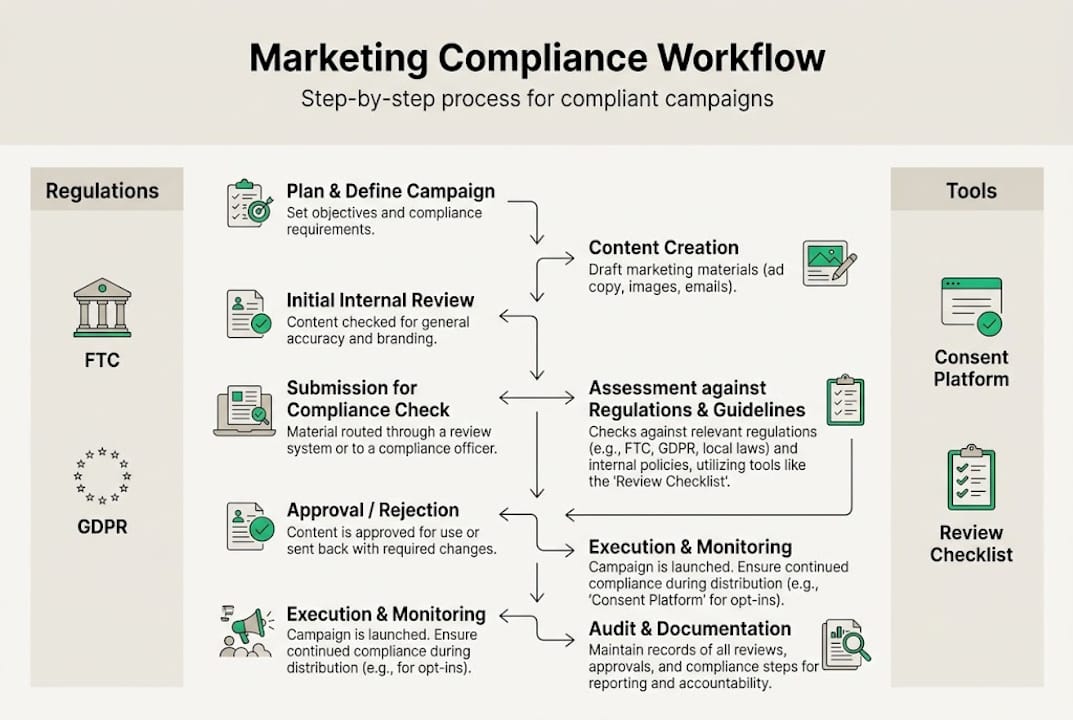
Here is a quick comparison of the major frameworks:
| Regulation | Region | Model | Key requirement |
|---|---|---|---|
| FTC | United States | Opt-out | Substantiated claims, clear disclosures |
| GDPR | European Union | Opt-in | Explicit consent before data collection |
| CCPA/CPRA | California, USA | Opt-out | Right to know, delete, and opt out |
| PIPEDA | Canada | Opt-in | Consent for collection and use |
Key requirements to track across all frameworks:
- Consent documentation: Record when, how, and what users agreed to.
- Data minimization: Collect only what is necessary for the stated purpose.
- Disclosure obligations: Label sponsored content, AI-generated material, and affiliate relationships.
- Right to erasure: Honor deletion requests within mandated timeframes.
- Cross-border transfer rules: Validate data transfer mechanisms for international campaigns.
Review a marketing compliance checklist to map these requirements against your current campaign types. Enforcement is accelerating. Regulators are no longer issuing warnings first.
Essential tools and resources for marketing compliance management
With the regulatory landscape mapped, the next step is equipping your team with the right technology and checklists.

Core compliance methodologies include data audits, consent management platforms, approval workflows, and ongoing training. No single tool covers all of these. Effective compliance programs layer multiple solutions.
Here is a breakdown of tool categories and their function:
| Tool category | Function | Best for |
|---|---|---|
| Consent management platforms | Capture and store user consent records | GDPR, CCPA compliance |
| Workflow automation tools | Route content through approval chains | Multi-stakeholder reviews |
| Audit trail software | Log all campaign changes with timestamps | Regulatory documentation |
| Dynamic checklist platforms | Adapt requirements by region and channel | International teams |
| AI compliance scanners | Flag non-compliant claims before launch | High-volume content teams |
Automated tools reduce human error. They enforce consistent review steps and generate documentation automatically. Manual tracking, by contrast, is faster to set up but prone to gaps, especially when teams are under deadline pressure. For organizations running campaigns across multiple regions, automation is not optional.
Sector-specific requirements also influence tool selection. A financial services firm needs tools that support FINRA record-keeping. A healthcare brand needs HIPAA-compliant data handling. Generic compliance software may not meet these standards.
The automation checklist for marketing compliance outlines how to structure tool integration across campaign types. For a broader view of how technology supports compliant digital experiences, the digital experience optimization guide covers enterprise-level implementation.
For teams adopting AI in content production, the AI marketing compliance resource provides a structured 90-day playbook for managing disclosure requirements and governance.
Pro Tip: Integrate compliance tools at the campaign planning stage, not after content is created. Retrofitting compliance into finished assets costs significantly more time and often requires full rework.
Key features to prioritize when evaluating tools:
- Real-time flagging of non-compliant claims
- Region-specific rule sets that update automatically
- Audit logs exportable for regulatory review
- Role-based access controls for legal and marketing teams
- Integration with your existing CMS and marketing stack
Building compliant marketing workflows: Step-by-step process
Once your toolbox is complete, operationalizing compliance means mapping it directly to campaign workflows.
Embed compliance early in campaign planning. Use dynamic checklists tailored to the specific region and industry for each campaign. Waiting until the review stage to check compliance creates bottlenecks and increases rework.
Here is a practical step-by-step process:
- Pre-campaign data audit: Verify that all data sources are consented, current, and permissioned for the intended use.
- Consent verification: Confirm opt-in or opt-out status for every audience segment before campaign activation.
- Stakeholder approval workflow: Route campaign assets through legal, compliance, and marketing operations for sign-off before launch.
- Evidence logging: Document every approval decision with timestamps, reviewer names, and version numbers.
- Version control: Maintain a full history of asset changes so any version can be retrieved for audit purposes.
- Post-launch monitoring: Track live campaigns for compliance drift, especially in dynamic or personalized content.
- Edge case escalation: Flag AI-generated content, influencer posts, and sector-specific claims for additional review before publication.
Cross-functional collaboration between marketing, legal, and compliance teams is essential. Compliance cannot be a legal department function alone. Marketing operations must own the process, with legal providing guardrails.
“Compliance embedded at step one is an enabler. Compliance added at step seven is a blocker.”
For teams building marketing autonomy workflows, the goal is to design approval chains that are fast without being permissive. The automated workflow setup guide covers how to configure these processes inside enterprise WordPress environments.
Pro Tip: Assign a compliance owner to each campaign, not just each channel. Ownership at the campaign level prevents gaps when assets span multiple platforms or regions.
Edge cases require specific protocols. AI-generated content needs disclosure review. Influencer content requires contractual compliance clauses and disclosure verification before posting. Sector-specific claims, such as health benefits or financial projections, need substantiation documentation attached to the approval record.
Measuring success: Compliance audits, KPIs, and continuous improvement
With workflows established, you’ll need to implement robust oversight and continuously refine your approach.
Compliant firms see faster approvals, less rework, and violation avoidance rates up to 92%. Those outcomes don’t happen by accident. They result from structured audit programs and clear performance metrics.
Key audit steps:
- Scheduled quarterly reviews: Assess all active campaigns against current regulatory requirements.
- Monthly spot checks: Randomly sample high-risk content categories such as AI-generated assets, influencer posts, and financial claims.
- Documentation audits: Verify that consent records, approval logs, and version histories are complete and retrievable.
- Vendor compliance reviews: Confirm that third-party partners and agencies meet your compliance standards.
- Policy update cycles: Revise internal guidelines whenever regulations change or new enforcement actions signal shifting priorities.
Top KPIs for marketing compliance programs:
| KPI | What it measures | Target benchmark |
|---|---|---|
| Approval cycle time | Speed from submission to launch | Reduce by 30% year over year |
| Violation count | Number of compliance errors per quarter | Zero tolerance goal |
| Rework rate | Percentage of assets requiring revision | Below 5% |
| Audit completion rate | Percentage of scheduled audits completed | 100% |
| Training completion | Staff completion of compliance training | 100% annually |
Regular audits, vendor vetting, and metrics tracking convert compliance from a cost center into operational trust. That trust has measurable business value. Customers and partners increasingly evaluate brands on their data practices.
Use audit results to drive tool and policy updates. If a particular content type consistently generates violations, that signals a gap in either training or tooling. Address it systematically, not case by case.
A free marketing autonomy audit can help identify where your current workflows create compliance risk and where automation can reduce manual review burden.
Why proactive compliance is your next strategic advantage
Most organizations treat compliance as a constraint. That framing is expensive.
Privacy regulations are viewed by some as bottlenecks, but by others as competitive advantages built on trust. The difference is not the regulation. It is the operational posture.
Teams that embed compliance from campaign inception launch faster. There is no last-minute legal review. No asset pulled from a live campaign. No emergency rework cycle. The upfront investment in structured workflows pays back in speed and predictability.
Compliance also builds brand equity. Consumers and B2B buyers are increasingly aware of data practices. A brand that demonstrates consistent, transparent data handling earns a level of trust that no advertising budget can replicate.
The marketing operations efficiency case for proactive compliance is straightforward: fewer violations, faster launches, lower legal costs, and stronger market positioning. That is not risk avoidance. That is a growth strategy.
Organizations that treat compliance as a strategic function, rather than a legal obligation, consistently outperform peers in campaign velocity and brand resilience. The investment is real. So is the return.
Ready to simplify your marketing compliance?
Marketing compliance at enterprise scale requires more than checklists. It requires integrated platforms, automated workflows, and governance structures that keep pace with regulatory change.
At 40Q, we build enterprise WordPress platforms that give marketing teams the autonomy to launch compliant campaigns without developer dependency. Our FAS Block System™ supports structured approval workflows, version control, and governance controls built directly into the publishing environment. Start with our marketing automation checklist to identify workflow gaps, or explore our AI solutions for compliance to see how intelligent automation can reduce review cycles and keep your campaigns audit-ready.
Frequently asked questions
Recommended

Mar 18, 2026
WordPress
Why scalable CMS is essential for enterprise success

Jan 4, 2024
WordPress
Revolutionizing Higher Education Marketing with WordPress

Nov 4, 2025
WordPress