WordPress
How to build a marketing autonomy workflow in WordPress

José Debuchy
April 11, 2026 | 3 min to read
TL;DR:
- Marketing autonomy allows teams to publish independently, speeding up campaign launches and reducing developer bottlenecks.
- Key tools include role-based access, modular block systems, AI assistance, and automated workflows within hybrid headless WordPress setups.
- Effective governance, continuous measurement, and organizational alignment are essential for sustaining autonomy benefits.
Developer bottlenecks are costing marketing teams real time and real revenue. 60% of enterprises report that reliance on developers slows campaign launches significantly. When every landing page, content update, or localized campaign requires a ticket in the dev queue, speed to market suffers. This guide walks you through the exact steps to build a marketing autonomy workflow in WordPress: from defining the right architecture and tools, to implementing governance, piloting your first autonomous campaign, and measuring ROI. No vague theory. Just a proven, actionable roadmap for enterprise marketing leaders ready to move faster.
Key Takeaways
| Point | Details |
|---|---|
| Accelerate campaigns | Autonomous workflows in WordPress can cut campaign launch times by up to 75%. |
| Empower teams | Enable marketing teams to independently publish and manage content without developer delays. |
| Mitigate risks | Implement strong governance, human review, and plugin control to avoid typical workflow pitfalls. |
| Boost ROI | Firms realize up to 29% more revenue and 50–70% more efficient developer resource usage. |
What is marketing autonomy and why does it matter?
Marketing autonomy in WordPress means your team controls publishing without waiting on developers for every update. It is the ability to create, edit, approve, and publish content independently, within guardrails that IT and compliance teams set in advance.
This is not about removing developers from the picture. It is about redefining their role. Developers build the system. Marketers operate it. That separation of concerns is what makes enterprise teams fast and reliable at the same time.
The architecture that makes this possible is hybrid headless WordPress. In this setup, WordPress handles content management and editorial workflows on the back end, while the front end is decoupled and served through a modern delivery layer. WordPress autonomy on hybrid headless setups gives teams the editorial freedom they need without exposing the platform to instability.
Key benefits of marketing autonomy for enterprise teams:
- Faster campaign launches, often measured in days instead of weeks
- Significant reduction in developer time spent on routine publishing tasks
- Greater content velocity across regions, brands, and languages
- Stronger alignment between marketing timelines and business goals
- Improved compliance through built-in governance and approval workflows
The adoption numbers reflect real momentum. According to our marketing autonomy guide, 36% of enterprises now use hybrid headless architectures, a figure that doubled in a single year. That growth signals a shift in how large organizations think about content infrastructure.
Stat to know: Organizations with mature autonomy workflows report 29% greater revenue impact compared to teams still operating through traditional developer-dependent models.
For marketing leaders, the business case is clear. Every day a campaign sits in the dev queue is a day of lost opportunity. Enterprise-grade WordPress empowerment is not a nice-to-have. It is a competitive requirement.
What you need: Core tools, architectures, and prerequisites
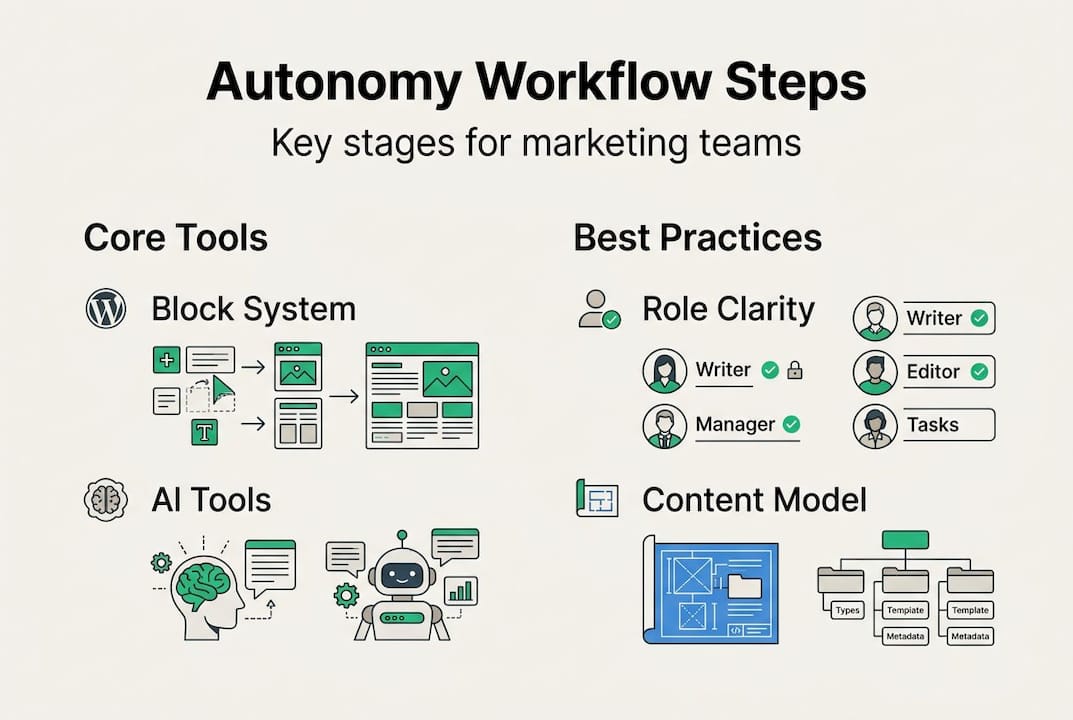
Building a marketing autonomy workflow requires more than a good CMS. You need the right combination of tools, roles, and planning structures before you write a single line of configuration.
Core tools and technologies:
- Block editor system: A modular block system (like the FAS Block System™) gives marketers drag-and-drop control over page layouts without touching code
- Role-based access control (RBAC): Defines who can create, edit, approve, and publish, keeping governance intact
- AI-assisted content creation: Speeds up drafting, localization, and optimization tasks; the WordPress AI Suite integrates directly into editorial workflows
- Workflow approval automation: Routes content through the right reviewers before anything goes live
- Compliance automation: Flags regulatory issues before publish, critical for regulated industries
Modular block systems, RBAC, AI-assisted tools, and workflow approvals are the core mechanics that make autonomy work at scale. Each one addresses a specific failure point in traditional publishing models.

Architecture overview:
| Component | Traditional WordPress | Hybrid Headless WordPress |
|---|---|---|
| Front-end delivery | Coupled to CMS | Decoupled, CDN-served |
| Editorial control | Developer-dependent | Marketing-controlled |
| Performance at scale | Variable | Optimized |
| Governance | Manual | Automated via RBAC |
Hybrid headless WordPress frameworks are preferred precisely because they balance speed, control, and usability. You get the editorial simplicity of WordPress with the performance and flexibility of a modern front-end stack. Explore headless WordPress benefits to assess fit for your organization.
Key roles to activate:
- Content lead: Owns editorial standards and publishing cadence
- Dev liaison: Bridges platform configuration and marketing needs
- Compliance reviewer: Ensures content meets regulatory requirements
- AI reviewer: Validates AI-generated content before it enters approval queues
Prerequisites before you start:
- A documented governance framework covering roles, permissions, and escalation paths
- A defined content model that maps content types to blocks and templates
- A change management plan to bring teams along through the transition
- WordPress multisite governance policies if managing multiple brands or regions
Pro Tip: Do not skip the content model. Teams that define their content types and block structures upfront cut implementation time by 30% or more and avoid costly rework later.
How to implement your marketing autonomy workflow step-by-step
With foundations in place, here is how to actually build and run the workflow. A staged implementation approach consistently outperforms trying to launch everything at once.
Stage 1: Governance first
- Define roles and permissions in your RBAC system. Map every content action to a role.
- Document escalation paths. Who approves what? What triggers a compliance review?
- Set content quotas and publishing windows to prevent uncontrolled volume spikes.
- Establish a change log process so every configuration update is tracked.
Stage 2: Technology enablement
- Configure your block system with approved templates and locked design elements.
- Integrate AI tools for drafting and localization, with human review checkpoints built in.
- Automate approval routing based on content type, region, and risk level.
- Connect compliance gates to the publish workflow so flagged content cannot go live without sign-off.
Stage 3: Pilot and refine
- Run one supervised campaign end-to-end using the new workflow.
- Measure time from brief to publish, developer touchpoints, and error rates.
- Debrief with the team. Adjust permissions, templates, and review steps based on real friction points.
Follow the content creation steps and governance best practices to keep each stage on track.
Staged vs. all-in-one implementation:
| Approach | Risk level | Time to value | Recommended for |
|---|---|---|---|
| Staged | Low | 6-12 weeks | Most enterprise teams |
| All-in-one | High | 2-4 weeks | Small, agile orgs only |
Pro Tip: Use AI for augmentation, not replacement. Teams that position AI as a drafting and localization assistant, with humans in the review loop, see higher content quality and fewer compliance incidents than teams that automate end-to-end without oversight.
How to verify success and manage common pitfalls
Implementation is just the beginning. Real value comes from consistent measurement and early detection of problems.
How to benchmark autonomy performance:
- Campaign velocity: Track time from brief to live publish before and after implementation
- Developer time redeployed: Measure hours freed from routine publishing tasks
- Revenue impact: Compare campaign performance against pre-autonomy baselines
- Cost reduction: Calculate savings from reduced agency dependency and faster iteration
The results from mature implementations are significant. Teams report 60-75% faster campaign launches, with 50-70% of developer time freed for higher-value work and a 29% lift in revenue impact. See developer time benchmarks for real-world reference points.
Warning signs to watch for:
- AI-generated content published without human review
- Plugin sprawl creating security and performance vulnerabilities
- Permission creep where roles expand beyond original governance design
- Server overload from unmanaged publishing volume
- Compliance gaps in regulated content categories
Over-reliance on AI, plugin sprawl, and server overload are the leading pitfalls in autonomy implementations. Most are preventable with the right governance structure in place from day one.
Mitigation steps:
- Build mandatory human review points into every AI-assisted workflow
- Use config-as-code to manage plugin and platform changes with version control
- Set publishing quotas per team and content type
- Implement compliance gates that block publish until required fields and approvals are complete
For regulated industries, compliance automation is non-negotiable. Map every content type to its regulatory requirements and encode those checks directly into the workflow. Explore AI workflow safety for enterprise-grade guardrails.
“The organizations that sustain autonomy gains are the ones that treat governance as a living system, not a one-time setup.”
A smarter take: Autonomy is a leadership and strategy issue, not just technology
Most autonomy projects fail not because the technology is wrong, but because the governance and organizational alignment are missing. Teams invest in block systems and AI tools, then wonder why campaigns still stall. The bottleneck shifted from the dev queue to unclear roles, inconsistent review processes, and lack of executive sponsorship.
Process and role clarity drive success more than platforms do. A well-governed team on a basic setup will outperform a poorly governed team on a sophisticated one every time.
Skipping governance creates tech debt fast. Permissions expand without oversight. Compliance exposure grows. Content quality drifts. The ROI from autonomy only materializes when governance is treated as a continuous investment, not a launch checkbox.
Smart leaders build autonomy as an ongoing capability. They revisit roles, permissions, and workflows quarterly. They treat governance as the force-multiplier that makes every technology investment pay off. That mindset is what separates organizations that sustain autonomy gains from those that regress within six months.
Next steps: Empower your team with proven autonomy solutions
You now have a clear picture of what marketing autonomy requires and how to build it. The next step is choosing the right platform and partners to make it real at enterprise scale.
40Q builds on WordPress VIP infrastructure, combining enterprise-grade performance with our proprietary FAS Block System™ to give marketing teams genuine publishing independence. Our WordPress AI Suite integrates AI-assisted drafting, localization, and compliance review directly into your editorial workflow. And our governance frameworks are designed for organizations where security, compliance, and scalability are non-negotiable. If you are ready to move from developer-dependent publishing to true enterprise-grade WordPress empowerment, let’s talk.
Frequently asked questions
Which WordPress architectures support true marketing autonomy at scale?
Hybrid headless WordPress frameworks are the preferred architecture for enterprise teams because they deliver the right balance of editorial control, scalability, and governance. They decouple the front end from the CMS without sacrificing the publishing experience marketers rely on.
How much faster can campaigns launch with autonomous workflows?
Marketing teams typically achieve 60-75% faster campaign launches, reducing time to market from weeks to as little as 2-5 days. That speed compounds over time as teams build confidence and refine their workflows.
What’s the biggest risk to avoid with marketing autonomy workflows?
Over-reliance on AI and plugin sprawl are the leading risks. Both are manageable with strict governance, mandatory human review checkpoints, and a controlled plugin approval process.
How should marketing teams measure success with autonomy workflows?
Track developer time redeployed, campaign launch speed, and revenue growth over a 3-6 month window. ROI tracking via velocity and revenue gives leadership a clear picture of what the investment is actually delivering.
Recommended

Oct 22, 2024
WordPress
What’s on Your MarTech Stack?
Aug 28, 2025
WordPress
MCP Made Simple: A Beginner’s Guide for Marketers and WordPress Teams

Apr 5, 2026
WordPress