
WordPress
Marketing autonomy: Boost enterprise ROI by 29%

José Debuchy
April 9, 2026 | 3 min to read
TL;DR:
- Enterprises with marketing autonomy see a 29% increase in revenue impact and faster AI compliance.
- Autonomous marketing empowers teams to launch and optimize campaigns quickly while maintaining governance.
- Building true autonomy requires strategic organizational design, governance frameworks, and cross-team alignment.
Enterprises that grant marketing teams genuine operational freedom see 29% greater revenue impact compared to those locked in IT-gated workflows. That’s not a marginal gain. It’s a structural advantage. Yet most large organizations still treat marketing autonomy as a convenience rather than a competitive priority. They assume tighter IT controls produce stronger outcomes. The data says otherwise. This guide breaks down what marketing autonomy actually means, what it delivers in measurable terms, and how to build it without sacrificing governance, security, or compliance.
Key Takeaways
| Point | Details |
|---|---|
| Boosts revenue & agility | Enterprise teams with marketing autonomy see faster growth and improved results. |
| Reduces IT bottlenecks | Self-serve content and automation tools free up both IT and marketing for higher impact work. |
| Requires smart governance | Proper oversight and compliance checks are essential for safe, scalable autonomy. |
| AI is a force multiplier | Agentic AI platforms orchestrate faster workflows but need cross-team collaboration to succeed. |
What is marketing autonomy in enterprises?
Let’s clarify what marketing autonomy actually means for enterprises and why it’s often misunderstood.
Marketing autonomy is the operational capacity for marketing teams to launch, optimize, and measure campaigns without waiting on IT for every change. It’s not about removing IT from the equation. It’s about redefining where IT involvement is necessary and where it isn’t.
In a traditional IT-gated model, a marketer who needs a new landing page submits a ticket. That ticket joins a queue. Development resources get allocated, reviewed, and deployed, often over days or weeks. By the time the page goes live, the campaign window may have passed. Autonomy flips this model. Marketing owns the execution layer. IT owns the infrastructure, security, and governance layer.
Traditional vs. autonomous marketing models
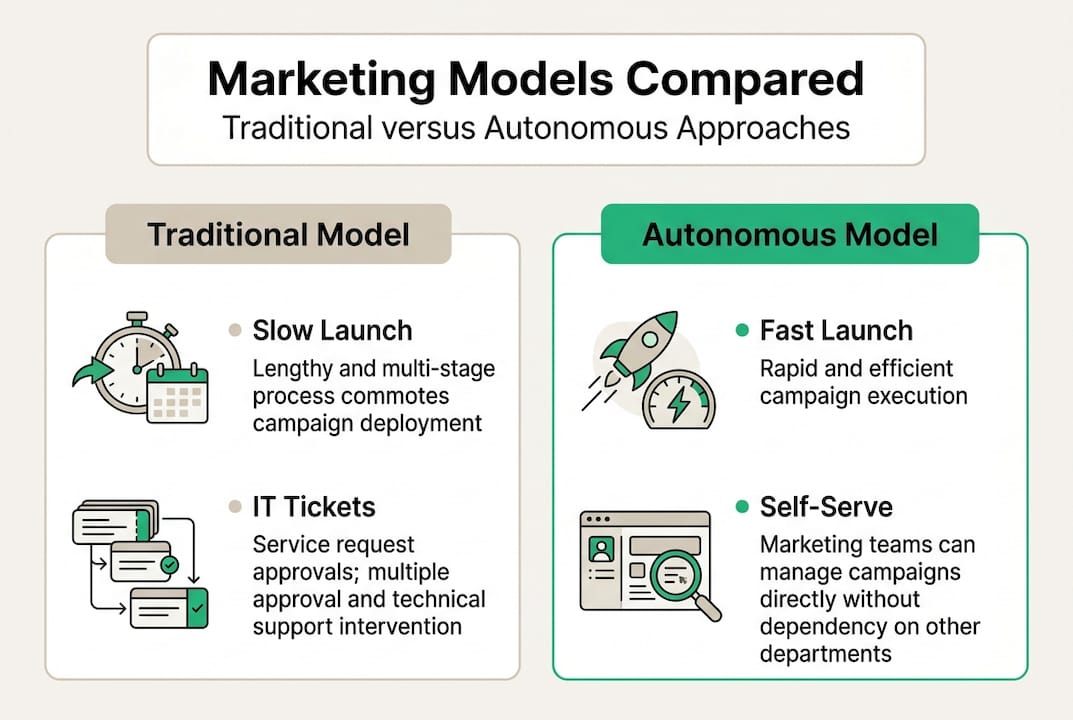
| Dimension | IT-gated model | Autonomous model |
|---|---|---|
| Page launch time | Days to weeks | Hours |
| IT ticket volume | High | Low |
| Campaign agility | Constrained | High |
| Governance control | Centralized in IT | Distributed with guardrails |
| Marketing innovation | Slow | Continuous |
The DORA report links autonomy to 30% higher organizational performance, specifically in organizations that build generative, trust-based cultures where teams have decision-making power. That’s a measurable outcome tied directly to how work gets structured.
Key elements of a functioning autonomous marketing system include:
- Self-serve content tools: Marketers can build, edit, and publish without code.
- Minimized approval bottlenecks: Workflows route only high-risk decisions to IT or legal.
- Real-time experimentation: Teams can run A/B tests, update copy, and swap assets without a release cycle.
- Defined autonomy boundaries: Clear rules on what marketing can and cannot change unilaterally.
Understanding why autonomy matters starts with recognizing that speed to market is no longer just a performance metric. It’s a revenue driver. Enterprises that can respond to market signals in hours, not weeks, hold a structural edge over slower competitors.
The business case: Results of marketing autonomy
With a clear definition in place, let’s look at what actually happens when enterprises grant autonomy and what the numbers say.
The revenue case is direct. Organizations adopting marketing autonomy see 29% greater revenue impact and achieve AI compliance 30 times faster than those operating under traditional IT-dependent models. These aren’t soft benefits. They show up in pipeline velocity, campaign output, and time to market.
Autonomous vs. IT-dependent enterprise outcomes
| Metric | IT-dependent | Autonomous |
|---|---|---|
| Revenue impact | Baseline | +29% |
| AI compliance speed | Baseline | 30x faster |
| Campaign launch time | Weeks | Hours |
| Marketing team burnout | High | Reduced |
| Innovation rate | Low | High |
The secondary benefits matter too. When marketing teams aren’t blocked by ticket queues, burnout drops. When they can test ideas quickly, innovation accelerates. When CMS and autonomy are aligned, content velocity increases across every channel.
“The organizations winning in 2026 aren’t the ones with the most IT resources. They’re the ones that have structured IT resources to enable, not gatekeep, marketing execution.”
Additional benefits enterprises report after implementing autonomy frameworks:
- Faster time to market across product launches and seasonal campaigns
- Reduced developer dependency for routine publishing tasks
- Higher marketing team retention due to reduced friction
- Improved cross-functional alignment between marketing and IT
Understanding the CMS role in autonomy is critical here. The platform layer determines how much autonomy is structurally possible. A rigid CMS that requires developer access for every content update is an autonomy ceiling, not a foundation.
Pro Tip: Use change management frameworks like ADKAR (Awareness, Desire, Knowledge, Ability, Reinforcement) when rolling out autonomy initiatives. Staff resistance is the most common implementation barrier, and it’s entirely addressable with structured communication and training.
How to build marketing autonomy: Systems, AI, and governance
Given these business outcomes, how do you operationalize marketing autonomy in complex, regulated environments?
The answer is a phased, governed approach. Phased implementation with governance, AI compliance tools, and enterprise CMS platforms built for self-service are the core mechanics. Rushing to full autonomy without guardrails creates risk. A staged rollout manages it.
Step-by-step roadmap:
- Assess bottlenecks. Map every point where marketing waits on IT. Quantify the delay and its business cost.
- Select platforms. Choose a CMS and AI suite designed for scalable enterprise content management. Headless or hybrid architectures give marketing flexibility while IT retains backend control.
- Set autonomy boundaries. Define what marketing can publish independently and what requires IT or legal review. Document this clearly.
- Train teams. Invest in enablement. Empowering content teams requires more than tool access. It requires workflow literacy and confidence.
- Monitor and audit. Build compliance checkpoints into the workflow. Automate where possible.
Traditional vs. AI-enabled content orchestration
| Capability | Traditional system | Agentic/AI-enabled system |
|---|---|---|
| Content scheduling | Manual | Automated with AI triggers |
| Compliance checks | Manual review | Real-time AI flagging |
| Personalization | Static templates | Dynamic, data-driven |
| Workflow routing | Ticket-based | Intelligent escalation |
The shift toward open, headless, AI-enabled CMS is not a trend. It’s the architecture that makes autonomous marketing structurally viable at scale. Agentic AI, meaning AI that can make decisions and trigger actions within defined parameters, is now central to how leading enterprises orchestrate content workflows.

Pro Tip: Pilot autonomy with a single business unit before enterprise-wide expansion. Choose a unit with a high content volume and low regulatory complexity. Use it to stress-test your governance model before scaling.
Overcoming risks: Compliance, oversight, and human alignment
Even with robust systems and governance, autonomy carries risks. Here’s how leading enterprises address them.
The most cited risks in autonomous marketing environments are AI hallucinations (where AI generates inaccurate or fabricated content), regulatory non-compliance, shadow IT (unauthorized tools adopted outside IT oversight), and cross-team misalignment. Each is manageable. None is a reason to avoid autonomy entirely.
AI risks like bias and hallucinations require human oversight built into the workflow, not bolted on after the fact. Regulated industries, including financial services, healthcare, and legal, need documented sign-off processes for AI-generated content before it goes live. This isn’t optional. It’s a compliance requirement.
Governance checklist for autonomous marketing environments:
- Human sign-off protocols: Define which content types require human review before publishing.
- Clear escalation paths: Document who gets notified when a compliance flag is triggered.
- Regular audits: Schedule quarterly reviews of AI outputs, content accuracy, and workflow adherence.
- Shadow IT controls: Enforce an approved tool list and monitor for unauthorized platform adoption.
- Cross-team alignment sessions: Hold monthly syncs between marketing, IT, legal, and compliance.
The shift to agentic AI in CMS and DXP platforms for content orchestration is accelerating, but Forrester notes it requires genuine cross-team alignment to function safely. IT, legal, and marketing must agree on the rules before agentic systems are given decision-making authority.
“Autonomy without oversight is chaos. Oversight without autonomy is paralysis. The goal is structured freedom.”
Enterprise teams that get this balance right move faster, publish more, and make fewer compliance errors than those operating under either extreme. The enterprise autonomy guide outlines how to structure this balance in practice.
Our take: Why true marketing autonomy will define the next decade
Most enterprises underinvest in autonomy. They implement self-serve tools at the surface level while leaving the underlying approval structures intact. The result is a system that looks autonomous but functions like the old model with a new interface.
The enterprises that get autonomy right don’t treat it as a tooling problem. They treat it as an organizational design problem. The technology is available. The governance frameworks exist. What’s missing in most cases is the executive commitment to restructure how IT and marketing share accountability.
Partial autonomy produces partial results. A marketing team that can edit copy but can’t launch a page without a ticket hasn’t gained meaningful speed. True autonomy means owning the full execution cycle within defined guardrails.
Our experience working with high-traffic, content-heavy enterprises shows that the teams outpacing their peers in agility and innovation are the ones that started bold pilot programs, learned fast, and scaled governance alongside capability. Not after it. The window for competitive differentiation through autonomy is open now. It won’t stay open indefinitely.
Ready to empower your enterprise marketing team?
If autonomy is the goal, the platform and process have to support it from day one.
40Q builds enterprise-grade WordPress platforms purpose-built for marketing autonomy. Our WordPress AI Suite integrates AI-assisted workflows directly into your content operations. Our enterprise WordPress empowerment tools give marketing teams full execution control while IT retains governance and security oversight. And if you’re looking to quantify the return before committing, our marketing automation checklist maps the ROI case clearly. Talk to our team to explore what a tailored autonomy implementation looks like for your organization.
Frequently asked questions
Recommended
- Marketing autonomy guide 2026: 29% revenue boost – 40Q
- What Is Marketing Autonomy? 60% Faster Enterprise Campaigns – 40Q
- Why marketing autonomy matters: boost speed and security – 40Q
- Marketing Autonomy Scorecard – Questionnaire – 40Q
- How automation transforms e-commerce response times | SuperSocial Blog

Apr 7, 2026
WordPress
10 proven landing page strategies for higher conversions

Oct 7, 2025
WordPress
How Global Brands Run on WordPress VIP

Mar 30, 2026
WordPress