
WordPress
Enterprise WordPress: Empowering Content and Compliance

José Debuchy
February 3, 2026 | 3 min to read
Managing digital content across global teams in the finance or healthcare sector often means juggling diverse requirements and tight compliance standards. Enterprise organizations like NASA have proven that WordPress can meet even the most rigorous regulatory and security demands while supporting extensive digital operations at scale. This article offers practical insights for leaders on enterprise WordPress as a centralized solution, highlighting critical features that enable efficient content delivery and robust governance for complex organizational environments.
Key Takeaways
| Point | Details |
|---|---|
| Enterprise WordPress as a Strategic Platform | Enterprise WordPress offers scalability and flexibility for complex organizational digital needs, enabling unified content management across various departments. |
| Key Features for Organizations | Essential features include multisite management, advanced security protocols, and seamless third-party integrations, supporting diverse organizational structures. |
| Implementation Models | Different implementation models, like headless and hybrid architectures, provide tailored solutions depending on organizational requirements and complexity. |
| Security and Compliance Focus | Robust security strategies, including granular access controls and compliance monitoring, are crucial for protecting sensitive information and meeting regulatory standards. |
Defining Enterprise WordPress for Organizations
Enterprise WordPress represents a strategic digital platform designed for complex organizational needs, transcending traditional content management systems. Large-scale enterprises leverage WordPress as a robust solution capable of supporting extensive digital operations across multiple departments and global regions.
At its core, enterprise WordPress transforms how organizations manage digital content by providing unprecedented scalability and flexibility. Key characteristics that distinguish enterprise WordPress include:
- Comprehensive multi-site capabilities
- Advanced user role and permission management
- Enterprise-grade security protocols
- Seamless third-party integrations
- Performance optimization for high-traffic environments
Modern enterprise organizations require a content management system that acts as a centralized hub, enabling unified digital experiences. WordPress serves as a content hub that allows teams to create content once and distribute it across multiple channels, breaking down traditional communication silos.

The platform’s adaptability means it can support diverse organizational structures, from marketing and product development to leadership and engineering teams. Its extensible architecture allows customization to meet specific departmental requirements while maintaining a consistent technological foundation.
Pro tip: When evaluating enterprise WordPress solutions, prioritize platforms offering robust governance features and scalable infrastructure to support your organization’s long-term digital strategy.
Core Features and Essential Capabilities
Enterprise WordPress platforms are distinguished by their comprehensive set of advanced features designed to meet complex organizational requirements. Key enterprise capabilities prioritize extensibility and scalability across global digital infrastructures, enabling businesses to create robust, adaptable web solutions.
Enterprise WordPress delivers a sophisticated technological framework with critical capabilities that address complex organizational needs:
- Robust multisite management
- Advanced content governance systems
- Enterprise-grade security frameworks
- Comprehensive user permission architectures
- High-performance content delivery networks
- Seamless third-party application integrations
The platform’s architecture supports intricate digital ecosystems by providing flexible customization options that can be tailored to specific departmental requirements. This adaptability allows organizations to build complex web infrastructures without sacrificing performance or user experience.
Enterprise WordPress transforms digital content management by offering unparalleled flexibility and scalability for complex organizational environments.
Technical capabilities extend beyond traditional content management, incorporating advanced features like granular access controls, sophisticated workflow management, and enterprise-level compliance tracking. These capabilities enable large organizations to maintain rigorous content standards while empowering diverse teams to collaborate effectively.
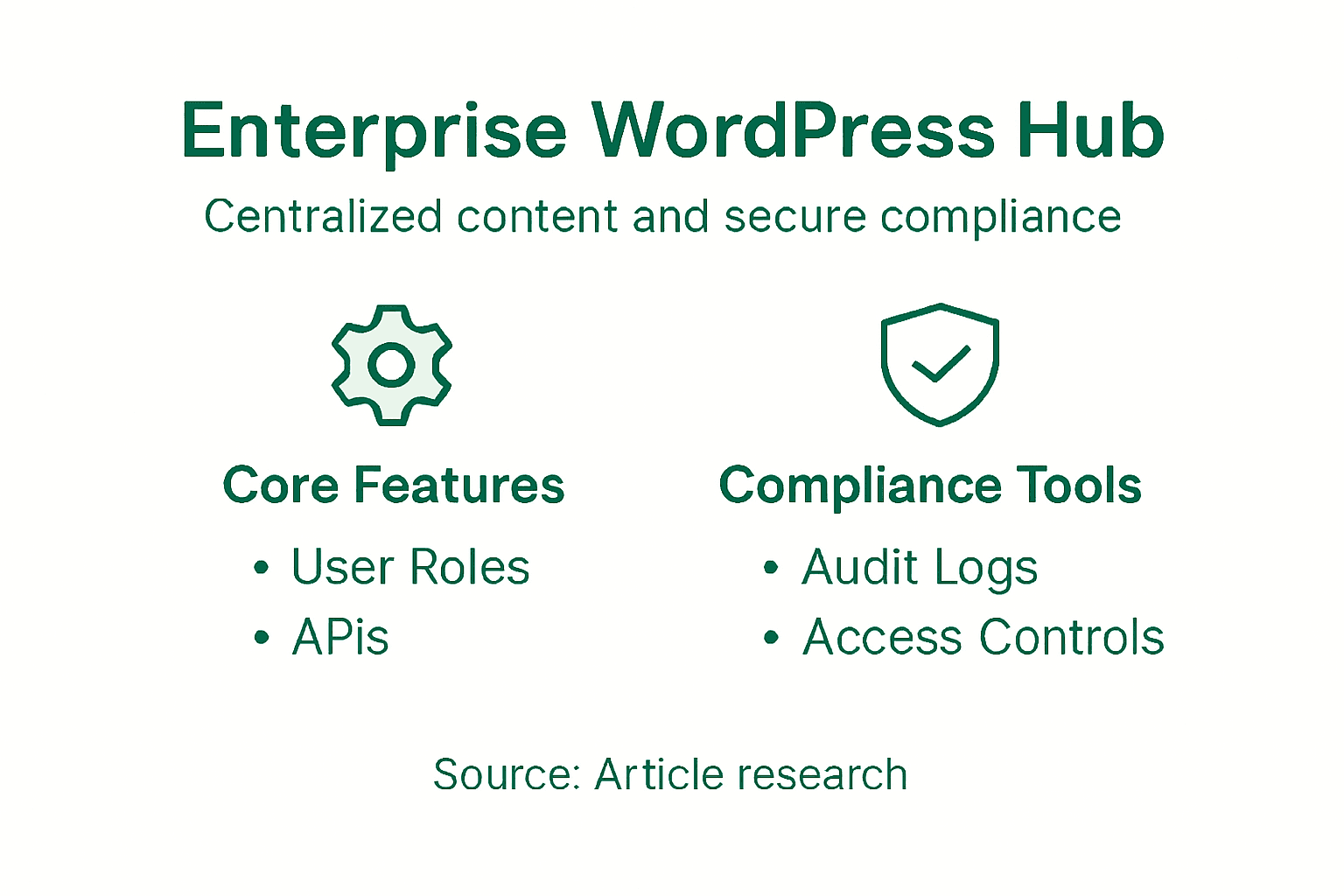
Pro tip: When implementing enterprise WordPress, prioritize platforms that offer robust API integrations and modular architectures to ensure long-term technological adaptability.
Variations and Implementation Models
Hybrid headless WordPress architectures are transforming how organizations approach digital content management, moving beyond traditional monolithic implementations. These advanced models provide unprecedented flexibility for enterprises seeking sophisticated digital experiences.
Enterprise WordPress deployment strategies encompass multiple implementation models:
- Traditional Monolithic WordPress
- Decoupled (Headless) WordPress
- Hybrid WordPress Architectures
- Multisite Network Configurations
- Microservice-Integrated Platforms
Each implementation model offers unique advantages tailored to specific organizational requirements. Traditional monolithic approaches provide straightforward content management, while decoupled architectures enable more complex front-end experiences through advanced API integrations.
Here is a comparison of common Enterprise WordPress implementation models and their ideal use cases:
| Model Type | Ideal For | Key Benefit |
|---|---|---|
| Monolithic WordPress | Standard sites with simple needs | Unified management and simplicity |
| Decoupled (Headless) | Highly custom front-ends | Flexible user experiences |
| Hybrid WordPress | Complex, multi-channel delivery | Shared content, diverse outputs |
| Microservice-Integrated | Organizations using many APIs | Easy third-party integrations |
| Multisite Network | Large setups with many sites | Centralized governance |
Enterprise WordPress implementation models are not one-size-fits-all solutions but strategic choices reflecting an organization’s technological maturity and digital objectives.
Hybrid approaches represent the most sophisticated implementation strategy, allowing organizations to leverage WordPress as a centralized content hub while maintaining independent front-end technologies. This model supports complex digital ecosystems by enabling seamless content distribution across multiple channels and platforms.
Pro tip: Evaluate your organization’s specific digital requirements carefully before selecting an implementation model, considering factors like scalability, integration complexity, and long-term technological flexibility.
Autonomy, Security, and Compliance Requirements
Enterprise WordPress security strategies represent a critical framework for organizations seeking robust digital governance. These comprehensive approaches address the complex intersection of technological autonomy, rigorous security protocols, and stringent regulatory compliance.
Enterprise WordPress security and compliance requirements encompass multiple critical dimensions:
- Granular user access controls
- Multi-factor authentication mechanisms
- Comprehensive audit logging
- Encryption of sensitive data
- Regular security vulnerability assessments
- Compliance tracking and reporting
- Role-based permission management
The platform’s architectural design enables organizations to implement sophisticated security frameworks that protect sensitive information while maintaining operational flexibility. Advanced permission structures allow precise control over content creation, modification, and distribution across complex organizational hierarchies.
Enterprise WordPress security is not about absolute lockdown, but about creating intelligent, adaptable protection strategies that evolve with organizational needs.
Rigorous compliance mechanisms go beyond traditional security measures, incorporating advanced monitoring and reporting capabilities. These systems enable organizations to demonstrate adherence to industry-specific regulatory requirements, from healthcare privacy standards to financial reporting regulations.
The following table summarizes critical enterprise WordPress security elements and their direct organizational impact:
| Security Element | Organizational Impact | Example Application |
|---|---|---|
| Granular Access Controls | Reduces risk of data leaks | Department-level restrictions |
| Encryption of Sensitive Data | Safeguards confidential information | Encrypted user data storage |
| Compliance Monitoring | Ensures regulatory adherence | HIPAA audit logs |
| Multi-factor Authentication | Strengthens account security | Admin dashboard login |
| Audit Logging | Provides accountability and traceability | Change monitoring |
Pro tip: Implement a comprehensive security governance framework that includes regular penetration testing, continuous monitoring, and adaptive access control policies.
Comparing Alternatives and Common Pitfalls
Enterprise CMS alternatives present complex challenges for organizations seeking scalable digital platforms. WordPress distinguishes itself through open-source flexibility and robust community support, offering a compelling alternative to proprietary content management systems.
Enterprise WordPress comparison reveals several critical considerations:
- Open-source adaptability vs. proprietary platform limitations
- Community-driven innovation versus vendor-controlled development
- Scalability and extensibility challenges
- Total cost of ownership
- Integration complexity
- Long-term technological sustainability
Comparative analysis of CMS platforms highlights several common enterprise implementation pitfalls that organizations must carefully navigate. These challenges often emerge from inadequate architectural planning, over-reliance on third-party page builders, and lack of standardized integration strategies.
Enterprise digital transformation is not about selecting the perfect platform, but about building adaptable technological ecosystems that can evolve with organizational needs.
Successful enterprise WordPress implementations require strategic governance, comprehensive architectural planning, and a nuanced understanding of organizational digital requirements. Enterprises must move beyond surface-level platform comparisons and focus on long-term technological adaptability and ecosystem integration.
Pro tip: Conduct a comprehensive digital ecosystem assessment before platform migration, evaluating not just technical capabilities but also long-term scalability and organizational alignment.
Unlock Enterprise WordPress Potential with 40Q
The article highlights real challenges enterprises face with WordPress such as maintaining marketing autonomy while ensuring stringent security and compliance. If your organization struggles to balance these needs alongside scalability and governance, 40Q provides tailored solutions. By implementing our proprietary FAS Block System™ on top of WordPress, we empower marketing teams to publish content quickly and independently without compromising on IT control over performance and security.
If your organization needs to balance marketing autonomy with security, compliance, and governance at scale, 40Q has built the infrastructure to make it work. As a certified WordPress VIP Partner, we help enterprise teams across the United States move away from rigid DXPs toward modern, open WordPress architectures. Learn more about our enterprise WordPress agency services and how we’ve done it for companies like Everest Group, Commvault, and ThreatModeler.
Ready to transform your digital content management with a platform designed for speed, security, and scalability? Visit 40Q Agency to learn how we can help your organization fully harness Enterprise WordPress capabilities while maintaining complete control over compliance and governance. Take the next step toward autonomous marketing and hassle-free publishing today.
Frequently Asked Questions
What is Enterprise WordPress?
Enterprise WordPress is a digital platform tailored for complex organizational needs, offering scalability, flexibility, and advanced features for extensive digital operations across multiple departments and regions.
How does Enterprise WordPress enhance content management?
Enterprise WordPress acts as a centralized content hub, allowing teams to create content once and distribute it across multiple channels, thereby breaking down communication silos and streamlining digital experiences.
What are the key security features of Enterprise WordPress?
Key security features include granular user access controls, multi-factor authentication, comprehensive audit logging, encryption of sensitive data, and regular security vulnerability assessments to ensure robust data protection and compliance.
What are the different implementation models of Enterprise WordPress?
Enterprise WordPress can be implemented in various models such as Traditional Monolithic, Decoupled (Headless), Hybrid Architectures, Multisite Networks, and Microservice-Integrated Platforms, each offering unique advantages tailored to specific organizational requirements.
Recommended

Apr 14, 2026
WordPress
Secure Content Publishing: A Guide for Enterprise WordPress

Apr 13, 2026
WordPress
Enterprise content workflows: streamline and scale with confidence

Nov 4, 2025
WordPress