
WordPress
Why Scalable Website Architecture Drives Growth

José Debuchy
February 7, 2026 | 3 min to read
Racing to keep WordPress content fresh and accessible for global audiences can feel impossible when security and compliance stand in the way. For marketing operations leaders navigating rapid publishing demands, scalable website architecture unlocks a way to adapt and grow without disrupting performance or risking sensitive data. This guide uncomplicates the principles of flexible infrastructure and reveals how smart architectural choices can transform content speed, scale, and operational safety for enterprise organizations.
Key Takeaways
| Point | Details |
|---|---|
| Scalable Architecture | A scalable website architecture is essential for handling increased demands without sacrificing performance or user experience. |
| Types of Scalability | Organizations should understand vertical and horizontal scaling to choose the best approach based on their needs and future goals. |
| Publishing Autonomy | Implementing scalable systems enables faster content deployment and empowers teams to manage workflows independently. |
| Security and Compliance | Robust security measures must be integrated into scalable architectures to protect data while maintaining operational efficiency. |
Defining Scalable Website Architecture
Scalable website architecture represents a strategic approach to designing digital platforms that can dynamically adapt and expand without compromising performance or user experience. At its core, this architectural model allows websites to efficiently handle increasing traffic, data volume, and computational demands while maintaining optimal functionality.
The fundamental characteristics of scalable web architecture include:
- Flexible infrastructure that can automatically adjust computing resources
- Modular design enabling independent component updates
- Distributed processing capabilities to manage complex computational tasks
- Load balancing mechanisms that distribute network traffic efficiently
- Decentralized data management strategies
According to cybersecurity research, secure cloud configurations play a critical role in creating robust scalable architectures. These configurations must support continuous availability, integrate seamlessly with enterprise systems, and maintain stringent security protocols.

Enterprise-grade scalable architectures go beyond simple horizontal expansion. They require intelligent design that anticipates potential bottlenecks, implements redundancy, and creates adaptable system boundaries. This means developing platforms that can dynamically allocate computational resources, distribute processing loads, and maintain consistent performance under variable demand.
Pro tip: Prioritize modular design principles and invest in infrastructure that can scale horizontally without requiring complete system redesigns.
Key Components and Types of Scalability
Scalable system design requires a comprehensive understanding of architectural strategies that enable dynamic growth and performance optimization. Scalability fundamentally represents an organization’s ability to expand computational capabilities without compromising system integrity or operational efficiency.
The primary types of scalability include:
- Vertical scaling: Adding more resources to a single machine
- Horizontal scaling: Distributing workloads across multiple machines
- Microservices architecture: Breaking complex applications into smaller, independent services
- Serverless architecture: Dynamically allocating computational resources based on demand
Highly scalable systems require strategic planning across multiple architectural dimensions. Key components essential to effective scalability involve performance bottleneck mitigation, resource utilization optimization, concurrency management, network efficiency, and intelligent data access strategies.
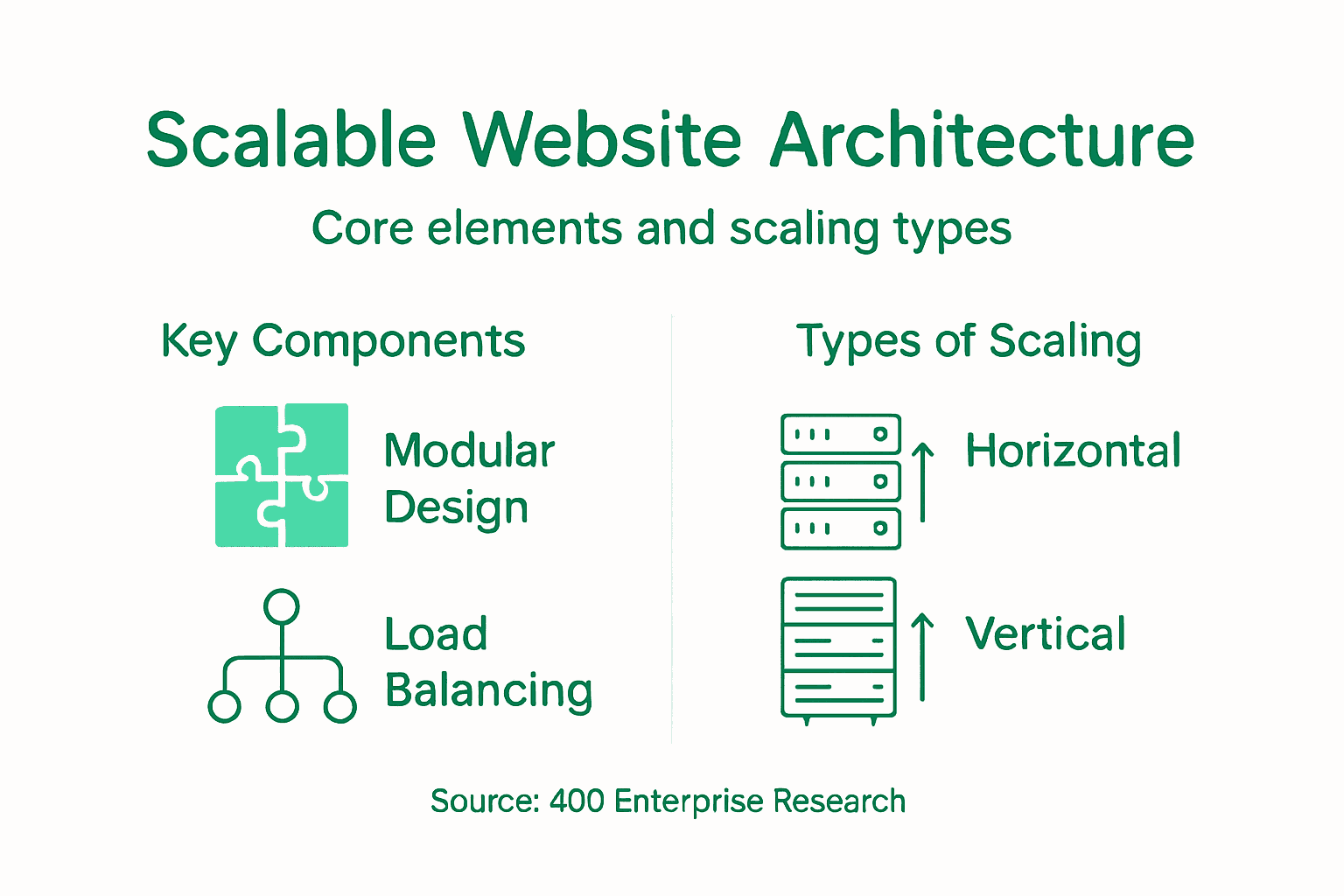
Enterprise organizations must carefully evaluate their specific technological requirements when selecting scalability approaches. Horizontal scaling offers greater flexibility by allowing incremental expansion, while vertical scaling provides immediate performance improvements through enhanced single-machine capabilities. The choice depends on specific computational demands, budget constraints, and long-term infrastructure goals.
Here’s a comparison of horizontal and vertical scalability approaches for enterprise environments:
| Aspect | Horizontal Scaling | Vertical Scaling |
|---|---|---|
| Resource Addition | Add more machines | Upgrade existing machine |
| Cost Efficiency | Incremental hardware expense | Large, upfront investments |
| Downtime | Minimal during scaling | Potentially high during upgrades |
| Long-Term Flexibility | High adaptability | Limited by hardware limits |
| Best Use Case | Rapid growth needs | Quick performance boost |
Pro tip: Design your scalable architecture with modularity and future growth potential as primary considerations, allowing seamless expansion without complete system redesigns.
How Scalability Enables Publishing Autonomy
Publishing autonomy represents a critical strategic advantage for modern organizations seeking to rapidly adapt and distribute content across diverse platforms. Content management increasingly demands flexible architectures that empower teams to create, modify, and publish materials without constant technical intervention.
Key aspects of publishing autonomy through scalable systems include:
- Rapid content deployment without infrastructure bottlenecks
- Decentralized publishing workflows that reduce dependency on technical teams
- Flexible content adaptation for multiple channels and audiences
- Dynamic resource allocation to manage varying content demands
- Independent content modification without system-wide disruptions
Curriculum flexibility and autonomy demonstrate how scalable architectures transform publishing processes. By creating modular, adaptable systems, organizations can independently customize content distribution, modify publishing strategies, and respond quickly to emerging market requirements without extensive technical reconfiguration.
Enterprise content teams require platforms that support granular control and seamless scaling. This means developing infrastructure that allows marketing, communications, and educational departments to launch campaigns, update materials, and distribute content across multiple regions without encountering technical constraints or requiring extensive developer support.
Summary: Key impacts of scalable architecture on publishing teams:
| Benefit | Impact on Teams | Long-Term Advantage |
|---|---|---|
| Faster deployment | Accelerates campaign launches | Outpaces market changes |
| Decentralized workflows | Reduces IT reliance | Empowers content creators |
| Flexible adaptation | Supports diverse audiences | Enhances global reach |
Pro tip: Select content management platforms that offer built-in scalability features, ensuring your publishing infrastructure can grow alongside your organizational needs.
Security, Compliance, and Performance Impacts
Scalable website architectures must balance technological performance with robust security protocols and regulatory compliance requirements. Enterprise platforms demand sophisticated strategies that protect sensitive data while maintaining system flexibility and operational efficiency.
Critical security considerations in scalable architectures include:
- Identity and access management controls
- Network segmentation strategies
- Encryption protocols for data protection
- Automated security deployment mechanisms
- Continuous threat monitoring capabilities
Cloud security mitigation strategies emphasize the importance of understanding shared responsibility models and implementing comprehensive security frameworks. Enterprise organizations must develop proactive approaches that integrate security controls directly into their architectural design, ensuring protection without compromising system performance or scalability.
Performance optimization in secure, scalable environments requires strategic resource allocation and intelligent design principles. This means implementing adaptive systems that can dynamically adjust computational resources, maintain high availability, and respond quickly to potential security threats without creating significant latency or disruption to core business operations.
Pro tip: Implement multi-layered security frameworks that provide granular control and adaptive protection mechanisms across your scalable infrastructure.
Risks of Neglecting Scalability in Enterprises
Neglecting scalability represents a critical strategic vulnerability that can dramatically undermine an organization’s technological resilience and competitive positioning. Enterprise infrastructure becomes increasingly fragile when architectural limitations prevent natural growth and adaptation to changing business requirements.
Primary risks associated with scalability neglect include:
- Operational performance degradation
- Increased cybersecurity vulnerabilities
- Reduced system responsiveness
- Higher infrastructure maintenance costs
- Limited technological innovation potential
Scalability challenges in enterprise systems highlight the computational overhead and inefficiencies that emerge when organizations fail to design flexible, expandable technological frameworks. These limitations can create significant barriers to implementing advanced technologies and responding dynamically to market changes.
Cybersecurity risks amplify exponentially when scalability is not strategically considered. Organizations become increasingly susceptible to data breaches, operational disruptions, and complex security vulnerabilities as their technological ecosystems grow without a coherent, adaptable architectural strategy. This creates potential points of failure that can compromise entire enterprise technology infrastructures.
Pro tip: Conduct regular scalability audits that assess your current infrastructure’s capacity to support anticipated growth and technological complexity.
Unlock Growth with Scalable Website Architecture Built for Enterprise Success
The article highlights common challenges like operational performance degradation and developer dependency that hinder growth in enterprise websites. If your marketing teams struggle to launch campaigns quickly because of rigid systems or constant IT bottlenecks, then scalable website architecture with modular design and autonomous publishing workflows is exactly what you need. Concepts such as horizontal scaling and dynamic resource allocation are critical for maintaining performance and security as traffic grows.
At 40Q, we specialize in building enterprise-grade WordPress platforms that directly address these pain points. Our proprietary FAS Block System™ empowers marketing teams to independently launch landing pages and localized content swiftly while IT retains full control over scalability and compliance. Designed for high-traffic organizations demanding speed to market without sacrificing reliability, our solutions turn the challenges of scalable architecture into your strongest advantage.
Explore how our platform aligns with your goal of marketing autonomy and robust scalability.
Ready to eliminate publishing bottlenecks and safeguard your enterprise growth? Visit 40Q now to learn how our scalable WordPress solutions can transform your content workflows and future-proof your digital presence.
Frequently Asked Questions
Recommended

Apr 16, 2026
WordPress
Top 3 Content Workflow Platforms 2026
May 28, 2025
WordPress
Beyond AEM: Smarter Digital Experience Strategies for Growth-Minded Teams

Apr 17, 2026
WordPress