
WordPress
AI’s real role in enterprise SEO strategy in 2026

José Debuchy
April 17, 2026 | 3 min to read
TL;DR:
- AI enhances technical SEO tasks but requires human review for quality, differentiation, and compliance.
- Pure AI-generated content risks penalties post-March 2026 unless augmented with human editing.
- Combining AI with human oversight and proprietary data creates resilient, high-performing enterprise SEO strategies.
The assumption that AI will replace SEO teams is widespread. It is also wrong. Enterprise marketing leaders are investing heavily in AI-powered tools for WordPress platforms, expecting full automation of SEO workflows. But the March 2026 Google algorithm updates changed the calculus significantly. Thin, AI-generated content took massive traffic hits, while teams that blended AI efficiency with human editorial judgment gained ground. This guide breaks down what AI actually does well, where it fails, and what a winning framework looks like for large organizations navigating content visibility in 2026.
Key Takeaways
| Point | Details |
|---|---|
| AI accelerates SEO tasks | AI automates audits, research, and technical fixes, helping scale enterprise SEO workflows effectively. |
| Human oversight is critical | Combining human editing with AI content boosts engagement and protects against search engine penalties. |
| Pure AI content risks penalties | Enterprises relying on unedited AI risk major traffic and ranking losses after 2026 updates. |
| Strategic collaboration wins | Success comes from frameworks where AI handles scale and humans guide quality and differentiation. |
| Focus on data-driven content | Unique, data-rich assets and diversified channels build SEO resilience in the age of AI. |
How AI transformed SEO: Evolution, enablers, and current challenges
AI entered enterprise SEO gradually, then all at once. Early tools automated meta tag generation and basic keyword tracking. By 2023, large language models were producing full articles at scale. By 2025, autonomous agents were running technical audits across tens of thousands of WordPress pages without human intervention. For high-traffic, content-heavy organizations, this velocity was transformative.
The core advantages are real. AI processes data at a volume no human team can match. It identifies optimization patterns across thousands of URLs, clusters keywords by intent, and flags technical errors before they compound. For enterprise WordPress SEO, this kind of scale matters. Marketing teams managing thousands of landing pages cannot manually audit every redirect chain or monitor every title tag variation.
But the 2026 updates exposed a critical flaw. AI’s influence on SEO tools has accelerated capability growth, but Google’s March 2026 core update drew a hard line. AI content without human editing suffers major penalties and traffic loss. Sites relying on synthetic, unreviewed content saw losses between 60% and 90% in organic visibility.
What changed after March 2026:
- Google’s ranking systems now detect content saturation and lack of differentiation
- Programmatic pages without unique data or expert context are demoted aggressively
- E-E-A-T signals (Experience, Expertise, Authoritativeness, Trustworthiness) carry heavier weight
- Engagement metrics like time-on-page and return visits are factored more directly
“The teams that survived the 2026 update did not use less AI. They used it more intelligently, with human editors treating AI output as a starting point rather than a final product.”
| Era | AI role | Human role | SEO outcome |
|---|---|---|---|
| Pre-2023 | Basic automation | Full editorial control | Stable |
| 2023 to 2025 | Content generation at scale | Minimal review | Mixed |
| 2026 onward | Draft creation, audits, analysis | Strategic oversight required | High risk without human layer |
How enterprise content teams are adopting AI tools in 2025 and 2026 reflects this shift. The most sophisticated organizations moved fast, then course-corrected. The lesson: AI without governance is an SEO liability, not an asset.
With the big picture established, let’s break down where AI shines and where it requires a human touch.
Where AI excels in enterprise SEO workflows
AI’s strongest contributions in enterprise SEO are process-oriented, not judgment-oriented. That distinction matters. When you deploy AI against repeatable, data-heavy tasks, it delivers measurable efficiency gains. When you ask it to produce authoritative, differentiated content without oversight, the results degrade quickly.
Here is where AI creates real value in enterprise SEO workflows:
- Technical auditing: AI scans large WordPress sites for crawl errors, broken internal links, duplicate content, and Core Web Vitals issues at scale
- Keyword clustering: AI groups thousands of keyword variants by semantic intent, reducing hours of manual analysis to minutes
- Competitor tracking: Automated monitoring of SERP changes, competitor content updates, and ranking shifts across dozens of keyword sets
- Content briefs: AI generates structured outlines, recommended headings, and semantic keyword lists for writers to build from
- Internal link suggestions: AI identifies link opportunities across large content libraries that human editors would miss
AI strategies for WordPress have matured significantly. AI excels at scale, particularly through autonomous agents managing large WordPress environments with thousands of indexed pages.

Content-related tasks still require human judgment. AI can generate a usable first draft, but it cannot inject proprietary data, firsthand experience, or brand-specific perspective. Those elements are what Google’s 2026 systems reward.
Statistic callout: Organizations using AI for technical SEO tasks report 40% to 60% reductions in audit completion time, but content quality scores only improve when human editors are actively involved in the review cycle.
Pro Tip: Use AI tools to triage and prioritize technical issues by estimated traffic impact. This lets your SEO team concentrate on high-value fixes rather than working through an undifferentiated backlog.
Now that you’ve seen the broad changes, let’s get tactical about where AI makes the most difference in everyday enterprise SEO.
Where pure AI fails: Content quality, E-E-A-T, and compliance issues
The risks of leaning too heavily on AI are not theoretical. The March 2026 update made them quantifiable. Google demotes thin, synthetic content that lacks differentiation, and enterprise sites running scaled programmatic pages without editorial review paid a steep price.
| Factor | Pure AI content | AI + human editorial |
|---|---|---|
| Content uniqueness | Low | High |
| E-E-A-T signals | Weak | Strong |
| Compliance accuracy | Unreliable | Reviewed and verified |
| Penalty risk | High | Low |
| Engagement metrics | Below average | Significantly higher |
| Brand voice consistency | Inconsistent | Controlled |
Pure AI content fails on several specific dimensions. It lacks unique data. It cannot reference proprietary research, internal case studies, or firsthand industry experience. It generates generic tone that blurs brand differentiation. For enterprise organizations operating in regulated industries, it also introduces compliance risk. AI may produce content that is factually incomplete, legally imprecise, or inconsistent with regional regulatory requirements.
“Scaled programmatic SEO without human editing does not just underperform. It actively triggers algorithmic demotion under the 2026 framework.”
Here is what marketing leaders must require before publishing AI-generated content:
- Human editorial review: Every piece must be reviewed by a subject matter expert or senior editor
- Unique data integration: Add proprietary stats, client examples, or original research before publishing
- Brand voice alignment: Ensure tone, vocabulary, and messaging match established brand guidelines
- Compliance check: Validate claims against regulatory requirements relevant to the market
- E-E-A-T reinforcement: Include author credentials, firsthand experience signals, and authoritative citations
- Engagement optimization: Review for readability, logical flow, and a clear call to action
For teams managing SEO content optimization on WordPress, this checklist is non-negotiable post-2026. And for enterprise content creation at scale, it means building editorial review into the production pipeline, not treating it as an optional step.
But what’s the risk if you lean too heavily on AI? Here’s where pure automation runs into real problems.
AI and human collaboration: A winning framework for resilient SEO
The solution is not to abandon AI. It is to architect smart collaboration. Leading enterprise teams are structuring workflows that assign AI to the tasks it performs well, while keeping humans in control of judgment-dependent decisions.
Combining human edits with AI output increases time-on-page by 2.3x and improves rankings by 3.5x compared to pure AI content. That is not a marginal improvement. It is a structural advantage.
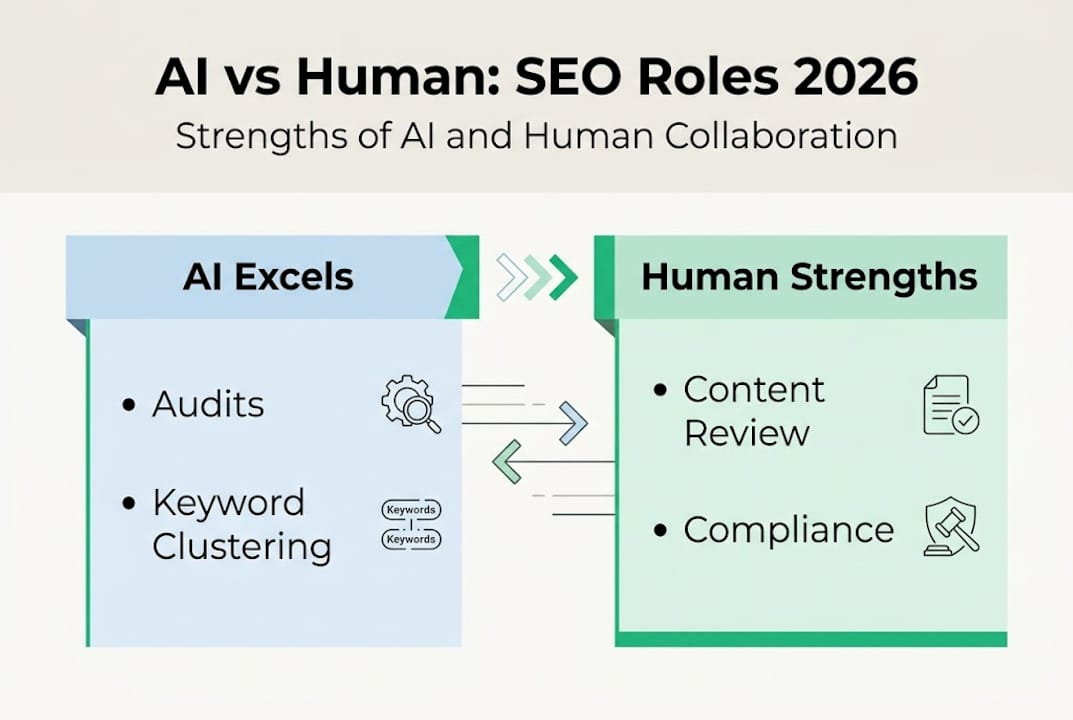
| Workflow stage | AI role | Human role |
|---|---|---|
| Research and keyword analysis | Full automation | Strategy and prioritization |
| Content brief creation | AI-generated outline | Editorial refinement |
| First draft | AI-produced | Human rewrite and enrichment |
| Technical audit | Automated scan | Review and triage |
| Compliance and brand review | Flagging only | Final decision and approval |
| Publishing and monitoring | Scheduled automation | Performance review |
Best practices for keeping AI content differentiated and algorithm-proof:
- Always add a layer of proprietary data or firsthand insight before publishing
- Assign each piece of content to a named expert for E-E-A-T signal reinforcement
- Use AI outputs as structured drafts, not finished products
- Build editorial checkpoints into content management workflows on WordPress
- Monitor engagement metrics post-publish and trigger human review when time-on-page drops
WordPress AI integration at the platform level supports this model. When AI tools are embedded into the CMS workflow rather than used externally, editorial checkpoints become natural stages in the publishing process rather than afterthoughts.
Pro Tip: Train your editorial team to treat AI drafts the way a film editor treats raw footage. The material is there. The craft is in the selection, sequencing, and shaping.
For teams exploring advanced AI for SEO, the framework above is a reliable starting point. Adapt the human checkpoints to match your organization’s compliance requirements and editorial capacity.
Why the future of SEO is differentiated data—not just smarter AI
Most enterprise leaders are focused on finding a better AI tool. That is the wrong frame. The organizations that came out ahead after March 2026 were not using superior software. They were publishing content that AI simply could not replicate: proprietary research, original analysis, expert perspective, and real user data.
Post-2026, differentiated content and diversification beyond Google are the real drivers of SEO resilience. Chasing the latest model upgrade while producing generic content is a losing strategy.
Content saturation is the real threat. When every organization uses the same AI tools and the same prompts, the output converges. Google’s systems are built to detect and demote that convergence. The competitive edge belongs to teams that bring something unique to every piece of content they publish.
For enterprise marketing leaders, the implication is structural. Invest in your data infrastructure. Build systems that capture proprietary insights. Diversify your SEO strategy across search channels, not just Google. The 2026 updates were a correction, not a ceiling. The next round will reward the organizations that built defensible, human-enriched content assets rather than volume-based AI pipelines.
Elevate your enterprise SEO with WordPress AI solutions
The strategies in this guide require the right platform foundation. Implementing AI-human collaboration workflows at enterprise scale is significantly easier when your WordPress environment is built for it.
40Q’s WordPress AI Suite gives marketing teams the tools to deploy AI-assisted content workflows without sacrificing editorial control or governance. Our advanced search capabilities are built for high-traffic, content-heavy organizations that need to compete at scale. Whether you are building out a new AI integration or hardening an existing enterprise content strategy, our enterprise-grade WordPress services are designed to support exactly this kind of resilient, future-proof approach. Reach out to explore what a structured AI-human workflow looks like on your platform.
Frequently asked questions
Recommended
Jan 15, 2026
WordPress
Why Choose Headless WordPress for Enterprise Autonomy

Mar 8, 2026
WordPress
Landing page optimization tips for enterprises on WordPress 2026

Mar 23, 2026
WordPress