
WordPress
Unified content platforms drive marketing autonomy in 2026

José Debuchy
March 9, 2026 | 3 min to read
Enterprises using unified content platforms report 53% faster content production compared to fragmented systems. Marketing and IT leaders face mounting pressure to balance speed with security, autonomy with governance, and innovation with compliance. This guide clarifies how unified content platforms resolve these tensions by consolidating tools, automating workflows, and enabling real-time collaboration while maintaining enterprise-grade security and IT control.
Key takeaways
| Point | Details |
|---|---|
| Marketing autonomy accelerates campaigns | Unified platforms reduce developer dependency by 60%, enabling marketing teams to launch content independently. |
| Enterprise security remains centralized | IT retains full governance through permissions, audit trails, and compliance controls. |
| Workflow efficiency improves dramatically | Tool consolidation and automation cut repetitive tasks by 40% while speeding collaboration. |
| Fragmented systems create bottlenecks | Legacy approaches suffer from inconsistent content, security gaps, and higher operational costs. |
| Implementation requires strategic alignment | Success depends on cross-functional collaboration between marketing and IT from assessment to rollout. |
Introduction to unified content platforms
Unified content platforms integrate content creation, management, and distribution into a single ecosystem that balances marketing autonomy with IT governance. These systems consolidate previously disconnected tools into one interface, enabling teams to create, approve, publish, and analyze content without switching between applications or waiting for developer support.
Core functions include modular content components that marketing teams assemble independently, automated workflow routing that accelerates approvals, real-time collaboration features that connect distributed teams, and centralized security controls that maintain compliance. Organizations adopt these platforms to eliminate the friction caused by fragmented content systems where marketing waits days for simple updates while IT struggles to maintain security across dozens of disconnected tools.
The collaboration challenge stems from conflicting priorities. Marketing demands speed and flexibility to respond to market changes, test campaigns, and personalize experiences. IT requires stability, security, and governance to protect data, ensure uptime, and meet regulatory requirements. Traditional systems force teams to choose between these goals.
Unified platforms resolve this tension through The Unified Content Platform Triad: marketing autonomy through modular components, enterprise security through centralized governance, and workflow efficiency through automation. This framework ensures both teams achieve their objectives simultaneously rather than compromising. Organizations that implement this approach see measurable improvements in digital experience delivery and operational performance.
Unified content platforms accelerate workflow efficiency by consolidating tools, automating repetitive tasks, and enabling real-time collaboration across distributed teams. The result is faster time to market, reduced operational costs, and improved content consistency. When implemented correctly, these systems deliver enterprise-grade CMS benefits without sacrificing the control IT needs to protect organizational assets.

How unified platforms improve marketing autonomy
Marketing autonomy means teams can execute campaigns, launch landing pages, and update content without developer intervention. Unified platforms achieve this through reusable content blocks that non-technical users assemble like building blocks. A marketing manager can construct a product launch page by selecting pre-approved components for hero sections, testimonials, pricing tables, and CTAs without writing code or submitting IT tickets.
This approach reduces developer dependency by 60% in typical implementations. Teams that previously waited three days for simple homepage updates now make changes in minutes. Campaign iteration cycles shrink from weeks to hours, enabling rapid A/B testing and personalization at scale. Marketing gains the agility to respond to competitive moves, seasonal trends, and customer feedback in real time.
Real-world outcomes demonstrate the impact. Organizations report 40% faster campaign launches, 35% more content published per quarter, and 50% reduction in change request backlogs. Marketing teams spend less time in approval queues and more time optimizing performance, analyzing results, and refining strategy.
Autonomy does not mean chaos. IT establishes governance guardrails by controlling which components marketing can use, defining brand standards within modular blocks, setting permission levels for different user roles, and maintaining approval workflows for sensitive content. Marketing operates independently within these boundaries, preserving compliance while gaining speed. Teams using modern CMS platforms find this balance transforms their operational efficiency.
Pro Tip: Embed reusable content blocks for common elements like testimonials, pricing tables, and CTAs to ensure brand consistency while maximizing marketing speed. This approach reduces errors and accelerates production simultaneously.
The marketing autonomy model proves especially valuable for organizations managing multiple brands, regional sites, or high-volume content operations. Teams can localize campaigns for different markets, test variations across segments, and scale successful approaches without proportionally increasing IT workload. Organizations migrating from legacy platforms like Drupal often cite autonomy gains as the primary driver for change. The 2026 marketing autonomy landscape shows this trend accelerating as competitive pressure demands faster execution.
Enterprise-grade security and governance
Unified platforms maintain enterprise security through centralized controls that IT manages while marketing operates independently. Fine-grained permission systems define exactly what each user can access, edit, publish, and delete based on role, department, geography, or content type. A regional marketing manager might create landing pages for their territory but cannot modify global brand guidelines or access financial data.
Audit trails record every action taken within the platform, creating compliance documentation automatically. Who changed what content, when they made the change, what the previous version contained, and whether required approvals were obtained all become part of a permanent, searchable record. This transparency satisfies regulatory requirements in industries like healthcare, finance, and government where content changes must be traceable.
Compliance extends beyond access control to include data residency requirements, encryption standards, backup procedures, and disaster recovery protocols. Organizations subject to GDPR, HIPAA, or SOC 2 requirements configure unified platforms to enforce these standards automatically rather than relying on manual processes prone to human error.
IT retains control over infrastructure, security updates, integration points, and system architecture while marketing manages day-to-day content operations. This separation of concerns prevents security vulnerabilities common in fragmented systems where marketing teams install unauthorized plugins, create shadow IT solutions, or circumvent security protocols to work around bottlenecks. Scalable web publishing requires this level of governance to maintain performance under high traffic while preventing breaches.
The IT governance role evolves from gatekeeper to enabler. Instead of approving individual content changes, IT establishes the framework within which marketing operates safely. This shift reduces IT workload while improving security posture because controls are systematic rather than ad hoc.
Workflow efficiency and developer dependency reduction
Tool consolidation eliminates the complexity of managing separate systems for content creation, digital asset management, analytics, personalization, and distribution. Teams that previously toggled between five applications to publish a single campaign now work within one interface. Training time drops, context-switching overhead disappears, and new team members become productive faster.
Automation handles repetitive tasks that previously consumed hours of manual effort. Content automatically routes to appropriate approvers based on type and sensitivity, images resize for different devices and channels without designer intervention, metadata populates from predefined templates, and publication schedules execute without human monitoring. These efficiency gains compound across thousands of content pieces annually.
Real-time collaboration features connect distributed teams through shared workspaces, inline commenting, version control, and notification systems. A content creator in New York, legal reviewer in London, and regional manager in Singapore can review and approve campaign materials simultaneously rather than waiting for sequential handoffs across time zones.
AI-assisted workflows take efficiency further by suggesting content improvements, personalizing experiences based on user behavior, automating image selection, and optimizing headlines for engagement. Organizations using WordPress AI tools report 30% reduction in content production time and 25% improvement in performance metrics. AI-assisted content workflows reduce manual curation and personalize delivery at scale, transforming how teams operate.
| Metric | Traditional Systems | Unified Platforms | Improvement |
|---|---|---|---|
| Campaign launch time | 12 days | 5 days | 58% faster |
| Developer tickets per month | 47 | 18 | 62% reduction |
| Tools required | 6-8 | 1-2 | 75% consolidation |
| Training time for new users | 3 weeks | 1 week | 67% faster onboarding |
| Content consistency errors | 23% | 6% | 74% improvement |
Pro Tip: Integrate native AI tools rather than third-party solutions to maximize operational gains and avoid integration complexity that erodes efficiency benefits.
The workflow improvements extend beyond marketing to benefit IT teams as well. Fewer support tickets, reduced system maintenance overhead, simplified vendor management, and lower training costs create capacity for strategic initiatives. Organizations implementing enterprise-grade CMS workflows redirect resources from maintenance to innovation, accelerating digital transformation.
Comparison: unified vs. fragmented content systems
Unified platforms provide modular content components that non-technical users assemble independently, while fragmented systems require developer involvement for layout changes, component creation, and integration work. This architectural difference determines whether marketing can execute campaigns at market speed or waits in development queues.
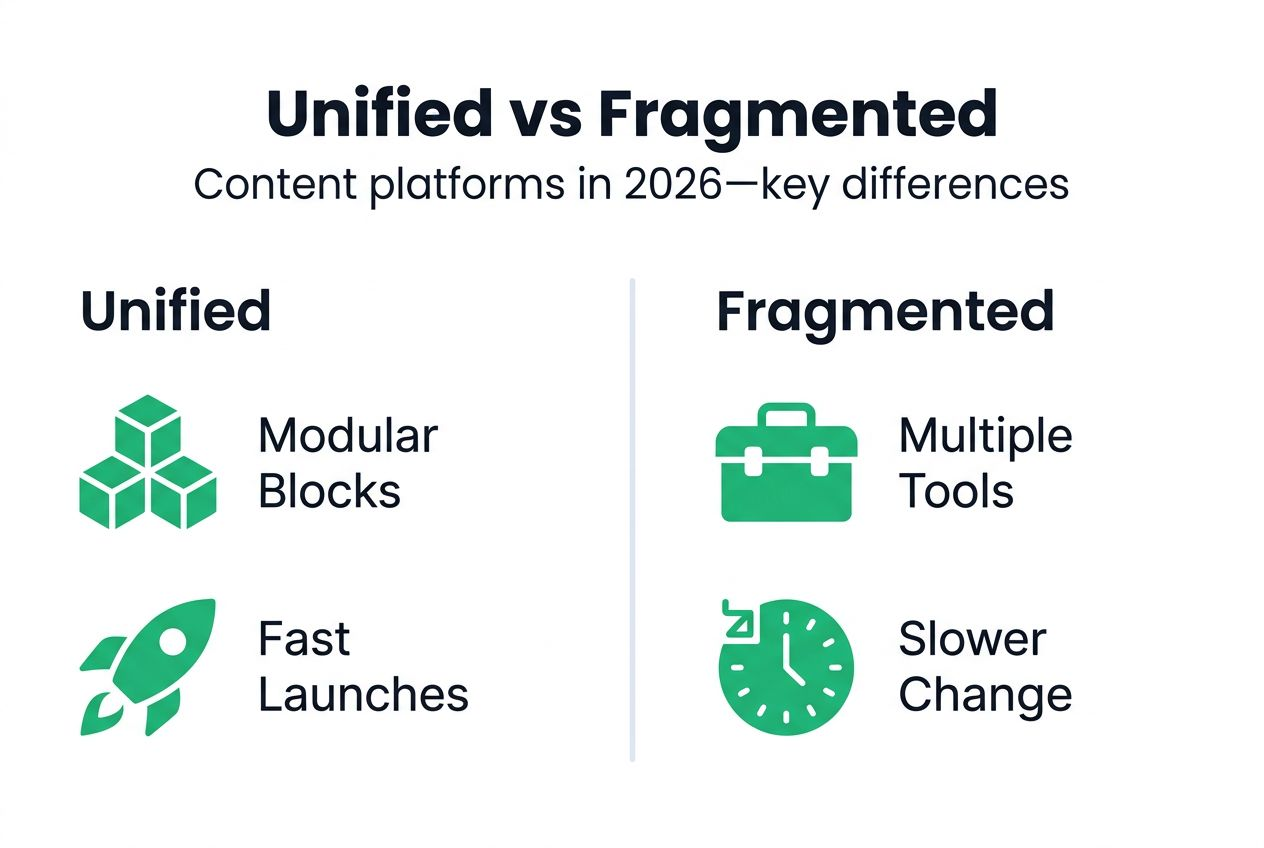
Content consistency improves dramatically in unified environments because brand standards, design patterns, and compliance requirements embed into reusable components. Marketing cannot accidentally violate guidelines because non-compliant options do not exist in the component library. Fragmented systems rely on manual compliance checks that catch errors after creation, wasting time and creating risk.
Security vulnerabilities multiply in fragmented environments where each tool introduces potential attack vectors, update cycles fall out of sync, and integration points create exposure. Unified platforms reduce attack surface by centralizing security controls, automating updates, and eliminating unnecessary integration complexity. IT teams manage one security perimeter instead of six.
Time to market suffers in fragmented systems due to tool-switching overhead, approval bottlenecks, and integration delays. Teams spend more time coordinating between systems than creating value. Unified platforms compress production cycles by removing these friction points, enabling organizations to capitalize on market opportunities before they close.
| Dimension | Fragmented Systems | Unified Platforms |
|---|---|---|
| Architecture | Multiple disconnected tools requiring custom integration | Single integrated ecosystem with native connectors |
| Marketing autonomy | High developer dependency for changes | Self-service content creation and publishing |
| Content consistency | Manual compliance checks, frequent errors | Automated enforcement through component design |
| Security posture | Multiple attack vectors, complex update management | Centralized controls, simplified security model |
| Operational cost | High due to tool licensing, integration maintenance | Lower through consolidation and automation |
| Time to market | Slow due to handoffs and approval queues | Fast through streamlined workflows |
| Scalability | Difficult, requires custom development | Built-in through platform architecture |
| IT overhead | High support burden from complexity | Reduced through self-service and automation |
Operational costs favor unified platforms despite potentially higher upfront investment. Fragmented systems accumulate expenses through multiple vendor contracts, custom integration development, ongoing maintenance, and inefficiency costs from slow execution. Unified platforms consolidate these expenses while improving output, creating better ROI over time.
Common misconceptions about unified content platforms
Marketing autonomy does not eliminate IT oversight. Instead, it shifts IT focus from approving individual content changes to establishing governance frameworks that enable safe self-service. IT defines what components exist, who can use them, and under what conditions, then monitors compliance through automated controls rather than manual review. This approach actually strengthens oversight by making it systematic and enforceable.
Unified platforms scale effectively for large enterprises through multi-site management, content syndication, workflow orchestration across regions, and performance optimization under high traffic loads. Organizations managing hundreds of sites and publishing thousands of content pieces monthly find unified platforms handle this complexity better than fragmented approaches that require custom development for scale.
These systems are not inherently rigid or overly complex. The perception stems from comparing unified platforms to simple tools used by small teams. Enterprise requirements for security, compliance, governance, and scale necessitate more sophisticated architecture, but modern platforms abstract this complexity through intuitive interfaces. Marketing users interact with simple component libraries while IT manages underlying complexity through configuration rather than custom code.
Common fears that slow adoption include concerns about migration complexity, user adoption challenges, vendor lock-in risks, and integration limitations with existing tools. Organizations address these through phased implementations that prove value quickly, comprehensive training programs that build confidence, careful vendor evaluation that ensures openness, and thorough integration planning that connects essential systems.
Balanced governance models resolve tensions by giving marketing autonomy within defined boundaries while preserving IT control over security, performance, and compliance. This is not a compromise where both sides lose something but rather a redesign where both achieve their objectives more effectively than before. Marketing gains speed and flexibility, IT reduces support burden while improving security posture.
Practical implementation and case studies
The Unified Content Platform Triad framework guides implementation by focusing on three interdependent pillars: marketing autonomy through self-service components, enterprise security through centralized governance, and workflow efficiency through automation. Organizations that optimize all three simultaneously achieve superior results compared to those emphasizing one dimension while neglecting others.
Implementation follows a proven sequence:
- Conduct readiness assessment examining current pain points, technical debt, team capabilities, and organizational priorities to establish baseline and define success metrics.
- Align stakeholders across marketing, IT, legal, and executive leadership on objectives, governance model, and success criteria before making technology decisions.
- Select platform based on requirements for scale, security, integration needs, and vendor viability rather than feature checklists that miss strategic fit.
- Design governance framework defining user roles, approval workflows, component libraries, and compliance controls that balance autonomy with oversight.
- Migrate content in phases starting with high-value, low-risk projects that demonstrate quick wins and build organizational confidence.
- Train users through role-specific programs that teach relevant skills without overwhelming teams with features they will not use.
- Iterate based on user feedback, performance metrics, and evolving requirements rather than treating implementation as one-time project.
Common failure points include underestimating change management needs, treating implementation as purely technical project, skipping governance design phase, migrating everything simultaneously instead of phased approach, and neglecting ongoing training and optimization. Organizations avoid these pitfalls through cross-functional project teams, executive sponsorship, and realistic timelines.
A global financial services firm implemented a unified platform to manage localized campaigns across 23 countries while maintaining compliance with regional regulations. Marketing teams gained ability to customize campaigns for local markets using approved components, reducing launch time from six weeks to nine days while improving compliance scores by 40%. IT reduced support tickets by 55% while strengthening security controls.
Another case involves a healthcare organization using AI-assisted workflows to personalize patient education materials based on conditions, demographics, and engagement history. The unified platform integrated patient data, content management, and analytics to deliver relevant information automatically. Content production capacity increased 300% while maintaining HIPAA compliance and improving patient satisfaction scores.
Organizations implementing WordPress AI capabilities within unified platforms see particularly strong results in content personalization, automated optimization, and production efficiency. The 2026 marketing autonomy landscape shows AI integration becoming standard rather than experimental as teams recognize the competitive advantage.
Conclusion and next steps
Unified content platforms deliver measurable benefits in marketing autonomy, enterprise security, and workflow efficiency by resolving tensions that plague fragmented systems. Organizations gain the ability to execute campaigns faster while maintaining governance, reduce operational costs while improving output quality, and scale content operations without proportionally increasing headcount or complexity.
Success requires strategic alignment between marketing and IT from initial assessment through ongoing optimization. Both teams must participate in governance design, contribute to component library development, and share responsibility for platform success. Organizations treating implementation as purely marketing or purely IT initiative miss opportunities for transformation.
Begin with readiness assessment examining current pain points, technical capabilities, and organizational priorities. Identify quick wins that demonstrate value without requiring complete system replacement. Run pilot programs with engaged teams on high-visibility projects that showcase platform benefits to build organizational momentum.
Establish governance frameworks before migration to prevent chaos during transition. Define roles, permissions, approval workflows, and compliance controls collaboratively rather than imposing IT restrictions that frustrate marketing or allowing marketing freedom that creates security risks. The IT role in content management evolves into strategic partnership rather than adversarial relationship.
Invest in ongoing training and optimization rather than treating implementation as one-time project. User needs evolve, platform capabilities expand, and organizational requirements shift over time. Regular reviews ensure the platform continues delivering value while adapting to change. Organizations following the marketing autonomy guide principles build sustainable competitive advantages through continuous improvement.
Explore enterprise solutions with 40Q
Implementing unified content platforms that balance marketing autonomy with enterprise security requires specialized expertise in architecture, governance, and workflow design. 40Q partners with medium and large organizations to build WordPress-based platforms that eliminate developer dependency while maintaining IT control through our proprietary FAS Block System™.
Our WordPress VIP implementations handle high-traffic, content-heavy environments where performance and reliability cannot be compromised. We design component libraries that empower marketing teams to launch campaigns independently while preserving brand consistency and compliance requirements.
The enterprise-grade WordPress approach combines modular content architecture with centralized governance controls, giving both marketing and IT what they need to succeed. Our WordPress AI Suite integrates content intelligence directly into workflows, automating optimization and personalization without adding complexity. Explore how we help organizations achieve marketing autonomy without sacrificing enterprise security.
Frequently asked questions
Recommended

Jun 17, 2026
WordPress
Best WordPress Enterprise Agencies in 2026

Feb 14, 2026
WordPress
Role of IT in Marketing Technology Success

Apr 3, 2026
WordPress