
WordPress
Why Choose Headless WordPress for Enterprise Autonomy

Eddie Wise
January 15, 2026 | 3 min to read
Most enterprise teams discover that traditional WordPress sites can slow them down, with over 60 percent of American organizations reporting bottlenecks caused by developer reliance each year. For digital marketing directors, improving content velocity is a core priority. The move to headless WordPress architecture transforms the way global businesses create and deliver digital experiences—giving you the speed, autonomy, and flexibility needed to outperform competitors in the modern marketplace.
Table of Contents
- Defining Headless WordPress Architecture
- Key Differences: Traditional Vs Headless Approach
- Enterprise Benefits: Speed And Scalability
- Marketing Autonomy And Reduced Developer Dependency
- Security, Compliance, And Governance Advantages
- Comparing Alternatives: Is Headless The Right Fit
Key Takeaways
| Point | Details |
|---|---|
| Headless Architecture Advantages | Separating backend from frontend offers flexibility, enhanced performance, and improved security for digital experiences. |
| Marketing Autonomy | Marketing teams can manage content independently, reducing reliance on developers and speeding up campaign launches. |
| Scalability and Agility | Organizations benefit from the ability to scale components independently and quickly adapt to changing digital demands. |
| Robust Security Model | Decoupled architecture minimizes vulnerabilities while allowing advanced security protocols at the API layer. |
Defining Headless WordPress Architecture
A headless WordPress architecture represents a transformative approach to content management that decouples the backend content creation system from the frontend presentation layer. By separating these components, enterprises gain unprecedented flexibility in how they design, develop, and deliver digital experiences. Headless WordPress technologies enable organizations to use WordPress exclusively as a powerful content management backend while leveraging modern frontend frameworks like React, Angular, or Vue.js for rendering.
In this architectural model, WordPress serves as a robust content repository, managing and storing all digital content through its familiar interface. The key distinction is that instead of generating HTML directly, WordPress exposes content through robust APIs like REST or GraphQL. This means development teams can retrieve content programmatically and render it using any preferred technology stack. Such an approach provides significant advantages: enhanced performance, improved security, greater development flexibility, and the ability to create omnichannel content experiences across web, mobile, and emerging digital platforms.
The technical implementation involves using WordPress as a headless CMS by disabling the traditional theme system and instead focusing on content creation and API delivery. Developers can then build custom frontend applications that consume WordPress content through standardized API calls. This strategy allows marketing teams to continue using WordPress’s intuitive content management capabilities while giving technical teams the freedom to architect sophisticated, high-performance digital experiences using contemporary web technologies.
Pro tip: When transitioning to a headless WordPress architecture, start by creating a content API strategy that defines how different content types will be retrieved and consumed across your digital platforms.
Key Differences: Traditional vs Headless Approach
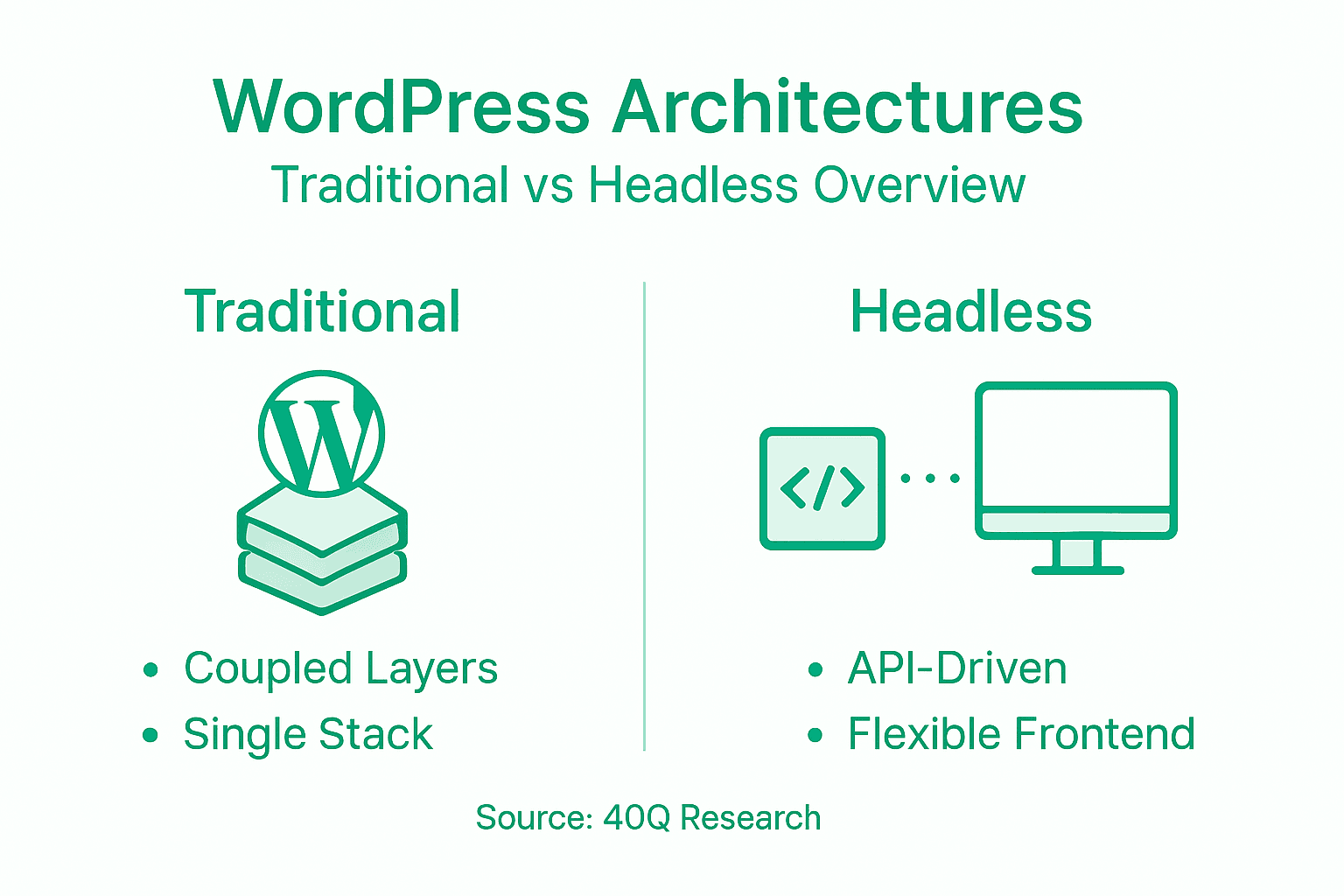
In traditional WordPress architectures, the content management system is tightly coupled, meaning the backend content creation and frontend presentation are integrated within the same platform. Content management systems typically rely on themes and plugins that directly control how content is displayed, limiting flexibility and performance optimization. This monolithic approach means that content is generated and rendered simultaneously, creating dependencies that can slow down website performance and restrict technological innovation.
The headless approach fundamentally transforms this model by completely separating the content management backend from the frontend presentation layer. In this architecture, WordPress becomes a pure content repository and API-driven backend, while frontend technologies like React, Vue.js, or Next.js handle the actual rendering and user experience. This decoupling provides enterprise teams with unprecedented flexibility. Development teams can select the most appropriate frontend frameworks, optimize performance independently, and create more sophisticated, responsive digital experiences without being constrained by traditional WordPress rendering limitations.
Key differences between traditional and headless WordPress architectures extend beyond technical implementation. Traditional WordPress locks organizations into predetermined presentation models, whereas headless WordPress enables true technological agility. Marketing teams maintain their familiar content management interface, while technical teams gain the freedom to build custom, high-performance frontend applications. The headless model supports advanced use cases like creating consistent content experiences across multiple platforms – web, mobile applications, digital signage, and emerging technologies – all powered by a single WordPress backend.
Pro tip: Before migrating to a headless WordPress architecture, conduct a comprehensive audit of your current content delivery workflows to identify specific performance and flexibility bottlenecks.
Here’s a concise comparison of traditional vs headless WordPress architectures and their impact across key business areas:
| Aspect | Traditional WordPress | Headless WordPress |
|---|---|---|
| Frontend Flexibility | Limited by themes and plugins | Any framework (React, Vue, etc.) |
| Performance | Often theme/plugin bottlenecks | Faster, optimized custom frontends |
| Security Model | Exposed backend and admin panel | Backend isolated, fewer attack paths |
| Omnichannel Delivery | Primarily web-focused | Seamless web, mobile, and more |
| Developer Involvement | Frequent for content updates | Reduced for marketing teams |
Enterprise Benefits: Speed and Scalability
Headless WordPress architectures deliver extraordinary performance advantages that directly address enterprise-level digital challenges. Performance optimization strategies enable organizations to dramatically reduce page load times and improve user experience by decoupling content management from frontend rendering. Traditional WordPress sites often struggle with complex plugin ecosystems and theme-related performance bottlenecks, whereas headless approaches allow for lightning-fast, custom-built frontend implementations that can handle massive traffic loads with unprecedented efficiency.
The scalability potential of headless WordPress is particularly transformative for enterprise organizations. By separating backend content management from frontend presentation, companies can independently scale each component based on specific performance requirements. Frontend technologies like React, Vue.js, and Next.js can be optimized for rapid rendering, while the WordPress backend remains a stable, robust content repository. This architectural flexibility means enterprises can quickly adapt to traffic spikes, implement complex content delivery networks, and maintain consistent performance across multiple digital platforms without experiencing systemic slowdowns or architectural constraints.

Moreover, headless WordPress provides enterprises with unprecedented technological agility. Development teams can leverage modern JavaScript frameworks to create highly responsive, interactive digital experiences that load instantaneously. The API-driven approach allows for seamless content distribution across web, mobile, and emerging digital platforms, ensuring that marketing teams can publish and distribute content without being limited by traditional rendering constraints. This approach not only improves performance but also future-proofs digital infrastructure by enabling continuous technological innovation and adaptation.
Pro tip: Conduct periodic performance audits of your headless WordPress implementation, measuring API response times and frontend rendering speeds to continuously optimize your digital ecosystem.
The following table summarizes the enterprise benefits of adopting a headless WordPress strategy:
| Benefit | Description | Business Impact |
|---|---|---|
| Speed | Decoupled rendering eliminates bottlenecks | Faster page loads, better UX |
| Scalability | Backend and frontend scale independently | Handles high traffic efficiently |
| Agility | Open API enables quick platform updates | Rapid adaptation to new markets |
| Future-Proofing | Supports modern tech and innovation | Long-term competitive advantage |
Marketing Autonomy and Reduced Developer Dependency
Marketing autonomy represents a critical transformation enabled by headless WordPress architectures, fundamentally reshaping how organizations manage digital content. Content management strategies empower marketing teams to create, edit, and publish content independently, without constant reliance on technical teams for frontend modifications. By maintaining WordPress’s familiar content management interface while decoupling it from presentation layers, organizations can dramatically reduce the traditional bottlenecks that slow down content production and campaign launches.
The traditional WordPress ecosystem often creates significant friction between marketing and development teams, with every content update or design change requiring extensive technical intervention. Headless WordPress eliminates these constraints by providing a clean separation between content creation and content delivery. Marketing professionals can leverage the intuitive WordPress backend to draft, edit, and schedule content, while developers construct sophisticated, high-performance frontend experiences using modern JavaScript frameworks. This architectural approach means marketing teams gain unprecedented speed and flexibility, able to launch landing pages, update campaigns, and experiment with content strategies without waiting for developer resources.
Furthermore, headless WordPress transforms the relationship between marketing and technology teams by creating a more collaborative, efficient workflow. Instead of being constrained by technical limitations, marketing professionals become empowered content creators who can rapidly iterate and experiment. The API-driven approach allows for seamless content distribution across multiple platforms, enabling teams to create omnichannel content experiences without complex technical dependencies. This model not only accelerates content velocity but also provides marketing teams with greater creative control and strategic agility in an increasingly competitive digital landscape.
Pro tip: Establish clear content governance protocols and API documentation to ensure smooth collaboration between marketing and development teams in a headless WordPress environment.
Security, Compliance, and Governance Advantages
Headless WordPress architectures introduce a robust security model that fundamentally transforms enterprise digital risk management. Enterprise security strategies create multiple layers of protection by isolating the content management backend from direct public access. This architectural approach significantly reduces potential attack surfaces, preventing malicious actors from directly interacting with the WordPress core system and minimizing vulnerabilities that traditional monolithic WordPress installations frequently encounter.
The decoupled nature of headless WordPress provides extraordinary governance capabilities for enterprises operating in highly regulated industries. By implementing strict API authentication protocols and controlling data access through carefully designed endpoints, organizations can ensure precise content delivery while maintaining comprehensive audit trails and access controls. This model allows IT teams to implement granular permissions, monitor content interactions, and enforce complex compliance requirements without compromising the flexibility and user experience of the content management system.
Moreover, the API-driven architecture of headless WordPress enables sophisticated security implementations that go beyond traditional wordpress protection strategies. Development teams can implement advanced authentication mechanisms like JSON Web Tokens (JWT), OAuth, and multi-factor authentication directly at the API layer. This approach provides a more sophisticated security model where each content request can be thoroughly validated, encrypted, and tracked, giving enterprises unprecedented control over their digital content ecosystem and ensuring that sensitive information remains protected across multiple digital platforms.
Pro tip: Implement comprehensive API security audits quarterly and maintain a detailed access control matrix to proactively identify and mitigate potential security vulnerabilities in your headless WordPress infrastructure.
Comparing Alternatives: Is Headless the Right Fit
Determining whether a headless WordPress architecture is appropriate requires a comprehensive evaluation of organizational digital strategy and technical capabilities. Enterprise content management strategies demand careful consideration of multiple factors beyond traditional technology selection criteria. Organizations must assess their specific requirements for content delivery, frontend flexibility, development resources, and long-term digital transformation goals before committing to a headless approach.
Traditional coupled CMS platforms remain suitable for organizations with simpler digital needs, limited technical resources, and straightforward content publishing requirements. Headless WordPress becomes compelling when enterprises require sophisticated, multi-channel content distribution, advanced frontend experiences, and the ability to rapidly iterate digital platforms using modern web technologies. Key decision factors include the complexity of existing digital ecosystem, development team expertise, performance requirements, and the need for seamless content delivery across web, mobile, and emerging digital platforms.
The transition to headless WordPress is not universally recommended but represents a strategic advantage for forward-thinking organizations. Enterprises with robust technical teams, complex content distribution needs, and a commitment to continuous digital innovation will derive maximum benefits. Smaller organizations or those with limited development resources might find the implementation complexity and initial investment challenging. Successful adoption requires a holistic approach that includes comprehensive technical assessment, strategic planning, skill development, and a clear understanding of how a decoupled architecture aligns with broader business objectives.
Pro tip: Conduct a thorough proof-of-concept project to validate the technical feasibility and organizational readiness before fully committing to a headless WordPress migration.
Unlock Enterprise Autonomy with Headless WordPress and 40Q
The article highlights the challenges enterprises face with traditional WordPress setups that limit frontend flexibility and increase developer dependency. If your organization struggles with slow content updates, performance bottlenecks, or security concerns, a headless WordPress architecture is the solution. It empowers marketing teams with greater autonomy while giving IT teams control over scalability, security, and governance. 40Q builds enterprise-grade WordPress platforms that solve these pain points by leveraging our proprietary FAS Block System™ to deliver faster content launches, AI-assisted workflows, and robust security for high-traffic, content-heavy businesses.
Experience the freedom to innovate without sacrificing reliability and compliance by partnering with a WordPress VIP partner committed to your success.
Ready to revolutionize your digital experience with headless WordPress and marketing autonomy? Discover how 40Q can help your enterprise scale securely and confidently. Visit 40Q today to explore our solutions and request a consultation. Learn more about how we reduce developer dependency and accelerate your time to market by visiting our homepage and see why enterprises trust us to deliver performance and agility.
Frequently Asked Questions
May 29, 2024
WordPress
Unleash WordPress Power: Handling High Traffic Like a Pro

Oct 21, 2025
WordPress
How to Empower Content Teams with a Modern CMS

Feb 4, 2026
WordPress