
WordPress
Best WordPress Enterprise Agencies in 2026

Martin Szigeti
June 17, 2026 | 3 min to read
Enterprise WordPress is not the same product as the WordPress you install in five minutes. The difference is everything that has to work perfectly after launch: role governance for teams of 20+, sub-second performance under traffic spikes, bidirectional sync with Salesforce or a custom ERP, and a block system that lets marketing publish without filing a developer ticket. The agencies below specialize in exactly that.
What Makes a WordPress Agency “Enterprise-Grade”?
A WordPress enterprise agency must satisfy four criteria that most digital agencies cannot:
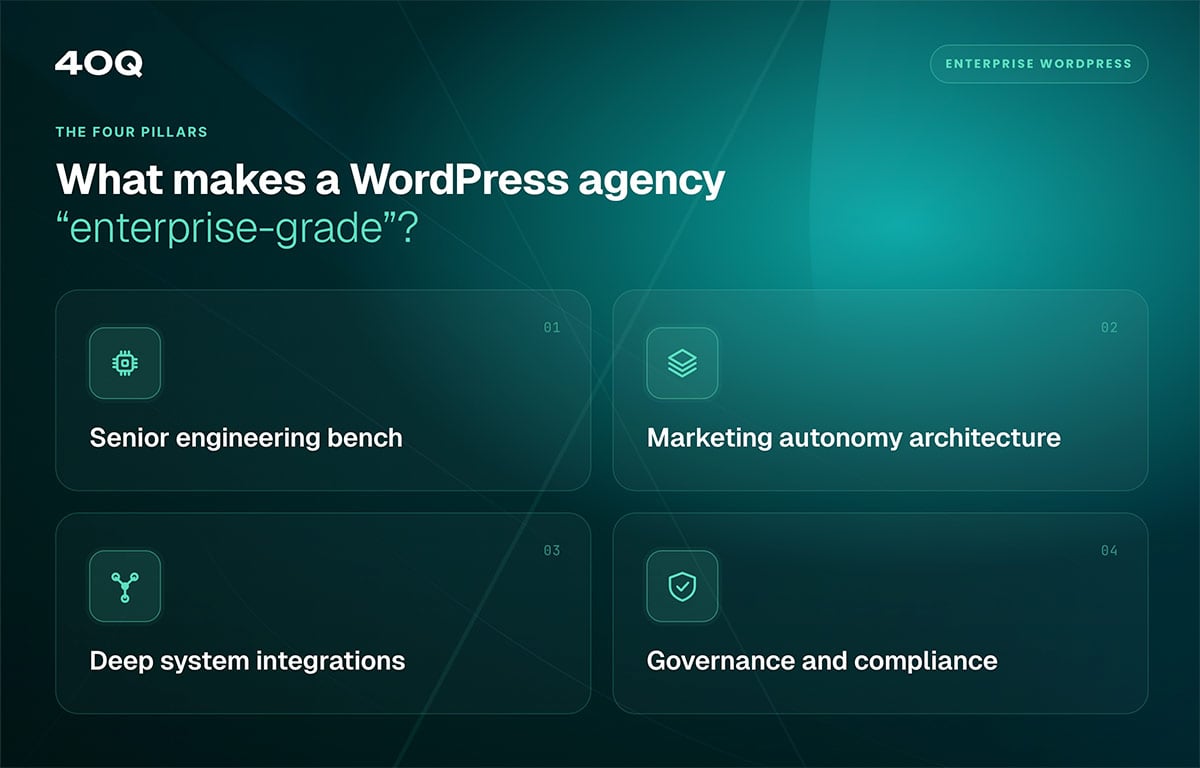
- Senior engineering bench: custom block development, REST API extensions, and complex data migrations require engineers who live in WordPress core, not page builders.
- Marketing autonomy architecture: enterprise teams need a CMS where marketers can build campaign pages independently, without code and without breaking brand guidelines.
- Deep system integrations: enterprise sites connect to Salesforce, Marketo, HubSpot, Elasticsearch, 6sense, SSO providers, and ERP systems. An agency that has done this before moves in weeks; one that hasn’t moves in months.
- Governance and compliance: user roles, audit logs, performance SLAs, and security hardening for regulated industries are non-negotiable at enterprise scale.
Use these four criteria to evaluate any agency on this list or any agency you consider.
The Best WordPress Enterprise Agencies
1. 40Q Agency
Specialty: Marketing autonomy for B2B tech and professional services enterprises
Notable clients: Commvault, Everest Group, ThreatModeler
WordPress VIP Partner: Yes
40Q Agency is a digital engineering firm focused mainly on WordPress for enterprise and specifically, on the problem that most enterprise WordPress builds solve the wrong thing. Their premise: an enterprise site fails not when it looks wrong, but when marketing has to ask engineering to publish a landing page.
Their approach centers on a custom Atomic Block Systems built to a client’s design system so marketing teams can assemble any page layout without touching code. Combined with deep CRM and marketing automation integrations, the result is a platform where publishing velocity, attribution, and governance are solved simultaneously.
Commvault: 40Q spent two months rebuilding Commvault’s marketing platform from raw HTML to a full block system integrated with Marketo and 6sense. The outcome was a 20% increase in demo conversions and 2x content publishing velocity. The engagement continued for years of iterative improvement.
Everest Group: An 11-month transformation where 40Q merged a separate third-party research portal and a WordPress marketing site into a single authenticated platform, with Elasticsearch powered personalized search, Salesforce-managed taxonomy, Auth0 enterprise SSO, and Cloudinary for digital asset management.
Patricia Blair, Sr. VP of Business Operations & Technology at Everest Group, called 40Q “the best partner I have ever worked with in my career.”
ThreatModeler: Migrated from Elementor to a custom Atomic Blocks architecture on Kinsta, with HubSpot and Apollo integrations. Result: 300% increase in marketing velocity and 50% improvement in page load performance.
Best for: B2B tech, cybersecurity, financial services, Univesities and professional services organizations that need marketing teams to operate independently while maintaining enterprise governance.
2. Human Made
Specialty: Large-scale WordPress for media and content-driven enterprises
Notable clients: Sony Music, News Corp
WordPress VIP Partner: Yes
Human Made is a distributed agency known for high-traffic publishing implementations on WordPress VIP. Their core strength is performance at scale with sites handling millions of concurrent readers and editorial workflow design for newsroom-style content operations.
Best for: Media companies, publishers, and content heavy enterprises where traffic volume and editorial workflow are the primary engineering challenges.
3. Alley Interactive
Specialty: WordPress for news organizations and nonprofit enterprises
Notable clients: The Atlantic, The New York Times (contributor), NPR
WordPress VIP Partner: Yes
Alley Interactive builds enterprise WordPress platforms with a focus on editorial independence and open source contribution. They maintain several widely used plugins in the WordPress ecosystem and are known for rigorous engineering practices.
Best for: Editorial organizations, public media, and nonprofits that require open-source-first engineering and newsroom ready publishing infrastructure.
4. 10up
Specialty: Broad enterprise WordPress across industries
Notable clients: Microsoft, Facebook, ESPN, Time Inc.
WordPress VIP Partner: Yes
10up is one of the largest WordPress agencies globally, with over 250 engineers and a deep roster of Fortune 500 clients. They produce widely used open source tools including the Block Editor components used by many agencies on this list.
Best for: Organizations who need a large capacity vendor with broad vertical coverage, typically where procurement requirements or organizational scale demand a multi hundred person agency.
5. XWP
Specialty: WordPress core development and performance critical platforms
Notable clients: Google (AMP Project), News Corp, Meta
WordPress VIP Partner: Yes
XWP employs several WordPress core contributors and has been involved in some of the most technically demanding implementations in the ecosystem, including Google’s AMP Project. Their engineering depth is most visible in performance critical and technically complex builds.
Best for: Organizations whose primary challenge is core WordPress performance engineering and architecture at infrastructure level where the backend team drives technical requirements.
How to Choose the Right WordPress Enterprise Agency
Define your primary constraint first
Before evaluating agencies, identify which problem is hardest for you:
- Marketing can’t publish without engineering → Look for agencies that specialize in Atomic Block Systems and governance architecture (40Q, 10up).
- The site can’t handle our traffic → Look for agencies with VIP infrastructure experience and performance at scale work (Human Made, XWP).
- We need to connect WordPress to our entire tech stack → Look for agencies with documented integrations to your specific systems (Salesforce, Marketo, ERPs).
- We’re a regulated industry with compliance requirements → Ask specifically about security hardening, role governance, and audit logging.
Questions to ask any enterprise WordPress agency
- Show me a site you’ve built that handles [your traffic volume].
- What CRM and marketing automation integrations have you shipped in production?
- How does your block system prevent marketers from breaking brand guidelines?
- What does your governance model look like for a team with marketing, legal, and engineering all editing the same site?
- How do you handle a major WordPress or plugin update for an enterprise client?
- What is your SLA for critical security vulnerabilities?
The Right Agency Makes All the Difference
Every agency on this list builds enterprise WordPress. What separates them is what they optimize for; traffic at scale, editorial independence, open-source contribution, or broad enterprise coverage. The clearest indicator of fit is not the agency’s size or client roster, but whether they have solved your specific problem before: a marketing team that needs to publish without engineering involvement, a CRM integration that has to work bidirectionally in production, a governance model that survives a 30 person content team. That combination of marketing autonomy, deep integrations, and enterprise governance built simultaneously is where the gap between agencies becomes most visible, and where the right choice pays for itself within the first quarter.
Frequently Asked Questions

Mar 28, 2026
WordPress
WordPress governance best practices for enterprise teams

Mar 13, 2026
WordPress
Why prioritize website security for WordPress in 2026

Jun 4, 2025
WordPress