
WordPress
Enterprise compliance online: key mechanisms and strategies

José Debuchy
April 17, 2026 | 3 min to read
TL;DR:
- Modern enterprise compliance integrates policies directly into content workflows and technology platforms.
- Structured and headless CMS solutions support real-time validation, audit trails, and policy-as-code for better enforcement.
- Embedding compliance into system architecture enables faster marketing velocity, reduces audit risks, and builds trust.
Enterprise compliance online is rarely what leaders expect. Most CMOs and IT Directors assume it means running periodic audits or checking a regulatory box before launch. The reality is far more demanding. Modern compliance means embedding policy directly into content workflows, authoring environments, and technology architecture. Regulations like GDPR, HIPAA, WCAG 2.2, and 21 CFR Part 11 now govern how content is created, approved, published, and retained at scale. For high-traffic enterprises, the stakes are not just legal. Compliance directly shapes marketing velocity, brand trust, and the ability to scale globally without friction.
Key Takeaways
| Point | Details |
|---|---|
| Define compliance early | Clarity on standards and regulations is essential to align tools and teams for online content compliance. |
| Automate and centralize | Workflow automation, role-based access, and centralized validation greatly reduce compliance risks and manual overhead. |
| Modernize for agility | Structured and headless CMS enable future-proof compliance and marketing speed in complex enterprise environments. |
| Avoid legacy pitfalls | Legacy CMS and plugins often introduce hidden risks, inconsistent enforcement, and audit challenges. |
| Compliance is strategic | When embedded into content operations, compliance becomes a driver of trust, innovation, and organizational growth. |
Defining enterprise compliance online
Enterprise compliance online refers to the strategies, tools, and processes within enterprise Content Management Systems (CMS or ECM) that ensure online content adheres to regulatory requirements such as GDPR, HIPAA, WCAG accessibility, and industry-specific rules like 21 CFR Part 11. This is not a legal department problem. It is a platform architecture problem, a workflow design problem, and increasingly, a marketing leadership problem.
For enterprises managing thousands of pages across multiple regions, compliance is the foundation that makes scale possible. Without it, marketing teams face content freezes, legal reviews that kill campaign velocity, and audit failures that expose the organization to significant financial and reputational risk.
Key regulations that shape enterprise compliance online include:
- GDPR: Governs data privacy and consent for users in the European Union, with direct implications for forms, cookies, personalization, and content targeting.
- HIPAA: Applies to healthcare organizations handling protected health information (PHI) in digital content and patient-facing platforms.
- WCAG 2.2: The Web Content Accessibility Guidelines set the standard for digital accessibility, affecting every content element from image alt text to navigation structure.
- 21 CFR Part 11: FDA regulation governing electronic records and signatures in life sciences and pharmaceutical industries.
The CMS or ECM platform is the primary enforcement layer. A well-configured platform encodes compliance rules into content models, authoring interfaces, and approval workflows. A poorly configured one leaves enforcement to individual editors, which is where risk accumulates. Understanding content and compliance in WordPress is critical for organizations running on that platform at scale.
“Compliance is not a feature you add to a CMS. It is a property of how the system is designed, configured, and governed from day one.”
The industry compliance matrix shows how different sectors face distinct regulatory combinations, and the WCAG compliance overview outlines the technical requirements enterprises must meet. IT’s role in content management is central to ensuring these requirements are enforced at the infrastructure level, not just the editorial level.
Core compliance mechanics in enterprise CMS
Knowing what compliance requires is one thing. Knowing how a CMS delivers it is another. The core mechanics include role-based access controls (RBAC), workflow automation for approvals, audit trails for version history and change tracking, content validation at authoring time, structured schemas encoding compliance rules, and separation of draft/preview from production states.

Here is how each mechanic maps to compliance outcomes:
| CMS Mechanic | Compliance Function | Risk Without It |
|---|---|---|
| RBAC | Controls who can publish or modify regulated content | Unauthorized edits, audit failures |
| Workflow automation | Enforces approval chains before publication | Unapproved content reaching production |
| Audit trails | Provides version history and change attribution | No evidence for regulatory review |
| Authoring validation | Flags missing alt text, required fields at creation | Accessibility violations, incomplete records |
| Structured schemas | Encodes field-level compliance rules | Inconsistent data, policy drift |
| Draft/production separation | Prevents preview states from leaking to live | Blurred compliance boundaries |
The sequence matters. Compliance should be enforced in this order:
- Schema design: Encode required fields and validation rules into the content model before any editor touches the system.
- Authoring-time validation: Surface compliance errors at creation, not after submission.
- Workflow gates: Require approvals from compliance, legal, or accessibility reviewers before content advances.
- Audit logging: Capture every state change with timestamps and user attribution.
- Production gating: Prevent content from going live without passing all validation checks.
By 2026, 70% of regulated enterprises will require auditable governance frameworks across their digital platforms. The enterprise CMS security checklist provides a practical starting point for IT teams evaluating platform readiness. Solid content workflows are the operational backbone of any compliance program.
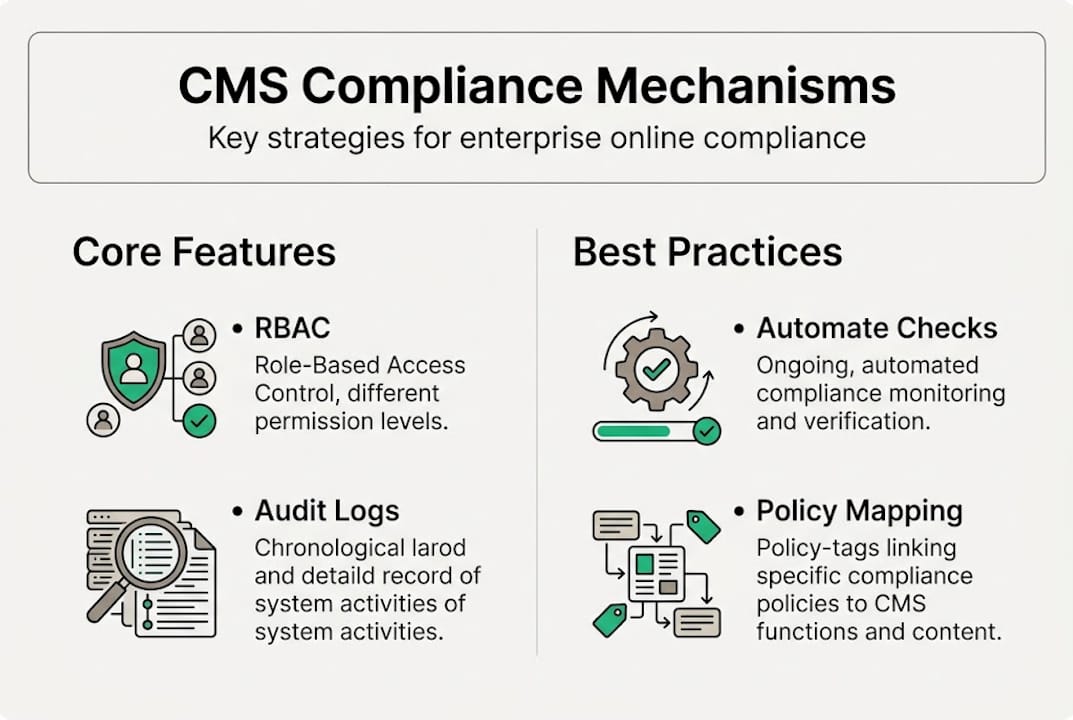
Pro Tip: Automate compliance checks at the authoring stage. Catching a missing accessibility field or a consent flag at creation costs seconds. Catching it after publication costs days and sometimes dollars.
Legacy challenges and edge cases: what can go wrong
Most compliance failures do not happen because organizations ignored the rules. They happen because legacy systems cannot enforce them consistently. Plugin-dependent platforms lead to policy drift, inconsistent enforcement, blurred draft/live states, and scattered logs that make audits slow and unreliable.
The most common failure patterns:
- Policy drift: Compliance rules exist in documentation but are not enforced in the CMS. Editors work around them over time.
- Audit chaos: Logs are spread across plugins, servers, and third-party tools. Reconstructing a content history for a regulator takes weeks.
- Caching mismatches: A compliant version of a page is cached while an updated, non-compliant version sits in preview, creating a gap between what the system thinks is live and what users actually see.
- Global approval collisions: Multi-region teams submit content simultaneously, triggering conflicting approval states with no clear resolution path.
A critical data point: 80% of AI-related compliance failures are tied to edge cases and data gaps, not core functionality. The same pattern holds for CMS compliance. The system works fine in standard scenarios. It breaks at the edges.
| Platform Type | Compliance Strength | Key Weakness |
|---|---|---|
| Plugin-reliant CMS | Low to moderate | Inconsistent enforcement, scattered logs |
| Structured/headless CMS | High | Higher initial configuration cost |
| Monolithic enterprise CMS | Moderate | Rigid, slow to adapt to new regulations |
For enterprises evaluating scalable CMS solutions, the plugin-reliant model is a known liability. The enterprise-grade CMS for autonomy model addresses these gaps by design, not by patching.
Modern CMS approaches: structured, headless, and policy-as-code
The industry has moved toward architectures that treat compliance as a property of the content model, not a layer added on top. Structured and headless CMS platforms offer schema-as-code, real-time validation, immutable audit trails, and release bundling for coordinated global launches.
The shift is significant. Instead of relying on editors to remember compliance rules, the system enforces them automatically. A field that requires a privacy disclosure cannot be published without one. An image without alt text cannot pass the authoring validation gate.
The modern approach follows this sequence:
- Encode policy in the content model: Compliance rules live in the schema, not in a style guide PDF.
- Validate at authoring time: Editors see errors before they submit, not after legal review.
- Use immutable audit logs: Every change is recorded in a tamper-proof log that satisfies regulatory review requirements.
- Bundle releases: Coordinate multi-region content launches through release management to prevent approval collisions and ensure synchronized compliance states.
- Automate accessibility checks: Integrate WCAG validation into the authoring workflow so accessibility is a default, not an afterthought.
The AI-ready CMS evaluation framework highlights how platforms that support policy-as-code are better positioned to adapt as regulations evolve. Custom CMS solutions built on this architecture give enterprises the flexibility to adapt compliance rules without rebuilding the platform.
Pro Tip: When evaluating platforms, ask vendors specifically how compliance rules are encoded. If the answer involves plugins or manual editor training, that is a risk signal.
Best practices for marketing, IT, and compliance leadership
Compliance strategy works best when it is built into the content lifecycle from the start, not retrofitted after a campaign is already in production. Authoring-time compliance reduces rework, accelerates approvals, and integrates with marketing workflows without slowing velocity.
Actionable priorities for leadership teams:
- Map compliance checkpoints to content stages: Define where WCAG validation, legal review, and consent checks occur in the workflow. Make them non-negotiable gates, not optional steps.
- Choose platforms with built-in validation: Avoid systems where compliance depends on editor discipline. The platform should enforce the rules.
- Centralize governance without removing agility: A single governance framework applied across regions and teams prevents policy drift while allowing local teams to move quickly within defined parameters.
- Use compliance as a market differentiator: In regulated sectors like healthcare, finance, and life sciences, demonstrable compliance builds buyer trust and shortens sales cycles.
- Audit continuously, not periodically: Scheduled audits catch problems after they have already caused risk. Continuous monitoring through automated tools catches them in real time.
The web accessibility importance for enterprise organizations extends beyond legal obligation. Accessible content reaches broader audiences, performs better in search, and signals organizational maturity to partners and regulators alike. The CMS regulatory compliance guide provides a detailed framework for evaluating platform readiness against specific regulatory requirements.
Pro Tip: Map every content stage, from brief to publish, and assign a compliance checkpoint to each one. This turns compliance from a bottleneck into a built-in quality gate.
Our perspective: compliance as your enterprise’s competitive edge
Most organizations treat compliance as a cost center. A legal obligation. Something to manage, not leverage. That framing is expensive.
We have seen what happens when compliance is embedded in culture and systems rather than bolted on at the end. Marketing teams move faster, not slower. Campaigns launch with confidence because the guardrails are already in place. IT teams spend less time firefighting and more time enabling. The audit is not a crisis. It is a report.
The conventional approach, post-hoc legal review, manual checklists, periodic audits, stifles teams and creates false confidence. Modern compliance, encoded in the platform, validated at authoring, monitored continuously, is what enables safe scaling.
Leaders who understand this use compliance to set the standard for trust and innovation in their sector. They do not ask “how do we pass the audit?” They ask “how do we build systems where passing is automatic?”
That is the standard enterprise-ready CMS criteria should be measured against. Not feature lists. Compliance by design.
How 40Q empowers compliant, agile enterprise CMS
40Q builds enterprise WordPress platforms where compliance is not an add-on. It is architecture. Marketing teams gain the autonomy to publish, localize, and launch campaigns without developer dependency, while IT retains full governance over security, performance, and regulatory adherence.

Our FAS Block System™ encodes content rules directly into the authoring experience, reducing compliance rework and accelerating time to market. For organizations ready to move beyond plugin-reliant systems, enterprise-grade WordPress delivers the structured foundation compliance demands. The WordPress AI Suite adds AI-assisted workflows that support compliant content creation at scale. Explore how 40Q helps leadership teams boost enterprise ROI without sacrificing governance.
Frequently asked questions
Recommended

Feb 22, 2026
WordPress
Web Accessibility: Why It Matters for Enterprises

Feb 5, 2026
WordPress
Scalable WordPress Setup Guide for Enterprise Success

Feb 2, 2026
WordPress