
WordPress
Digital Experience Optimization Guide for Enterprise Teams

José Debuchy
February 12, 2026 | 3 min to read
Managing high-traffic campaigns often exposes marketing operations teams to productivity bottlenecks and compliance challenges. For American, European, and Asian e-commerce companies, finding the right balance between team independence, content agility, and secure governance in WordPress is a strategic priority. This article delivers actionable strategies grounded in enterprise practices, helping you empower your team with flexible workflow autonomy, streamlined WordPress content management, AI-assisted processes, and robust compliance that fits global standards.
Quick Summary
| Main Insight | Explanation |
|---|---|
| 1. Assess Workflow Independence | Evaluate how much freedom your marketing team has to make decisions, identifying areas for improvement to enhance productivity. |
| 2. Implement Modular Content Systems | Use the WordPress FAS Block System for efficient content creation, reducing reliance on developers and streamlining publication processes. |
| 3. Utilize AI for Efficiency | Integrate AI-assisted workflows to automate repetitive tasks, allowing your team to focus on strategy and creative aspects of campaigns. |
| 4. Establish Strong Security Controls | Create strict access and governance protocols to protect sensitive marketing data and ensure compliance with regulations. |
| 5. Validate Campaign Performance Regularly | Regularly assess campaign metrics for effectiveness and compliance, establishing a framework for accurate reporting and legal adherence. |
Step 1: Assess marketing autonomy needs for your team
Assessing your marketing team’s autonomy needs provides critical insights into operational effectiveness and strategic alignment. Understanding how your team can work independently while maintaining organizational goals requires a strategic, comprehensive approach.
To effectively evaluate marketing autonomy, start by analyzing team decision-making structures that currently exist within your organization. This process involves examining several key dimensions:
- Current workflow independence
- Strategic objective clarity
- Decision-making authority levels
- Collaboration mechanisms
- Performance measurement frameworks
Begin by conducting a comprehensive audit of your marketing team’s existing processes. Map out current workflows and identify where bottlenecks or excessive bureaucratic interventions limit team productivity. Focus on understanding the specific points where team members feel constrained and where they desire more autonomy.
Marketing autonomy is not about complete independence, but about creating a flexible environment that empowers teams to make strategic decisions while maintaining alignment with organizational objectives.
Document your findings systematically, categorizing limitations and potential areas for increased team empowerment. Pay special attention to:
- Approval processes
- Resource allocation
- Creative decision-making
- Campaign development
- Performance metric interpretations
Pro tip: Create a standardized autonomy assessment template that can be regularly updated to track your team’s evolving operational independence and strategic capabilities.
Step 2: Implement scalable WordPress FAS Block System
Implementing the WordPress FAS Block System transforms how enterprise marketing teams create and manage digital content with unprecedented flexibility and efficiency. This strategic approach enables your organization to build dynamic, scalable content platforms that reduce developer dependency and accelerate publishing workflows.
To successfully implement the FAS Custom Block System, follow these critical steps:
- Map existing content creation processes
- Identify current workflow bottlenecks
- Design modular block configurations
- Establish governance frameworks
- Create standardized block templates
Begin by conducting a comprehensive audit of your current WordPress content architecture. Analyze how your marketing teams currently generate, approve, and publish content across different channels. The goal is to understand existing friction points and design block systems that streamline these processes.
Scalable content platforms require flexible infrastructure that empowers marketing teams while maintaining centralized control and compliance standards.
Implement your FAS Block System through a phased approach:
- Prototype initial block configurations
- Conduct internal testing and validation
- Train marketing team members
- Gradually roll out new block templates
- Monitor performance and iterate
Pro tip: Develop comprehensive documentation and training materials that explain your custom block system’s functionality, ensuring smooth adoption across your marketing organization.

Step 3: Integrate AI-assisted content workflows efficiently
Integrating AI-assisted content workflows transforms how enterprise marketing teams create, manage, and optimize digital content with unprecedented speed and precision. This strategic approach enables organizations to dramatically reduce manual processes while maintaining high-quality content standards.
To successfully implement AI-powered content workflows, follow these critical steps:
- Audit existing content creation processes
- Identify manual workflow bottlenecks
- Select appropriate AI content tools
- Define clear governance parameters
- Establish quality control mechanisms
Begin by conducting a comprehensive analysis of your current content production pipeline. Examine each stage of content development to understand where intelligent automation can create meaningful efficiencies. Focus on repetitive tasks that consume significant human resources without adding strategic value.
AI-assisted workflows are not about replacing human creativity, but about amplifying human potential through intelligent automation and strategic support.
Implement your AI content workflow through a structured approach:
- Map current content production stages
- Identify AI tool integration points
- Develop pilot testing protocols
- Create comprehensive training materials
- Monitor and continuously optimize workflow
Pro tip: Develop a robust feedback loop that allows your team to continuously refine AI-assisted content workflows, ensuring ongoing alignment with quality standards and evolving business objectives.
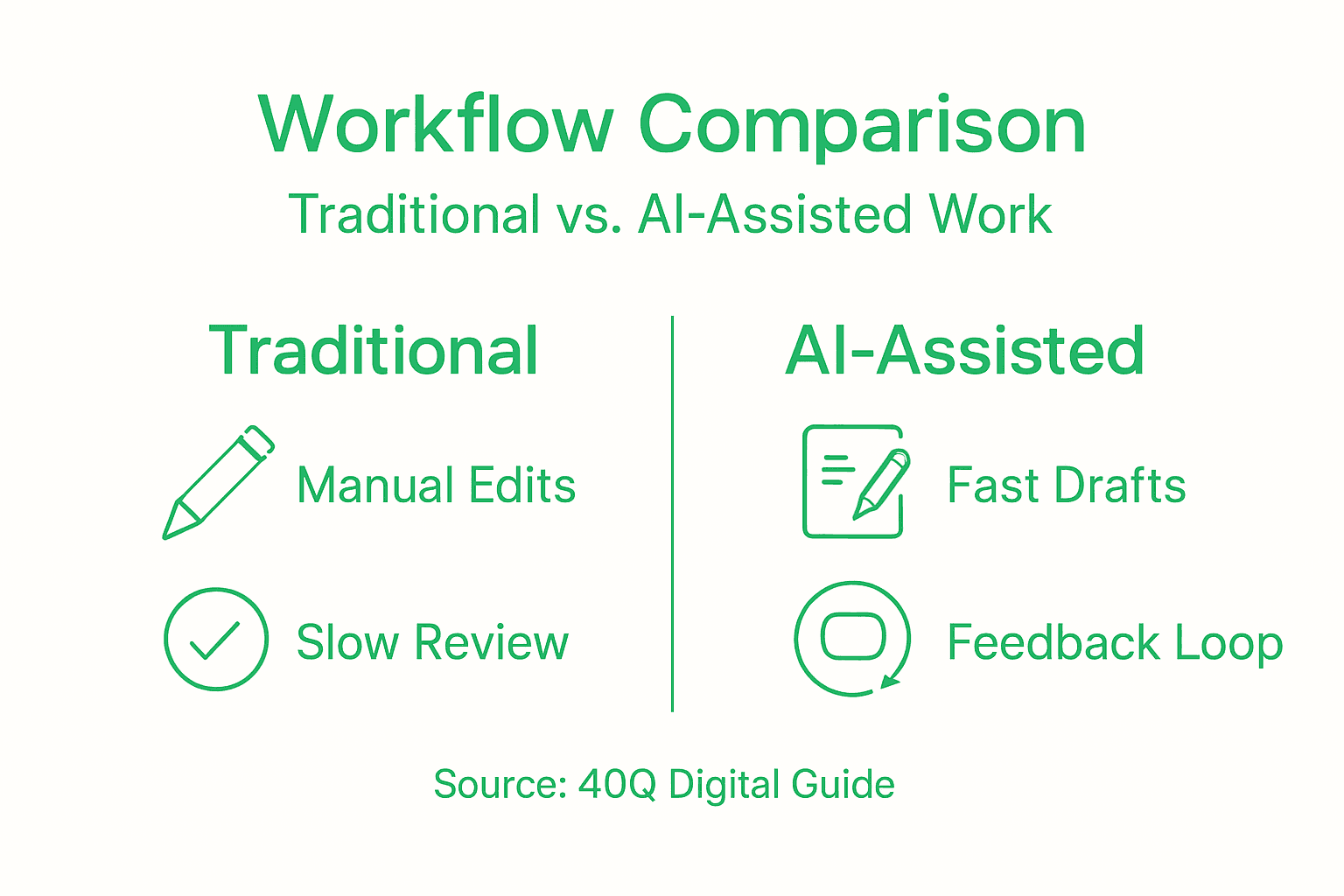
Compare how traditional vs. AI-assisted content workflows impact marketing teams:
| Aspect | Traditional Workflows | AI-Assisted Workflows |
|---|---|---|
| Speed | Manual, slower delivery | Accelerated, near real-time |
| Human Involvement | High, repetitive tasks | Focus on strategy and creativity |
| Error Rate | Higher, prone to oversight | Lower, automated checks |
| Scalability | Limited by staff bandwidth | Easily scales to demand |
| Quality Control | Inconsistent enforcement | Automated, standardized checks |
Step 4: Ensure robust security and governance controls
Ensuring robust security and governance controls is critical for enterprise digital platforms that handle sensitive marketing content and data. This strategic approach protects your organization from potential security risks while maintaining operational flexibility and compliance standards.
Implement comprehensive security governance frameworks through these essential steps:
- Define clear access management protocols
- Establish multi-layered authentication requirements
- Create granular permission hierarchies
- Develop comprehensive compliance monitoring
- Design incident response mechanisms
Begin by conducting a thorough audit of your current security infrastructure. Identify potential vulnerabilities across your digital content platforms, focusing on access controls, data encryption, and user authentication mechanisms. Your goal is to create a seamless yet secure environment that minimizes risk without impeding team productivity.
Security is not about restricting access, but about enabling controlled, intelligent collaboration that protects organizational assets.
Implement your governance strategy through a structured approach:
- Map current user access levels
- Design role-based permission structures
- Develop comprehensive security policies
- Implement continuous monitoring systems
- Create regular security awareness training
Pro tip: Develop a dynamic security governance framework that can adapt quickly to emerging technological threats while maintaining compliance with industry regulations.
Step 5: Validate campaign performance and compliance
Validating campaign performance and compliance is crucial for enterprise marketing teams seeking to maximize strategic insights while maintaining regulatory standards. This systematic approach ensures your marketing efforts are both effective and legally defensible across diverse operational environments.
Implement comprehensive campaign tracking foundations through these strategic steps:
- Standardize tracking parameter protocols
- Define consistent naming conventions
- Establish performance measurement frameworks
- Create cross-functional validation checkpoints
- Document compliance evidence trails
Begin by conducting a detailed review of your current campaign measurement infrastructure. Identify potential gaps in data collection, performance attribution, and regulatory documentation that could compromise your marketing intelligence or expose the organization to compliance risks.
Campaign validation is not just about measuring results, but about creating a transparent, accountable system that demonstrates marketing’s strategic value.
Execute your validation strategy through a structured methodology:
- Map existing performance tracking mechanisms
- Design standardized reporting templates
- Implement automated compliance checks
- Develop real-time monitoring dashboards
- Create periodic audit and reconciliation processes
Pro tip: Develop a dynamic performance validation framework that integrates technical measurement with legal compliance, enabling your marketing team to move quickly while maintaining rigorous standards.
Here’s a summary of how each step enhances enterprise marketing operations:
| Step | Core Focus | Main Benefit | Example Outcome |
|---|---|---|---|
| 1. Assess Autonomy | Workflow independence | Empowers independent action | Faster campaign approvals |
| 2. WordPress FAS Block | Modular content blocks | Streamlines content creation | Consistent website layouts |
| 3. AI-Assisted Workflows | Automate content tasks | Boosts efficiency & scalability | Quicker content production |
| 4. Security & Governance | Access controls, compliance | Protects sensitive data | Reduced security risks |
| 5. Campaign Validation | Performance & compliance | Ensures accurate reporting | Regulatory audit readiness |
Empower Your Marketing Team with Agile Digital Experience Solutions
The “Digital Experience Optimization Guide for Enterprise Teams” highlights the critical challenges marketing teams face today: balancing autonomy with governance, streamlining AI-assisted content workflows, and ensuring robust security while speeding up content delivery. If your team struggles with developer dependency slowing campaign launches or wrestles with inefficient content workflows, it is time to adopt a solution designed specifically for enterprises seeking both speed and control.
At 40Q, we specialize in empowering medium and large organizations through our proprietary FAS Block System™ that transforms WordPress platforms into enterprise-grade content engines. This system allows marketing teams to effortlessly build landing pages, run campaigns, and manage localized content without waiting on IT, while your security and compliance teams maintain full governance oversight. Discover how our focus on marketing autonomy, AI-assisted workflows, and enterprise security can unlock your team’s full potential and accelerate your digital experience strategy.
Take the next step in optimizing your digital marketing operations today. Visit 40Q to learn how you can eliminate developer bottlenecks and boost productivity with scalable, secure WordPress solutions designed for demanding enterprise needs.
Discover 40Q’s Enterprise WordPress Solutions
Frequently Asked Questions
Recommended

Feb 19, 2026
WordPress
7 Key Digital Publishing Advantages for Modern Enterprises
Apr 14, 2026
WordPress
Marketing compliance guide: tools, workflows, best practices

Mar 17, 2026
WordPress