
WordPress
Role of IT in Content Management Success

José Debuchy
February 11, 2026 | 3 min to read
Managing ever-increasing content complexity is now a daily reality for global marketing operations managers. As expectations for speed and personalization rise, the pressure to deliver high-performing content while maintaining IT governance and robust security grows sharper. This article clarifies IT’s pivotal role in enterprise content management, showing how successful organizations balance creative agility with strategic controls for greater content impact.
Key Takeaways
| Point | Details |
|---|---|
| IT as a Strategic Enabler | IT has evolved from mere data storage to a key player in content management, shaping processes that maximize content’s business value. |
| Integration of Advanced Technologies | Embracing generative AI, headless CMS, and API-driven systems is essential for creating responsive, efficient content ecosystems. |
| Balancing Governance with Innovation | Organizations need to develop collaborative frameworks that align IT governance with marketing creativity for optimal results. |
| Proactive Security Strategies | A comprehensive approach to security and compliance should empower employees while protecting critical content assets effectively. |
Defining IT’s Role in Content Management
In the digital transformation era, Information Technology (IT) has become the critical backbone of enterprise content management strategies. IT’s role extends far beyond traditional data storage, evolving into a strategic enabler that shapes how organizations create, manage, distribute, and govern content across complex digital ecosystems.
Modern IT departments are responsible for implementing and maintaining sophisticated content management systems that support comprehensive organizational needs. These systems must address multiple critical requirements:
- Platform Integration: Connecting content repositories across different departments and systems
- Security Governance: Ensuring robust access controls and data protection
- Workflow Automation: Streamlining content creation and approval processes
- Performance Optimization: Managing content delivery and accessibility at scale
The technological landscape for content management has dramatically shifted, with IT now playing a pivotal role in content lifecycle management. Enterprise content management is no longer just about storing documents but about creating intelligent, adaptive systems that can handle diverse media formats, support collaborative workflows, and integrate emerging technologies like artificial intelligence.

Strategically, IT transforms content management from a passive storage function into a dynamic, intelligent process. By leveraging advanced platforms and tools, IT enables organizations to treat content as a strategic asset – something to be actively managed, analyzed, and optimized for maximum business value.
Pro tip: Develop a comprehensive content management strategy that views IT as a strategic partner, not just a technical support function.
Key Technologies Shaping Content Management
The landscape of content management is rapidly evolving, driven by transformative technologies that are redefining how organizations create, manage, and distribute digital content. Advanced digital asset management systems now represent the cutting edge of enterprise content strategies, enabling unprecedented levels of efficiency and personalization.
Key technologies driving this transformation include:
- Generative AI Tools: Accelerating content creation and ideation
- Headless CMS Platforms: Enabling flexible, multi-channel content delivery
- Cloud-Native Content Systems: Supporting scalable, distributed workflows
- API-Driven Integration: Connecting disparate content ecosystems
- Machine Learning Personalization: Tailoring content experiences dynamically
Enterprise content management has shifted from a technical infrastructure problem to a strategic business capability. Modern platforms now incorporate intelligent automation, predictive analytics, and AI-driven insights that transform content from a static resource into a dynamic, adaptive asset.
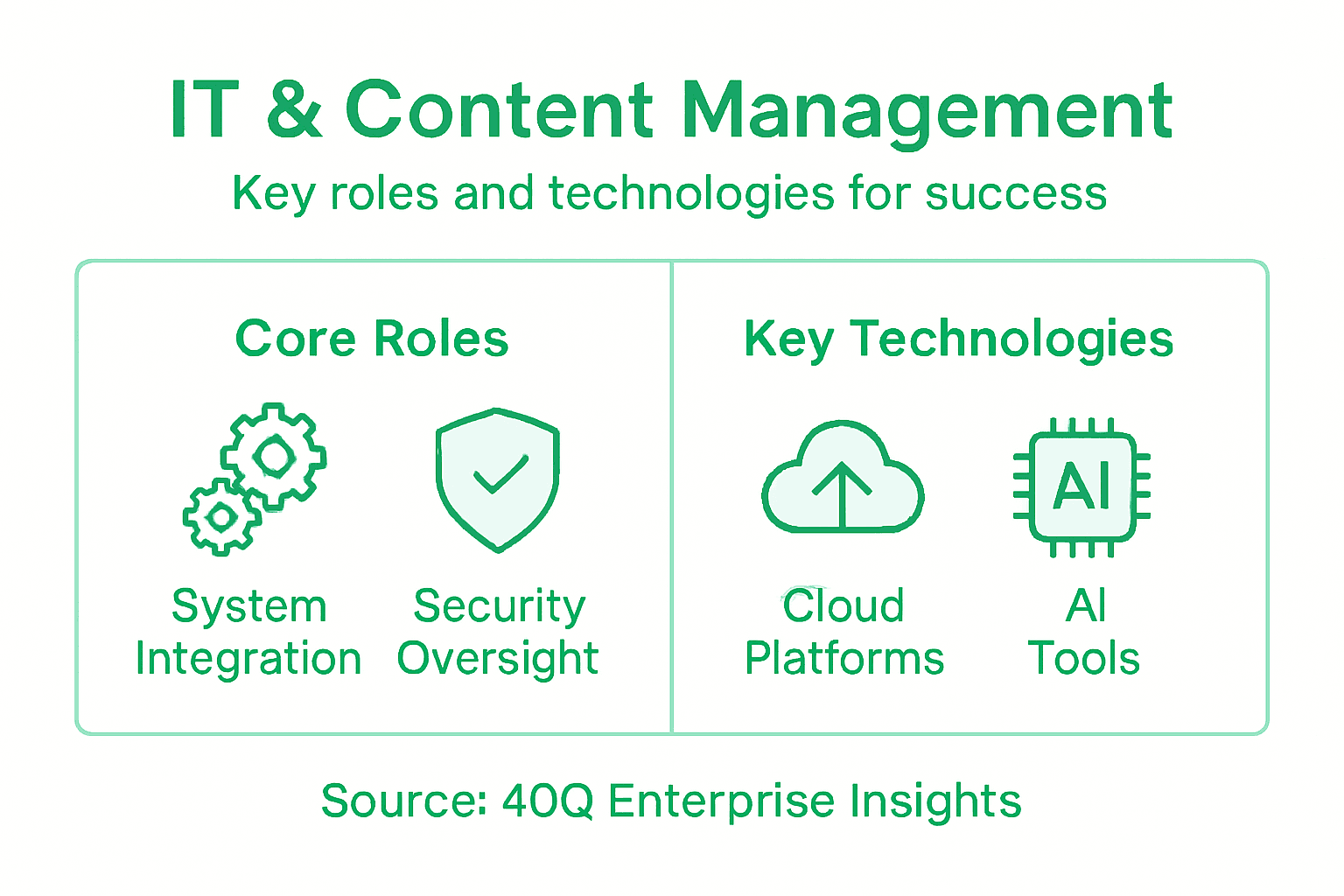
The technological convergence of cloud computing, artificial intelligence, and advanced analytics is creating a new paradigm for content management. By leveraging extensible CMS architectures, organizations can now create more agile, responsive, and intelligent content ecosystems that adapt in real-time to changing business needs and audience expectations.
Pro tip: Invest in technologies that offer seamless integration, AI capabilities, and flexible architecture to future-proof your content management strategy.
For a better understanding of leading content management technologies, here’s a summary of their key business advantages:
| Technology | Business Impact | Scalability Potential |
|---|---|---|
| Generative AI Platforms | Boosts content ideation speed | Easily adapts to growth |
| Headless CMS | Enables multi-channel reach | Works across global sites |
| Cloud Content Systems | Supports remote collaboration | Infinite storage capacity |
| API Integration | Connects diverse workflows | Flexible for new tools |
Balancing IT Governance With Marketing Autonomy
The dynamic between IT governance and marketing autonomy represents a critical challenge for modern enterprises seeking to maintain both security and creativity. Inherent tensions between algorithmic controls and creative freedom require sophisticated strategies that align technological constraints with marketing innovation.
Successful approaches to balancing governance and autonomy typically involve:
- Clear Policy Frameworks: Establishing transparent rules and expectations
- Flexible Permission Structures: Creating granular access controls
- Cross-Functional Collaboration: Developing shared understanding between departments
- Automated Compliance Tools: Implementing systems that enforce guidelines seamlessly
- Continuous Training Programs: Educating teams on governance requirements
Modern content management demands a nuanced approach that transcends traditional departmental boundaries. By implementing integrated data governance policies, organizations can create environments where marketing teams maintain creative momentum while IT ensures robust security and compliance.
The key lies in developing a symbiotic relationship where governance becomes an enabler rather than a restrictive force. By leveraging advanced content management platforms with intelligent workflows, enterprises can create ecosystems that simultaneously protect organizational assets and empower marketing creativity.
Here’s a quick overview of how IT and marketing objectives intersect in modern content management:
| Objective | IT Focus | Marketing Focus | Synergy Benefit |
|---|---|---|---|
| Security Compliance | Data protection protocols | Brand reputation safety | Trustworthy content delivery |
| Workflow Innovation | Automation and integration | Agility and creativity | Faster campaign launches |
| Access Management | Role-based permissions | Flexible collaboration | Enhanced cross-team results |
| Analytics Utilization | Predictive insights | Customer engagement data | Smarter content targeting |
Pro tip: Develop a collaborative governance model that treats IT and marketing as strategic partners, not competing departments.
Security, Compliance, and Risk Management Strategies
Enterprise content management demands a comprehensive approach to security that goes beyond traditional defensive mechanisms. Robust data governance frameworks have become essential for organizations navigating increasingly complex digital risk landscapes.
Key strategies for effective security and compliance include:
- Proactive Threat Detection: Implementing advanced monitoring systems
- Multi-Layered Defense Approaches: Creating comprehensive security protocols
- Automated Compliance Workflows: Reducing human error and standardizing processes
- Regular Security Audits: Continuously evaluating and improving risk management
- Role-Based Access Controls: Limiting system permissions strategically
Modern enterprises must develop sophisticated risk management approaches that integrate technological solutions with organizational culture. This means moving beyond technical controls to create a holistic security ecosystem that empowers employees while protecting critical content assets.
The most successful organizations treat security not as a restrictive force but as an enabling strategy that supports business innovation. By developing adaptive, intelligent risk management frameworks, enterprises can create resilient content management environments that balance protection with operational flexibility.
Pro tip: Develop a security strategy that views compliance as a collaborative process, not a punitive mechanism.
Accelerating Enterprise Content Workflows With IT Innovation
The digital transformation of content management is being driven by groundbreaking technological innovations that fundamentally reimagine organizational workflows. AI-powered intelligent workflow technologies are revolutionizing how enterprises create, manage, and distribute content across complex digital ecosystems.
Key technological innovations accelerating content workflows include:
- Natural Language Processing: Enabling intelligent content tagging and categorization
- Predictive Analytics: Forecasting content performance and audience engagement
- Automated Metadata Generation: Reducing manual classification efforts
- Machine Learning Content Personalization: Dynamically adapting content experiences
- Cross-Platform Content Synchronization: Ensuring consistent messaging
Enterprises are increasingly leveraging process automation and intelligent workflows to transform traditional content management approaches. These technologies enable organizations to convert raw data into actionable intelligence, dramatically reducing time-to-market and improving operational efficiency.
By embracing AI-driven innovations, IT departments can create adaptive content management environments that seamlessly integrate human creativity with technological precision. This approach moves beyond traditional workflow optimization, positioning content as a strategic asset that can be dynamically managed and continuously improved.
Pro tip: Implement incremental AI workflow innovations, focusing on measurable outcomes and continuous learning.
Empower Your IT and Marketing Teams for Content Management Success
The article highlights critical challenges enterprises face balancing IT governance, security, and scalable content workflows while empowering marketing autonomy and creativity. If you are struggling with developer dependency, slow campaign launches, or the need for secure, scalable content solutions aligned with evolving AI-assisted workflows, you are not alone. Modern enterprises require platforms that deliver robust security, seamless integration, and agility without compromising compliance or long-term maintainability.
At 40Q, we specialize in building enterprise-grade WordPress platforms designed to address these exact pain points. Our proprietary FAS Block System™ gives marketing teams direct control over launching landing pages, campaigns, and localized content rapidly. Meanwhile, IT retains full authority to manage performance, security, and governance at scale. Discover how our solution blends marketing autonomy with IT’s need for control by visiting 40Q Agency today. To learn more about how strategic IT involvement drives content success, explore our enterprise WordPress platform that empowers your teams to innovate securely and efficiently. Take control of your content management destiny with 40Q now.
Frequently Asked Questions
Recommended

Feb 12, 2026
WordPress
Digital Experience Optimization Guide for Enterprise Teams
Jan 13, 2026
WordPress
Cloud-Based WordPress: Empowering Enterprise Autonomy
Oct 28, 2025
WordPress