
WordPress
Why Decouple Marketing and IT: Boost Speed and Control

José Debuchy
February 23, 2026 | 3 min to read
Every Digital Marketing Director knows the frustration when campaign launches stall because IT holds the keys to every update. For content-heavy organizations across North America, this tension between speed and governance is real. By embracing decoupled marketing and IT roles, your team gains agility without sacrificing IT standards. This approach clarifies responsibilities, accelerates execution, and creates space for innovation while keeping enterprise security intact.
Key Takeaways
| Point | Details |
|---|---|
| Decoupling Enhances Efficiency | Clearly defined marketing and IT roles accelerate decision-making and reduce dependency, allowing teams to operate faster. |
| Autonomy Increases Accountability | Marketing gains control over execution, while IT focuses on security and compliance, increasing responsibility in both areas. |
| Effective Communication is Essential | Ongoing communication between marketing and IT is crucial to prevent silos and ensure alignment on shared goals. |
| Structured Flexibility Facilitates Adaptation | Build flexibility into processes to enable teams to quickly adjust to changing market conditions without compromising control. |
Defining Decoupled Marketing and IT Roles
Decoupling marketing and IT isn’t about creating silos. It’s about establishing clarity in who does what and why. When these teams operate with defined responsibilities, marketing moves faster while IT maintains governance. Both win.
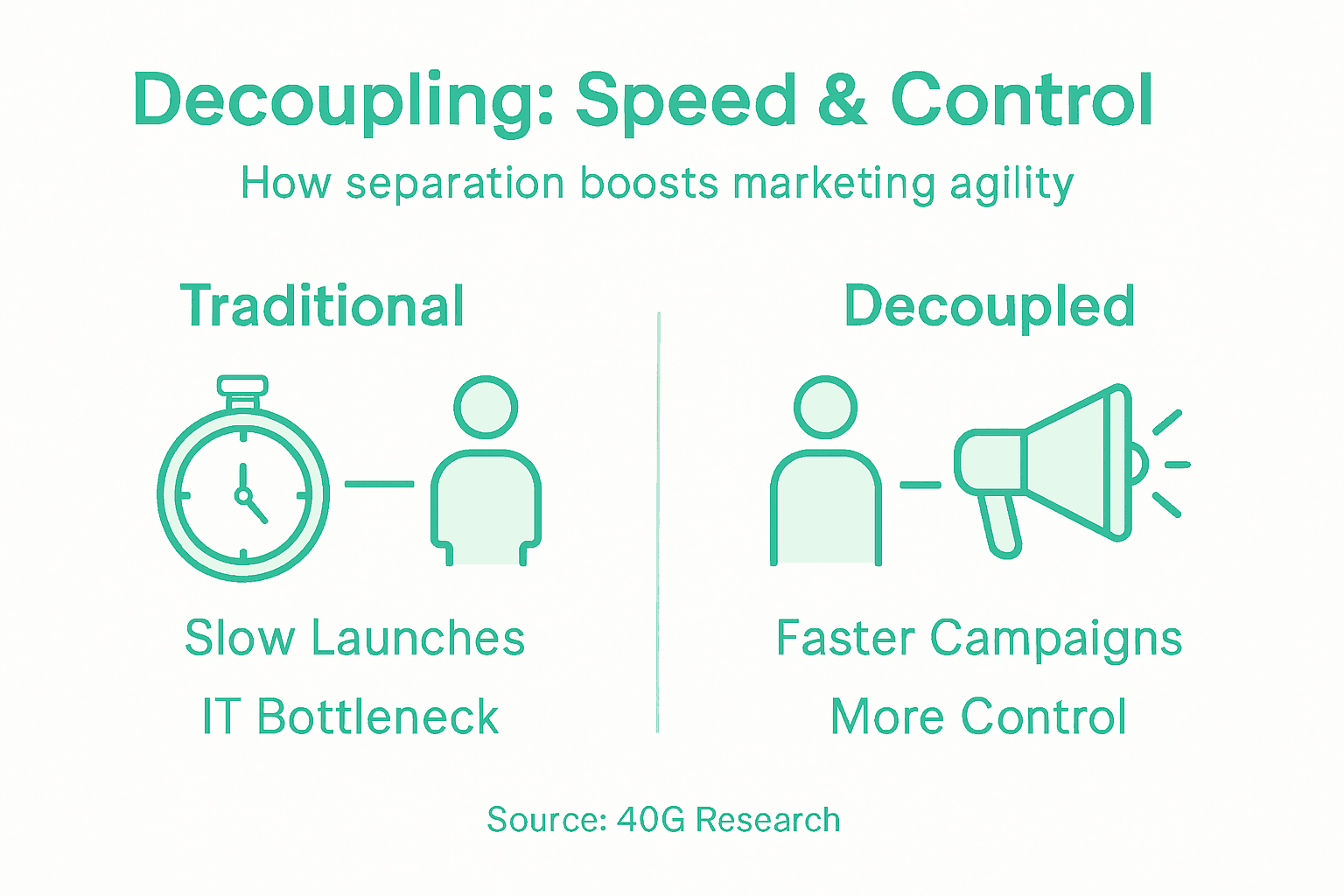
Traditionally, marketing relied on IT for almost every digital initiative. A new landing page? IT needed to build it. Update website copy? IT had to deploy it. This dependency slowed campaigns to a crawl. Digital transformation requires clear role definitions where marketing can act autonomously while IT protects infrastructure.
What Decoupling Actually Means
Decoupling separates day-to-day marketing execution from IT infrastructure management. Marketing gains control over publishing, campaign deployment, and content decisions. IT focuses on security, performance, scalability, and system reliability.
This isn’t a power grab. It’s a functional divide based on expertise:
- Marketing owns: Campaign strategy, content creation, audience targeting, messaging, and launch timing
- IT owns: Security protocols, system architecture, data integration, compliance, and infrastructure health
When marketing controls what they’re good at and IT controls what they’re good at, organizations move 3-5 times faster than traditional hierarchies.
The separation enables marketing analytics to optimize customer insights and campaign performance while IT manages the underlying data architecture.
The Real Benefit
Decoupling reduces bottlenecks. Marketing teams no longer wait weeks for IT approval to launch a campaign variation. IT no longer gets pulled into content decisions that aren’t their responsibility.

You eliminate the middle ground where neither team fully owns outcomes. Marketing accountability increases because they control execution. IT accountability increases because system reliability is their domain.
For organizations like yours with high-traffic content needs, this separation is critical. A single developer cannot remain the gatekeeper for 50+ marketing initiatives monthly.
Here’s how marketing and IT responsibilities typically shift after decoupling:
| Area of Responsibility | Traditional Approach | Decoupled Approach |
|---|---|---|
| Website Updates | IT manages all changes | Marketing updates content directly |
| Security and Compliance | Shared, often unclear | Fully owned by IT |
| Campaign Launches | IT builds and deploys | Marketing launches autonomously |
| Data Governance | Reactive, ad hoc | Proactively maintained by IT |
| Platform Selection | IT chooses tools | Joint selection based on needs |
Pro tip: Start by documenting exactly which decisions each team makes independently, which require collaboration, and which need approval chains. This clarity document becomes your operating manual.
How Decoupling Drives Marketing Agility
Speed wins in today’s market. When marketing waits for IT approval on every decision, competitors move faster. Decoupling removes that friction, enabling marketing teams to act with autonomy and respond to opportunities in hours instead of weeks.
Traditional structures create bottlenecks. A social media campaign opportunity emerges, but the request sits in an IT queue for 10 days. By then, the moment passes. Decoupling fixes this by giving marketing direct control over publishing and campaign execution while IT handles what they’re built for—security and infrastructure.
Speed Through Autonomy
When marketing operates independently from IT dependencies, decisions happen faster. Your team doesn’t need to wait for developer availability to update copy, adjust targeting, or launch variations. Marketing agility improves when teams act without extensive IT dependencies that delay execution.
This autonomy transforms how quickly you respond:
- Launch campaign variations in days, not weeks
- Test new messaging without technical approval cycles
- Adjust audience targeting based on real-time performance data
- Deploy localized content across regions independently
- Iterate on landing pages without developer hand-offs
Decoupled organizations move 3-5 times faster than traditional hierarchies. Your team can validate ideas and optimize campaigns while competitors are still planning.
Responding to Market Shifts
Markets change rapidly. Customer behavior shifts. Competitors launch new offers. Organizations reduce delays and promote cultural flexibility when marketing operates with autonomy, enabling faster adaptation to market conditions.
Your marketing team can pivot strategy mid-month. You’re not waiting for IT resources. You’re not explaining technical requirements. You’re executing.
This matters for enterprise organizations. High-traffic websites require constant optimization. One team managing everything becomes the single point of failure. Decoupling distributes responsibility and accelerates decision-making.
The following table summarizes business outcomes of decoupling marketing and IT:
| Outcome | Speed Impact | Accountability Effect |
|---|---|---|
| Faster Campaigns | Launch in days, not weeks | Marketing directly responsible |
| Improved Security | Fewer rushed approvals | IT focused on governance |
| Easier Compliance | Compliance built into platforms | Automated audit trails |
| Enhanced Innovation | More room for experiments | Shared post-launch reviews |
Experimentation Without Barriers
Innovation requires testing. Decoupling enables your team to experiment with new tools, platforms, and approaches without navigating IT bureaucracy. You test new technologies, measure results, and scale what works.
IT still governs security and compliance. Your team still operates within approved systems. But you’re not blocked waiting for permission to try something.
Pro tip: Establish a monthly “agility checkpoint” where marketing and IT review what launched, what succeeded, and what needs adjustment. This keeps autonomy aligned with governance.
Enterprise Security and IT Governance Benefits
Decoupling marketing and IT doesn’t mean abandoning security or compliance. In fact, it strengthens both. When IT focuses exclusively on infrastructure, security, and governance, they do it better. Marketing operates within guardrails IT establishes, not around them.
Most organizations worry that giving marketing autonomy creates risk. The opposite is true. Clear separation of duties actually improves security posture and governance compliance.
Governance Without Bottlenecks
Enterprise governance frameworks enable organizations to maintain security and compliance while supporting agile operations. IT establishes policies, security controls, and approval workflows upfront. Marketing then operates within those boundaries independently.
This model distributes control intelligently:
- IT defines: Security protocols, data access rules, compliance requirements, and approved tools
- Marketing executes: Campaigns, content, and launches within those defined parameters
- Both benefit: Speed increases because approvals happen at the policy level, not per project
Effective governance balances autonomy with accountability. Marketing moves fast. IT sleeps better. Both teams win.
Reduced Security Risk
When a single developer approves every marketing request, that person becomes a security bottleneck. They’re making quick decisions under pressure, not conducting proper security reviews. Decoupling fixes this by having IT establish security frameworks upfront.
COBIT governance frameworks help organizations achieve value from IT while managing risks and ensuring compliance. Your IT team uses these frameworks to build secure systems, then marketing operates confidently within them.
You reduce risk through clarity, not restriction.
Compliance That Scales
For large organizations with multiple brands or regions, compliance becomes complex fast. One developer cannot audit every change across 50+ marketing sites. Decoupling enables IT to build compliance into the platform itself.
Marketing publishes within an already-compliant system. No manual approval needed for routine changes. Compliance happens automatically because the system enforces it.
Accountability and Auditability
When marketing operates within IT-governed systems, every action is logged. Who published what? When? What changed? IT has complete visibility without micromanaging. This creates the audit trail regulators want to see.
Traditional hierarchies lack this clarity. Decoupled structures document everything.
Pro tip: Implement quarterly governance reviews where IT audits marketing activities, compliance metrics, and security incidents. This keeps both teams aligned and identifies gaps before they become problems.
Common Decoupling Challenges and Risks
Decoupling isn’t a silver bullet. Done poorly, it creates new problems. Teams operate in silos. Communication breaks down. Projects conflict instead of complement each other. Understanding these risks upfront helps you avoid them.
The goal isn’t perfect separation—it’s intentional coordination with clear boundaries. You need mechanisms to keep both teams aligned even as they operate independently.
Fragmentation and Misaligned Goals
When teams decouple without proper communication structures, fragmentation and reduced coordination can lead to misaligned objectives and lost synergy between functions. Marketing launches a campaign promoting a new feature. IT didn’t know about the feature launch timing. The infrastructure isn’t prepared for the traffic spike.
This happens when decoupling becomes a wall instead of a bridge.
Prevent fragmentation through:
- Monthly joint planning meetings where both teams review roadmaps
- Shared dashboards showing campaign performance and system health
- Clear handoff protocols for major launches
- Regular sync points on technology decisions
Operational Silos and Slow Innovation
Strategic decoupling can create operational silos and slower innovation diffusion when coordination mechanisms aren’t established. Marketing discovers a tool that could accelerate content creation. They don’t mention it to IT. IT doesn’t know what tools are being used. Security gaps emerge because nobody’s tracking the technology landscape.
Silos form when teams stop talking to each other.
Data and Security Conflicts
Marketing wants to connect to a third-party analytics platform. IT worries about data security and compliance. Without clear governance, you get either gridlock or marketing working around IT entirely.
The solution isn’t choosing sides. It’s establishing shared governance frameworks upfront where both teams agree on data handling, security standards, and approved tools.
Communication Breakdown
Decoupling requires more communication, not less. Paradoxical? Yes. But true. Independent teams need structured touchpoints or they drift apart.
Without intentional coordination channels, you lose critical information about dependencies, risks, and opportunities.
Managing the Risks
These challenges are manageable. They require:
- Clear communication protocols: Regular syncs, documented decisions, shared visibility
- Shared governance: Policies both teams create and follow
- Feedback mechanisms: Channels for reporting conflicts or concerns
- Aligned metrics: Both teams track outcomes that matter to the organization
Decoupling works when there’s more coordination, not less. Structure your communication intentionally.
Pro tip: Create a “coordination calendar” with mandatory monthly sync meetings, quarterly business reviews, and an escalation process for conflicts. Document all decisions in a shared wiki both teams can access.
Keys to Successful Marketing-IT Collaboration
Decoupling marketing and IT doesn’t mean they stop working together. It means they work together differently. Instead of IT gatekeeping marketing decisions, both teams coordinate around shared goals. The relationship shifts from hierarchical to collaborative.
Successful decoupling requires intentional collaboration mechanisms. Without them, you get fragmentation. With them, you get speed plus governance.
Establish Transparent Communication
Clear communication is foundational. Marketing needs to understand IT constraints. IT needs to understand marketing timelines. Transparent communication and clearly defined roles reduce misunderstandings and enhance joint problem-solving capabilities.
Not once per quarter. Continuously.
Build communication into your regular cadence:
- Weekly: Brief syncs on current projects and blockers
- Monthly: Deeper planning reviews and technology updates
- Quarterly: Strategic alignment and retrospectives on what worked
Define Roles and Decision Rights Clearly
Ambiguity kills collaboration. When both teams are unclear who decides what, you get conflict. Define decision rights upfront. Marketing approves messaging and targeting. IT approves infrastructure and security. Some decisions require both.
Document this. Make it searchable. Reference it constantly.
Clear role definition prevents turf wars. When everyone knows what they own, collaboration flows naturally.
Use Shared Collaboration Tools
Don’t rely on emails and meetings. Use project management platforms where both teams see the same information. Marketing sees when IT needs data. IT sees when marketing launches campaigns that impact infrastructure.
Shared visibility prevents surprises. Surprises create friction.
Agree on Metrics That Matter to Both
Marketing cares about campaign performance. IT cares about system reliability. But both care about outcomes. Define shared metrics:
- Campaign time-to-launch (marketing wants fast, IT wants stable)
- System uptime during peak campaign periods
- Security incidents prevented through governance
- Customer experience quality
When both teams track the same outcomes, they naturally align.
Build in Flexibility
Plans change. Markets shift. Requirements evolve. Rigid processes break collaboration. Build flexibility into your governance so teams can adapt without abandoning standards.
This isn’t a free-for-all. It’s structure with breathing room.
Create an Escalation Process
Conflicts happen. Marketing wants to use a tool. IT has security concerns. Without a clear escalation path, disputes fester. Establish who decides when teams disagree, and make that decision fast.
Speed in escalation matters as much as speed in execution.
Pro tip: Assign a “collaboration champion” from each team responsible for maintaining communication channels, tracking decisions, and flagging emerging conflicts before they become problems.
Empower Your Marketing with Speed and Security Through Decoupling
The article highlights key challenges of marketing teams trapped by IT dependencies and bottlenecks. If you want to accelerate campaign launches, eliminate the wait for developer resources, and maintain enterprise-grade security, decoupling marketing and IT roles is essential. Marketing autonomy combined with IT governance leads to faster execution without sacrificing compliance or system stability.
At 40Q, we specialize in providing enterprise-grade WordPress platforms designed exactly for this balance. Our proprietary FAS Block System™ puts publishing power directly in marketers’ hands, enabling fast campaign and content launches while IT retains full control over security, performance, and scalability. This approach empowers high-traffic organizations to move 3-5 times faster with confidence.

Discover how to eliminate developer bottlenecks and boost your marketing agility without risking your security posture. Visit our homepage to learn about our WordPress VIP partnership. Explore the benefits of marketing autonomy combined with enterprise security at 40Q. Take the first step to transform your operation now.
Frequently Asked Questions
Recommended

Feb 20, 2026
WordPress
Web Maintainability: Empowering Enterprise Teams for Growth

Mar 8, 2026
WordPress
Landing page optimization tips for enterprises on WordPress 2026
Oct 14, 2025
WordPress