
WordPress
Why scalable CMS is essential for enterprise success

José Debuchy
March 18, 2026 | 3 min to read
Enterprise leaders are making a decisive shift: 66% are migrating from legacy CMS platforms to reduce total cost of ownership and unlock AI capabilities. This movement reflects a fundamental truth that many organizations learned the hard way: not all content management systems scale equally. Legacy platforms that served enterprises well for internal collaboration often buckle under public-facing demands, leaving marketing teams frustrated and IT departments firefighting performance issues. Understanding what makes a CMS truly scalable and why it matters in 2026 is no longer optional for organizations seeking competitive advantage through digital channels.
Key takeaways
| Point | Details |
|---|---|
| Cost reduction | Scalable CMS platforms reduce total cost of ownership through efficient resource utilization and elimination of vendor lock-in. |
| Operational efficiency | Modern architectures enable marketing teams to publish content faster while IT maintains control over security and performance. |
| AI readiness | Scalable platforms support AI-powered personalization and content workflows without architectural constraints. |
| Technical foundation | Horizontal scaling, edge caching, and API-first design enable independent scaling of content authoring and delivery systems. |
| Migration imperative | Legacy CMS limitations in public scalability create performance bottlenecks that modern headless solutions systematically eliminate. |
Understanding what makes a CMS scalable
Scalability in content management refers to a platform’s ability to handle increasing traffic, content volume, and user demands without performance degradation. This concept extends beyond simply throwing more hardware at the problem. True scalability requires architectural decisions that allow different system components to grow independently based on actual demand patterns.
Two fundamental approaches define how platforms scale. Vertical scaling adds more power to existing servers by upgrading CPU, memory, or storage capacity. Horizontal scaling distributes load across multiple servers, allowing systems to handle exponentially more traffic by adding machines rather than upgrading individual ones. Most enterprise CMS platforms combine both approaches, but horizontal scaling provides the unlimited growth potential that modern enterprises require.
Edge caching represents another critical scalability mechanism. By storing frequently accessed content on servers geographically distributed near end users, organizations dramatically reduce latency and server load. When a visitor in Tokyo requests a page, edge caching serves it from a nearby server rather than routing the request to a data center in Virginia. This approach not only improves user experience but also prevents traffic spikes from overwhelming origin servers.
API-first architecture fundamentally changes how content flows through systems. Traditional monolithic CMS platforms tightly couple content creation, storage, and presentation layers. API-first designs decouple these functions, allowing content authoring systems to scale independently from delivery infrastructure. Marketing teams can create content in one environment while multiple websites, mobile apps, and digital displays consume that content through APIs. This separation enables organizations to scale with confidence by optimizing each layer for its specific demands.
These technical foundations solve common bottlenecks that plague legacy systems. When a marketing campaign drives unexpected traffic, horizontally scaled systems automatically spin up additional servers. Edge caching ensures global audiences receive fast responses regardless of geographic location. API-first designs prevent content authoring activities from impacting public-facing performance. Together, these mechanisms create platforms that grow seamlessly with business needs.
Pro Tip: Evaluate potential CMS platforms by asking how they handle traffic spikes during major campaigns. Platforms that rely primarily on vertical scaling will eventually hit hard limits, while those built for horizontal scaling can theoretically handle unlimited growth.
The impact of scalability on enterprise operations and AI integration
Total cost of ownership extends far beyond initial licensing fees. Legacy platforms often trap organizations in expensive upgrade cycles, require specialized developer resources for routine changes, and generate hidden costs through performance issues and downtime. Scalable CMS platforms reduce these expenses by enabling efficient resource utilization and eliminating architectural constraints that drive up operational costs.
Operational efficiency gains manifest across both marketing and IT teams. Marketing departments gain the ability to publish content, launch campaigns, and personalize user experiences without submitting tickets to development teams. IT departments shift from constant firefighting to strategic initiatives because the platform handles routine scaling automatically. This division of responsibilities allows each team to focus on their core competencies rather than working around platform limitations.

Vendor lock-in represents a hidden cost that many organizations only recognize when attempting to migrate. Proprietary platforms create dependencies that make switching prohibitively expensive, giving vendors leverage to increase prices without fear of customer defection. Modern scalable platforms built on open standards and API-first principles allow organizations to change vendors, swap components, or migrate to different hosting environments without rebuilding entire systems. This flexibility provides negotiating power and protects long-term technology investments.
AI and generative AI capabilities require substantial computational resources and flexible architectures. Scalable platforms support AI-powered personalization by processing user behavior data in real time and serving customized content without performance penalties. They enable content teams to leverage AI writing assistants and automated workflows because the underlying architecture can handle the additional processing demands. Organizations stuck on legacy platforms often discover that AI initiatives require complete platform replacements, turning what should be incremental improvements into massive migration projects.
“The shift to scalable CMS is not just about handling more traffic. It is about creating an operational foundation that supports innovation, reduces dependency on scarce technical resources, and positions organizations to capitalize on AI opportunities without architectural constraints.”
Content velocity becomes a competitive advantage when platforms scale effectively. Marketing teams can test multiple campaign variations, launch localized content for different markets, and respond to trending topics in hours rather than weeks. This agility directly impacts revenue by reducing time to market and enabling rapid iteration based on performance data. Organizations that understand the true cost of their CMS often find that scalability issues create opportunity costs far exceeding direct platform expenses.
Legacy CMS vs modern scalable CMS: challenges and solutions
Traditional enterprise platforms like SharePoint excel at internal collaboration and document management but struggle when deployed for public-facing websites. These systems were architected for controlled user populations and predictable usage patterns. When exposed to internet traffic with its unpredictable spikes and global distribution, legacy platforms encounter performance problems that stem from fundamental architectural assumptions rather than configuration issues.
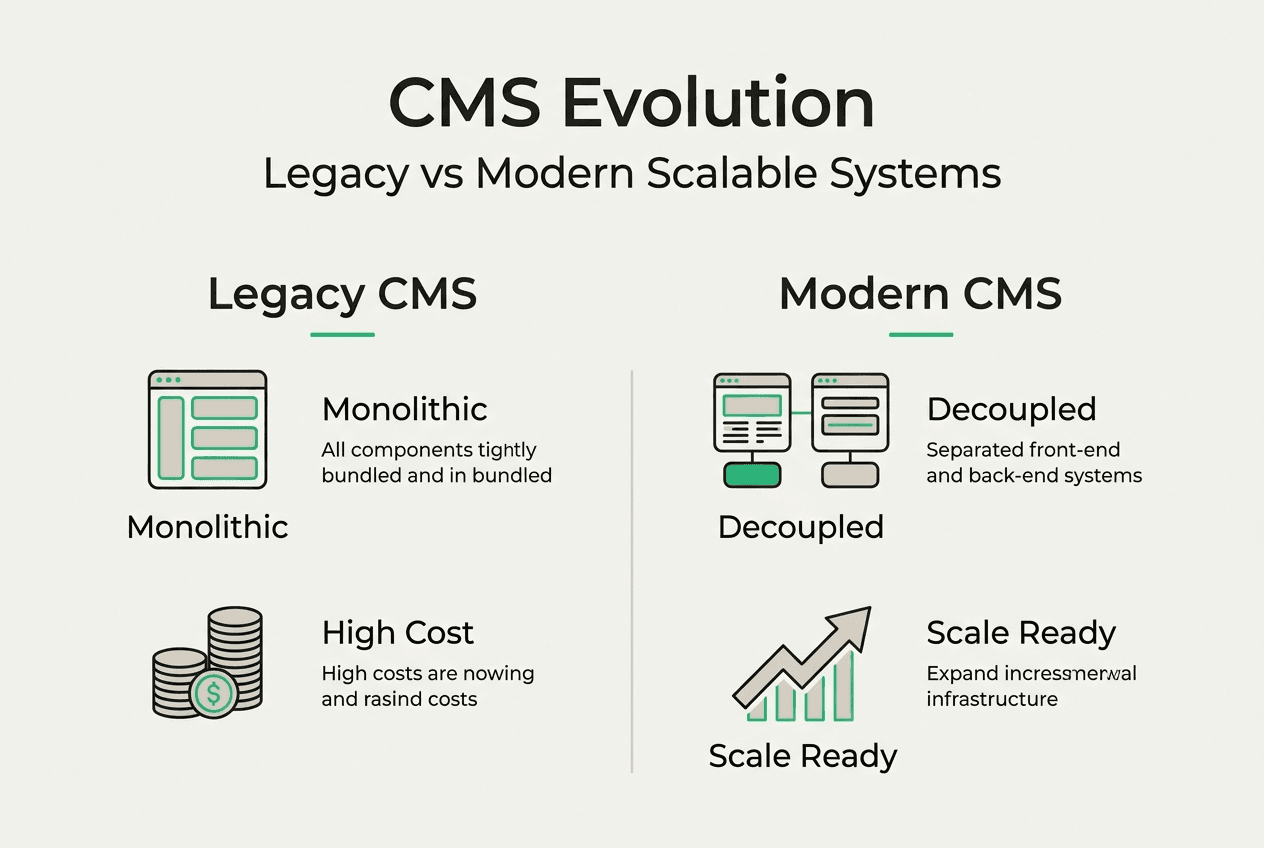
Alignment problems between content authoring and delivery systems create cascading failures. In monolithic architectures, a single bottleneck anywhere in the system impacts everything else. A slow database query affects content editors and public visitors simultaneously. Memory-intensive content processing tasks steal resources from page delivery. These interdependencies mean that routine editorial activities can inadvertently trigger performance degradations for end users.
Bulk publishing operations expose particularly severe limitations in legacy systems. When marketing teams need to publish hundreds of pages simultaneously for a product launch or site redesign, traditional CMS platforms often experience cache storms. Every published page invalidates cached content, forcing the system to regenerate pages under heavy load. The result is slow publishing, timeout errors, and potential site outages during critical business moments.
Modern headless CMS platforms solve these problems through architectural separation. Content authoring happens in a completely isolated environment that never impacts public-facing performance. Event-driven publishing pipelines process content updates asynchronously, preventing cache storms by intelligently managing regeneration sequences. Static site generation pre-builds pages during quiet periods, eliminating dynamic processing during traffic spikes.
| Aspect | Legacy CMS | Modern Scalable CMS |
|---|---|---|
| Architecture | Monolithic, tightly coupled | Decoupled, API-first |
| Scaling approach | Primarily vertical | Horizontal and elastic |
| Content delivery | Dynamic page generation | Edge caching and static generation |
| Bulk publishing | Cache storms and timeouts | Asynchronous event-driven pipelines |
| AI integration | Limited or requires rebuild | Native support for AI workflows |
| Vendor flexibility | Lock-in through proprietary tech | Open standards enable portability |
Migration from legacy to modern platforms requires careful planning but delivers immediate operational benefits. Organizations should begin by documenting current pain points and usage patterns to ensure the new platform addresses real needs rather than theoretical capabilities. Content audits identify which materials require migration versus archival, reducing project scope and timeline. Phased rollouts allow teams to validate performance under real conditions before committing fully to the new platform.
Pro Tip: During migration planning, involve both marketing and IT stakeholders from the start. Marketing teams understand content workflows and publishing requirements while IT teams grasp technical constraints and security needs. This collaboration prevents costly rework when one side discovers the other’s requirements late in the process.
Common migration pitfalls include underestimating content complexity, neglecting to test under realistic load conditions, and failing to train teams on new workflows. Successful migrations treat content as structured data requiring transformation rather than simple copying. Load testing with production-scale traffic reveals performance issues before launch. Comprehensive training ensures teams can leverage new capabilities rather than replicating old workflows on new platforms. Organizations that empower content teams through proper training see faster ROI and higher adoption rates.
Selecting and implementing a scalable CMS for your enterprise
Successful CMS selection begins with honest assessment of current limitations and future requirements. Document specific pain points your teams encounter daily: slow publishing workflows, inability to personalize content, developer dependency for routine changes, or performance issues during traffic spikes. Quantify these problems where possible by measuring time spent on workarounds, opportunity costs from delayed campaigns, or revenue impact from performance degradations. This foundation ensures you evaluate platforms based on solving real problems rather than chasing features.
Evaluating scalability features requires looking beyond marketing materials to architectural fundamentals. Does the platform support horizontal scaling or only vertical? How does it handle edge caching and content delivery networks? What APIs does it expose for integrating with other systems? Can it process bulk publishing operations without performance impact? Request demonstrations using your actual content volume and traffic patterns rather than vendor-prepared scenarios. Organizations that understand scalable WordPress publishing recognize that platform capabilities matter less than how those capabilities perform under real-world conditions.
-
Assess current state and define requirements. Gather quantitative data on content volume, traffic patterns, publishing frequency, and team workflows. Interview stakeholders across marketing, IT, and business units to understand their needs and frustrations. Document both immediate requirements and anticipated growth over the next three to five years.
-
Evaluate platform capabilities and vendor ecosystem. Create a scorecard that weights features based on your specific needs rather than generic best practices. Test platforms with realistic content and traffic scenarios. Assess vendor stability, community support, and partner ecosystem to ensure long-term viability.
-
Plan migration strategy with risk mitigation. Develop a phased rollout that validates assumptions before full commitment. Identify high-value, low-risk content areas for initial migration to build confidence and refine processes. Create rollback plans for each phase to minimize business disruption if issues arise.
-
Leverage professional services for specialized expertise. Engage partners who have completed multiple enterprise CMS migrations rather than attempting to build internal expertise from scratch. Professional services accelerate timelines, avoid common pitfalls, and transfer knowledge to internal teams. Organizations that partner for CMS migration typically achieve production deployment in three to six months versus twelve to eighteen months for fully internal projects.
-
Establish governance and optimization processes. Define clear ownership for platform management, content governance, and performance monitoring. Implement analytics to measure improvements in publishing velocity, page performance, and team productivity. Schedule regular reviews to optimize configurations and identify new opportunities as the platform matures.
Pro Tip: Build a business case that quantifies both hard costs like licensing and hosting plus soft costs like developer time spent on routine changes and opportunity costs from delayed campaigns. Executives respond more favorably to migration proposals that demonstrate clear ROI through operational efficiency gains rather than focusing solely on technical improvements.
Timeline expectations for enterprise CMS migrations vary based on content complexity and organizational readiness. Simple migrations with well-structured content and dedicated teams can reach production in three to four months. Complex scenarios involving content transformation, extensive integrations, or large content volumes typically require six to nine months. The key is setting realistic milestones that allow for proper testing and team training rather than rushing to arbitrary deadlines that compromise quality. Organizations seeking truly enterprise-ready platforms recognize that thoughtful implementation delivers better long-term outcomes than rapid deployment.
Explore scalable CMS solutions with 40Q
Navigating the transition to a scalable CMS requires both technical expertise and strategic understanding of enterprise content operations. 40Q specializes in helping organizations select, migrate to, and optimize WordPress VIP platforms that deliver the scalability and performance that enterprise marketing and IT teams demand. Our proprietary FAS Block System eliminates developer dependency for routine publishing while maintaining the security, governance, and performance controls that IT requires.
Our services span the complete lifecycle from initial assessment through ongoing optimization. We evaluate your current platform limitations, design architectures that support your specific scaling requirements, and execute migrations that minimize business disruption. Post-launch, our performance optimization services ensure your platform continues delivering fast, reliable experiences as traffic and content volume grow. Whether you are exploring options or ready to migrate, understanding what makes a CMS truly enterprise-ready positions you to make informed decisions that deliver lasting value in 2026 and beyond.
Frequently asked questions
Recommended
Oct 28, 2025
WordPress
The True Cost of Adobe Experience Manager

Feb 5, 2026
WordPress
Scalable WordPress Setup Guide for Enterprise Success

Mar 12, 2026
WordPress