
WordPress
Why WordPress security is crucial for marketing teams in 2026

José Debuchy
March 6, 2026 | 3 min to read
WordPress powers over 43% of websites globally, yet marketing teams often overlook a critical vulnerability: plugins. While core WordPress remains secure, 96% of breaches originate from third-party plugins that marketing teams rely on daily. In 2026, automated AI-driven attacks specifically target popular marketing plugins, putting campaigns, customer data, and brand reputation at unprecedented risk. This guide reveals the hidden threats, dispels common misconceptions, and provides practical frameworks to secure your marketing platform without sacrificing speed or autonomy.
Key takeaways
| Point | Details |
|---|---|
| Plugin vulnerabilities drive 96% of breaches | Third-party plugins used by marketing teams are the primary attack vector, not WordPress core. |
| Marketing sites are high-value targets | Campaign data, customer information, and brand assets make marketing platforms attractive to cybercriminals. |
| Security enhances marketing agility | Proper frameworks enable faster content deployment while maintaining compliance and IT governance. |
| Role-based access reduces risk by 50% | Segregating marketing and IT permissions protects platforms without limiting creative autonomy. |
| Automated updates eliminate known vulnerabilities | Enabling automatic patches for core and plugins prevents exploitation of disclosed security flaws. |
The rising importance of WordPress security for marketing
WordPress powers over 43% of websites globally, making it the most widely used CMS and simultaneously the largest target for cyberattacks. Marketing teams have embraced WordPress for its flexibility, extensive plugin ecosystem, and ability to quickly deploy content-rich campaigns. However, this widespread adoption creates a massive attack surface.
Marketing platforms face unique security challenges. Your sites handle sensitive customer data, host valuable brand assets, and serve as the primary touchpoint for audience engagement. A single breach can result in:
- Immediate blacklisting by search engines, destroying months of SEO work
- Loss of customer trust and brand reputation damage that takes years to rebuild
- Regulatory penalties for data privacy violations under GDPR, CCPA, and industry-specific compliance requirements
- Direct financial losses from downtime during critical campaign periods
- Theft of proprietary marketing strategies and competitive intelligence
The threat landscape has evolved dramatically. Cyberattacks targeting WordPress security risks increased 34% in 2024, with marketing sites particularly vulnerable due to their complex plugin configurations. Marketing teams typically install numerous plugins for analytics, lead capture, email integration, and content optimization. Each plugin introduces potential vulnerabilities that attackers actively scan for and exploit.
Unlike basic blogs or brochure sites, marketing platforms operate under constant pressure to launch quickly. This urgency often leads to security shortcuts: installing untested plugins, skipping updates during campaigns, or granting excessive permissions to meet deadlines. These compromises create openings for sophisticated attacks that can compromise entire marketing operations.
Understanding main security threats facing WordPress marketing teams
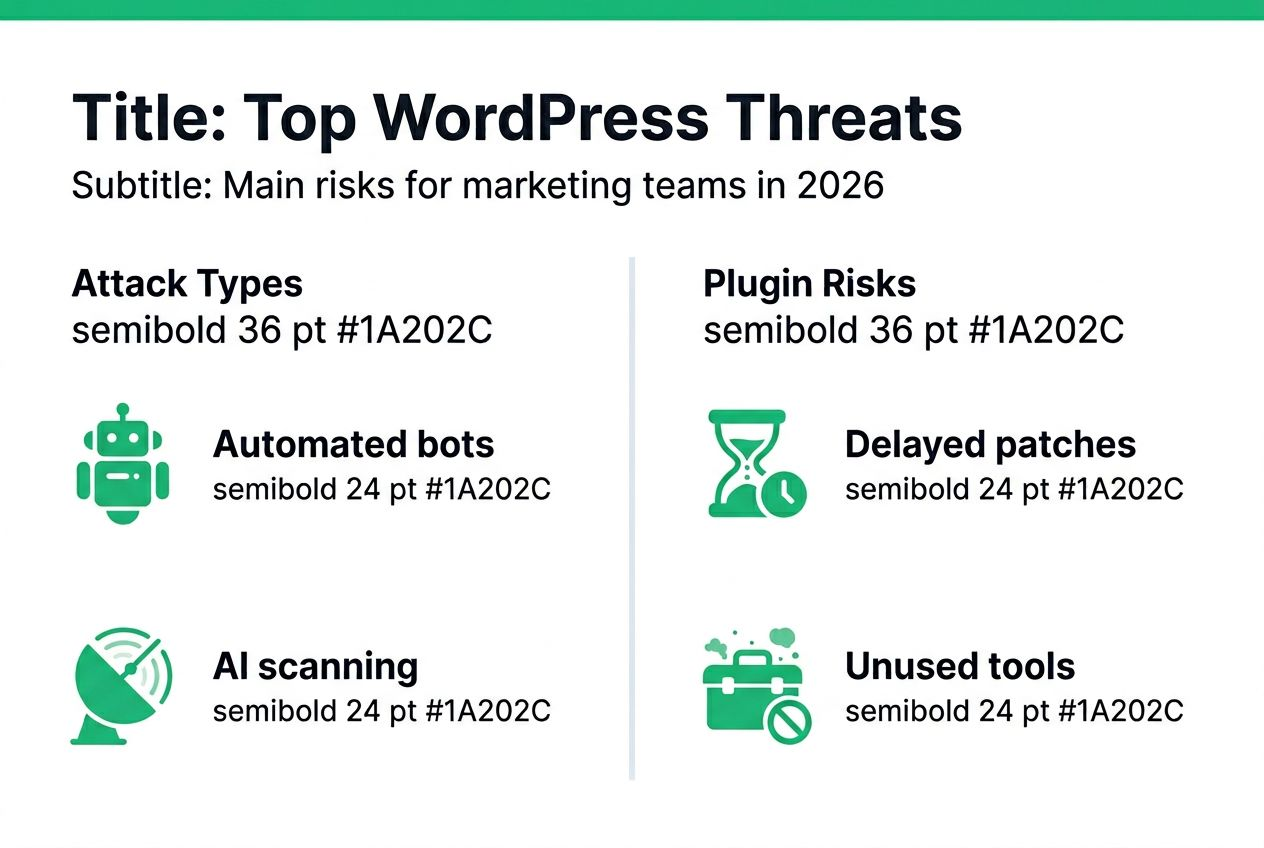
Marketing teams face a sobering reality: 96% of WordPress vulnerabilities come from plugins, not the core system. While WordPress core receives rigorous security audits and rapid patches, the thousands of third-party plugins marketing teams depend on have inconsistent security practices and slower update cycles.
The most dangerous threats include:
- Unpatched plugin vulnerabilities that remain exploitable for weeks or months after disclosure
- AI-driven automated attacks that scan millions of sites daily for known plugin weaknesses
- Brute force credential attacks targeting administrator accounts with weak passwords
- Supply chain compromises where trusted plugins are updated with malicious code
- Zero-day exploits in popular marketing plugins discovered before vendors can patch them
Critical statistic: Automated attacks targeting marketing team plugins increased 45% in 2025, driven by AI tools that identify and exploit vulnerabilities faster than human attackers ever could.
Marketing teams particularly struggle with plugin management. Popular tools for A/B testing, conversion optimization, and marketing automation often become targets precisely because of their widespread use. Attackers know that compromising a single popular plugin can give them access to thousands of marketing sites simultaneously.

The delayed patch problem compounds this risk. When a vulnerability is discovered, there’s often a window of days or weeks before developers release a fix. During this period, your marketing site remains exposed. Even after patches are available, many teams delay updates fearing they’ll break active campaigns. This creates an extended vulnerability window that attackers actively exploit.
Implementing enterprise-grade WordPress security frameworks becomes essential to protect against these evolving threats while maintaining the marketing agility your team requires.
Common misconceptions about WordPress security for marketing teams
Marketing teams often operate under dangerous false assumptions about WordPress security. These misconceptions leave sites vulnerable and prevent effective protection strategies.
Misconception 1: WordPress core is the main security risk. Reality: Most breaches originate from unpatched plugins and poor access control, not the WordPress core system. The core receives constant security scrutiny and rapid patches, while third-party plugins vary wildly in security quality.
Misconception 2: Security is IT’s responsibility alone. Marketing teams must actively participate in security. When marketing installs plugins, grants user access, or stores customer data, these decisions directly impact security posture. Treating security as someone else’s problem creates dangerous gaps in protection.
Misconception 3: Plugins from trusted sources are inherently safe. Even reputable plugin developers can introduce vulnerabilities through coding errors or dependency issues. Continuous monitoring and rapid patching matter more than initial trust. A plugin that was safe yesterday may have a critical vulnerability disclosed today.
Misconception 4: Automatic updates will break our campaigns. While updates occasionally cause compatibility issues, the risk of exploitation far exceeds the risk of temporary breakage. Proper staging environments and testing protocols allow safe automatic updates without campaign disruption.
Misconception 5: Strong security slows down marketing operations. Well-designed security frameworks actually accelerate marketing by eliminating emergency responses to breaches, reducing downtime, and building customer trust. Understanding common WordPress security misconceptions helps teams implement effective protection without sacrificing speed.
Pro Tip: Schedule a monthly security audit where marketing and IT review installed plugins together. Remove any unused plugins immediately, as dormant plugins remain exploitable attack vectors even when deactivated.
Balancing marketing autonomy with robust security controls
Marketing teams need speed, but IT teams need control. This tension creates friction that often results in either security gaps or marketing bottlenecks. The solution lies in frameworks that segregate responsibilities while enabling both teams to excel.
Role-based access control forms the foundation. Role-based permissions reduce security risk by up to 50% while preserving marketing agility. Marketing team members receive permissions to create and publish content but cannot install plugins, modify themes, or access server configurations. IT maintains oversight of security-critical functions without micromanaging daily content operations.
Consider how different approaches impact marketing autonomy:
| Approach | Marketing Autonomy | Security Control | Compliance Risk |
|---|---|---|---|
| Open plugin installation | High | Low | Very High |
| IT-approved plugin library | Medium | High | Low |
| Proprietary block systems like FAS | Very High | Very High | Very Low |
| No plugin installation | None | Maximum | Low |
The proprietary block system approach, exemplified by 40Q’s FAS Block System™, offers the best balance. Marketing teams gain complete autonomy to build landing pages, campaigns, and localized content using pre-approved, security-audited components. IT maintains full control over the underlying codebase, security patches, and compliance frameworks.
This architecture delivers several advantages:
- Marketing deploys campaigns without waiting for developer resources
- IT governs security boundaries and compliance requirements centrally
- Plugin attack surface shrinks dramatically by replacing vulnerable third-party code
- Scalability and performance remain consistent as marketing activity increases
- Audit trails track all changes for compliance documentation
Pro Tip: Create a plugin approval process that includes security audits, performance testing, and compliance reviews before adding new tools to your marketing stack. This small upfront investment prevents costly security incidents later.
Exploring balancing marketing autonomy with IT security reveals how modern architectures solve the traditional speed versus control dilemma. The key is designing systems where security boundaries are invisible to marketing users but impenetrable to attackers.
Practical security best practices for marketing teams on WordPress
Marketing leaders can implement these concrete steps immediately to strengthen WordPress security without disrupting content workflows:
-
Enable automatic updates with staging validation. Automatic WordPress core and plugin updates reduce exploitation of known vulnerabilities to near zero. Configure updates to install automatically on staging environments first, run automated tests, then promote to production. This ensures security without surprise breakage during campaigns.
-
Implement strong authentication mechanisms. Replace passwords with passkeys or enforce two-factor authentication for all users with publishing access. Weak credentials remain the easiest entry point for attackers targeting marketing sites.
-
Audit plugins quarterly and remove abandoned tools. Schedule regular reviews of installed plugins. Remove any that haven’t been updated in six months, have unresolved security issues, or are no longer actively used. Dormant plugins create persistent vulnerabilities.
-
Subscribe to security vulnerability feeds. Monitor disclosures affecting your specific plugins and themes. Services like WPScan and Wordfence provide alerts when vulnerabilities are discovered in tools your marketing team uses, enabling rapid response.
-
Integrate security into marketing workflows. Make security checks part of campaign launch processes rather than afterthoughts. Include security validation in your campaign checklists alongside design reviews and content approvals.
-
Limit user accounts and review access regularly. Create user accounts only when necessary and disable them immediately when team members leave or change roles. Review all active accounts monthly to ensure permissions match current responsibilities.
-
Implement comprehensive backup and recovery procedures. Maintain automated daily backups stored separately from your production environment. Test restoration procedures quarterly to ensure you can recover quickly from any security incident.
Pro Tip: Create a security incident response plan specifically for marketing scenarios. Document who makes decisions about taking sites offline during campaigns, how to communicate with customers during breaches, and backup content delivery methods.
Follow the website security checklist for marketing teams and implement enterprise-grade WordPress security best practices to build comprehensive protection without sacrificing marketing velocity.
Bridging security and marketing agility: case study of 40Q’s FAS Block System™
Enterprise organizations face a fundamental challenge: marketing teams need to move fast, but traditional WordPress implementations require developer involvement for secure content deployment. The 40Q FAS Block System™ demonstrates how purpose-built architectures solve this tension.
The system addresses core security concerns:
- Eliminates plugin vulnerabilities by replacing third-party plugins with proprietary, security-audited blocks
- Maintains IT governance through centralized control of all system components and security boundaries
- Enables marketing autonomy with drag-and-drop content assembly requiring zero developer involvement
- Ensures compliance by building privacy controls, audit trails, and data governance into the platform foundation
- Scales securely as traffic and content volume increase without introducing new attack surfaces
Marketing teams use FAS blocks to rapidly build landing pages, campaign microsites, and localized content variations. Each block undergoes security review and performance optimization before deployment. Once approved, marketing can use these blocks infinitely without security risk.
The architecture separates content creation from code deployment. Marketing teams never touch themes, plugins, or server configurations. They work entirely within the FAS block environment, which provides extensive creative flexibility while maintaining strict security boundaries.
“The FAS Block System™ lets our marketing team launch campaigns in hours instead of weeks, while our IT team maintains complete security control and compliance oversight. We’ve eliminated the traditional tradeoff between speed and safety.”
This approach proves particularly valuable for organizations with complex compliance requirements. Healthcare providers, financial services firms, and government contractors need both marketing agility and rigorous security. The FAS architecture delivers both by design rather than through compensating controls.
Explore the 40Q FAS Block System™ case study to see how enterprise organizations achieve marketing velocity without compromising security posture or compliance requirements.
Securing marketing platforms for long-term success
Neglecting WordPress security creates cascading consequences that extend far beyond immediate breach costs. Security breaches can cause financial loss, brand damage, and costly compliance penalties that take years to overcome. Marketing leaders who treat security as an afterthought face inevitable crises that destroy customer trust and derail growth initiatives.
The strategic benefits of security-first marketing are substantial:
- Enhanced customer trust translates directly to higher conversion rates and customer lifetime value
- Accelerated ROI from campaigns that run without security-related downtime or interruptions
- Reduced crisis management costs by preventing breaches rather than responding to them
- Competitive advantage in industries where security and privacy increasingly differentiate brands
- Future-proof infrastructure that adapts to evolving threats and compliance requirements
Successful organizations recognize that marketing and IT must collaborate rather than compete. Marketing leaders who understand security constraints make better technology choices. IT leaders who understand marketing velocity requirements design better security frameworks. This collaboration produces platforms that excel at both protection and performance.
Ongoing security education matters. Train marketing teams to recognize phishing attempts, use strong authentication, and follow security protocols. Make security part of marketing culture rather than an external constraint imposed by IT.
The consequences of security breaches extend beyond immediate remediation costs to include long-term brand damage, customer attrition, and regulatory scrutiny. Proactive security integration protects not just your platforms but your entire marketing investment and brand equity.
Explore enterprise-grade WordPress security solutions with 40Q
Your marketing team deserves platforms that balance security with speed. 40Q specializes in WordPress architectures designed specifically for enterprise marketing operations.
Our proprietary FAS Block System™ eliminates the traditional tradeoff between marketing autonomy and IT governance. Your marketing teams gain complete freedom to launch campaigns, build landing pages, and deploy localized content without developer involvement. Meanwhile, your IT teams maintain full control over security, compliance, performance, and scalability.
We’ve helped organizations across healthcare, finance, education, and enterprise technology solve the security-autonomy challenge. Our enterprise WordPress content and compliance solutions provide the foundation for marketing platforms that accelerate growth without compromising protection.
Discover how enterprise-grade WordPress for marketing teams transforms content operations. Schedule a consultation to explore custom solutions for your organization’s unique security and marketing requirements.
Frequently asked questions
Recommended

Mar 20, 2026
WordPress
Website compliance checklist 2026: secure WordPress sites
Jan 18, 2026
WordPress
High Traffic WordPress Guide for Enterprise Success

Oct 22, 2024
WordPress