
WordPress
Digital Asset Management Explained: Streamline Enterprise Content

José Debuchy
March 27, 2026 | 3 min to read
Enterprise teams lose 3.6 hours per day hunting for files buried in shared drives, email threads, and disconnected storage systems. That inefficiency compounds into billions in lost productivity globally. Digital asset management (DAM) is the infrastructure layer that eliminates this waste, giving marketing teams instant access to approved assets while IT maintains full control over security and governance. This guide covers what DAM actually does, how to evaluate platforms, what ROI looks like in practice, and where the technology is heading next.
Key Takeaways
| Point | Details |
|---|---|
| DAM centralizes management | A DAM system brings all your assets into one organized, searchable platform. |
| Transforms marketing autonomy | DAM enables non-technical teams to control and distribute assets without IT bottlenecks. |
| Proven ROI and efficiency | Enterprises achieve up to 434% ROI, 25% productivity gains, and drastically faster asset access. |
| Handles future complexity | Modern DAMs use AI and automation to scale with advanced assets, compliance, and personalization. |
What is digital asset management?
DAM is not just a fancier version of Dropbox. A DAM system is a centralized platform for storing, organizing, and distributing digital files, with built-in version control, metadata, and AI-powered search that transforms raw file storage into a governed content operation. Think of it as the difference between a warehouse with no labels and a fully indexed distribution center where every item is tracked, approved, and ready to ship.
For enterprise marketing and IT teams, the practical impact is significant. Here is what a mature DAM platform actually manages:
- Metadata tagging and taxonomy: Every asset carries structured data, making search fast and accurate across thousands of files
- Permissions and access control: Role-based access ensures brand managers, agencies, and regional teams see only what they should
- Workflow automation: Approval chains, expiration alerts, and usage rights are enforced automatically, not manually
- Version control: Teams always work from the current approved asset, eliminating the “which logo is correct” problem
- Self-service portals: Non-technical users find and download assets without filing IT tickets
The role of IT in marketing technology shifts fundamentally when DAM is in place. Instead of fielding asset requests, IT teams focus on governance, integrations, and platform performance. Marketing moves faster. IT stays in control. Both win.
Stat to know: Organizations without DAM spend an average of 3.6 hours per day per employee searching for digital assets. At enterprise scale, that is a staggering operational cost hiding in plain sight.
DAM in action: How mechanics, workflows, and integrations drive value
Defining the basics is not enough. Here is how DAM really works inside a modern enterprise content operation.
The asset lifecycle in a well-configured DAM follows a clear sequence:
- Ingestion: Assets are uploaded from creative tools, agencies, or automated pipelines, with bulk import and format normalization handled at entry
- Metadata enrichment: AI auto-tagging, manual taxonomy assignment, and rights metadata are applied immediately upon upload
- Taxonomy organization: Assets are categorized by campaign, region, channel, format, and usage rights for fast retrieval
- Approval workflow: Stakeholders review and approve assets within the platform, creating an auditable trail before anything goes live
- Distribution: Approved assets push directly to CMS, PIM, CRM, or social platforms via API integrations or native connectors
The end-to-end workflow from ingestion to multi-channel distribution is what separates DAM from basic storage. Marketing teams control campaign assets from brief to publication without a single developer ticket. For a deep dive into DAM workflows, the mechanics of each stage reveal significant optimization opportunities.

This is where decoupling marketing and IT becomes real. API-first DAM architectures connect directly to your WordPress stack, headless CMS, or commerce platform, letting marketing publish without waiting on development cycles. The results are measurable: faster campaign launches, fewer errors, and less back-and-forth between teams. See how this plays out in a real enterprise DAM integration context.
Pro Tip: Before selecting a DAM, map your current asset lifecycle end-to-end. Identify exactly where delays happen, whether that is approval bottlenecks, search failures, or distribution gaps. Your DAM configuration should solve those specific friction points, not just add another storage layer.
Core features compared: What sets DAM systems apart
With an understanding of how DAM operates, let’s compare the top features that drive enterprise impact.
Not all DAM platforms are built for enterprise scale. The core features that matter most include metadata tagging, version control, secure sharing, advanced search, and workflow automation. But how those features are implemented varies dramatically across platforms.
| Feature | Basic DAM | Mid-tier DAM | Enterprise DAM |
|---|---|---|---|
| Metadata tagging | Manual only | Semi-automated | AI-powered auto-tagging |
| Search | Filename search | Keyword search | Semantic and visual AI search |
| Permissions | Folder-level | Role-based | Granular, attribute-based |
| Workflow automation | None | Basic approvals | Multi-stage, conditional logic |
| CMS/PIM integration | Manual export | Native connectors | API-first, bidirectional sync |
| Cloud/hybrid options | Cloud only | Cloud only | Cloud, hybrid, on-premise |
| Extensibility | Limited | Plugin-based | Open API, custom development |
| Compliance support | Minimal | Basic audit logs | Full rights management, GDPR tools |
For enterprise teams, the features that unlock the greatest marketing autonomy are AI-powered search, granular permissions, and API-first extensibility. These three capabilities determine whether your marketing team can operate independently or still depends on IT for every asset request.
Review enterprise DAM best practices to understand how feature selection connects to broader digital experience strategy. The full DAM features breakdown is worth reviewing before finalizing your evaluation criteria.
Pro Tip: Ask every DAM vendor for their API documentation before any demo. If the API is incomplete or poorly documented, your integration roadmap will stall. Strong API-first design is non-negotiable for enterprise environments.
ROI and value benchmarks: What enterprises actually achieve
Before moving to implementation, it is essential to ask: what results can you expect from DAM adoption?
The numbers are compelling. The DAM market is growing from $5.3 billion in 2024 to a projected $10.3 billion by 2029, driven by a 14% compound annual growth rate. That growth reflects real enterprise investment in platforms that deliver measurable returns.
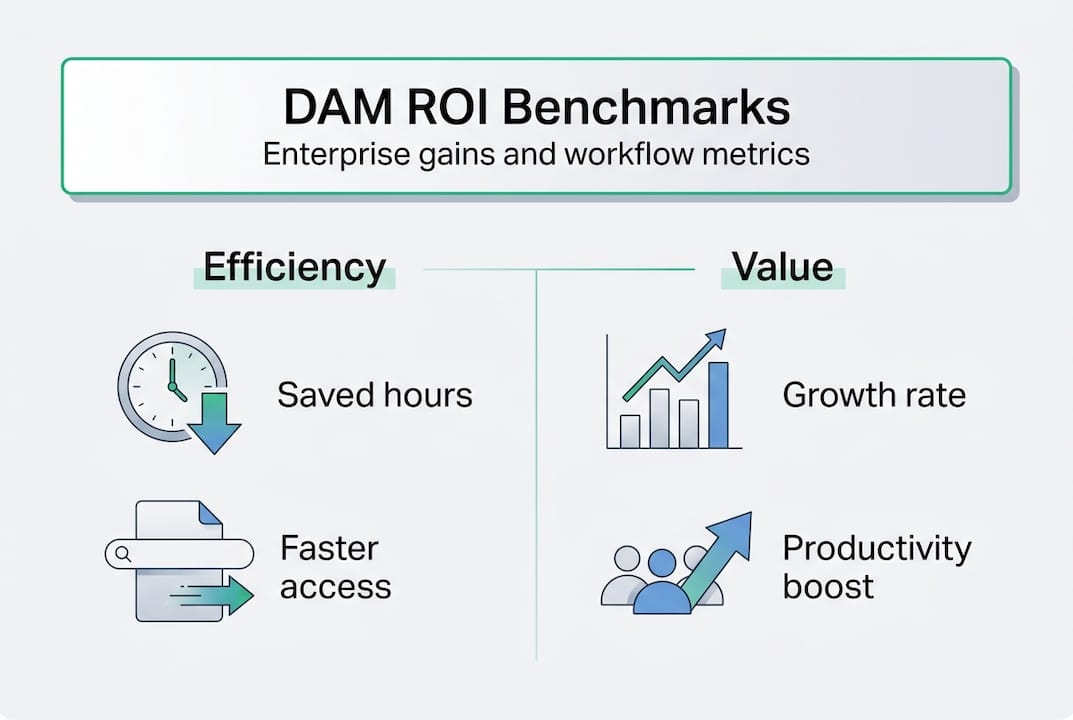
| Metric | Reported outcome |
|---|---|
| ROI range (3 years) | 168% to 434% |
| Net present value | Up to $2.6M |
| Productivity increase | Up to 25% |
| Asset management time saved | Up to 90% reduction |
| Time-to-market improvement | Significant across all case studies |
Forrester research found that DAM delivers 168% to 434% ROI over three years, with a 25% productivity boost and net present value reaching $2.6 million for mid-to-large organizations. Those figures are not outliers. They reflect what happens when marketing teams stop losing time to asset chaos.
“The productivity gains from DAM are not incremental. They are structural. When marketing teams stop losing hours to asset searches and approval delays, that time goes directly into campaign output and revenue-generating work.”
For a real-world view of how these gains materialize, the DAM integration results from enterprise implementations show how platform decisions translate into operational outcomes. The ROI case for DAM is not theoretical. It is documented, repeatable, and scalable.
Advanced challenges: Edge cases, compliance, and scaling for the future
For enterprises with complex needs, consider these advanced challenges to ensure DAM success.
Most DAM evaluations focus on the happy path: uploading images, tagging them, and sharing links. But enterprise environments surface harder problems that basic platforms cannot handle. Edge cases in enterprise DAM include managing large video assets, compliance and audit requirements, legacy system migration, and AI governance.
Here are the challenges that catch enterprise teams off guard:
- Large format and video assets: 4K video, 3D renders, and interactive content require scalable storage architecture and transcoding pipelines, not just extra disk space
- Rights management and compliance: Expired licenses, regional usage restrictions, and GDPR-related consent tracking must be enforced at the asset level, not just documented in a spreadsheet
- Legacy migration: Moving from shared drives or outdated DAM systems means cleaning metadata, resolving duplicates, and rebuilding taxonomy before a single asset goes live
- AI governance: Auto-tagging tools introduce errors at scale. Without human review workflows and confidence thresholds, bad metadata propagates across your entire library
- Data silos: DAM only eliminates silos if it integrates with your existing stack. A DAM that sits disconnected from your CMS or PIM just creates a new silo
The DAM 4.0 framework provides a useful lens for evaluating platform maturity against these challenges. For teams navigating AI governance in DAM, the key is establishing clear human-in-the-loop checkpoints before AI-generated metadata is trusted at scale. Organizations building toward a future-proof enterprise content strategy need DAM that scales with those ambitions.
Pro Tip: Run a metadata audit on your current asset library before migrating to a new DAM. Garbage-in, garbage-out applies here. A clean taxonomy built before migration saves months of remediation work afterward.
The future: DAM maturity models and intelligent content automation
Knowing today’s challenges is key, but preparing for the future will set your enterprise ahead.
DAM is not a static technology. It evolves in distinct stages, and where your organization sits on that curve determines what you can actually do with it. The DAM maturity model progresses through four levels:
- DAM 1.0 (Library): Centralized storage with basic search. Better than shared drives, but still largely manual
- DAM 2.0 (Workflow): Approval chains, permissions, and metadata standards are formalized. Teams stop emailing assets
- DAM 3.0 (Platform): API-first integrations connect DAM to CMS, PIM, and commerce systems. Marketing operates with real autonomy
- DAM 4.0 (AI/Agentic): Intelligent systems auto-tag, auto-distribute, and respond to content demand signals. The DAM becomes an active participant in the content supply chain
The shift to DAM 4.0 is already underway. Agentic AI systems can detect when a campaign asset is approaching license expiration and automatically trigger a renewal workflow. They can analyze performance data from your CMS and surface which asset variants are driving conversions. This is not future speculation. It is what leading platforms are shipping now.
For teams investing in AI enhancement for DAM, the priority is building the governance infrastructure now so AI can operate reliably at scale later. Review Forrester’s 2026 DAM outlook for analyst perspective on which capabilities will define competitive advantage in the next three years.
Pro Tip: When evaluating DAM vendors for future readiness, ask specifically about their AI roadmap and how they handle model updates. Vendors who cannot explain their AI governance approach are not ready for enterprise deployment.
Empower your team with smarter digital asset management
The case for DAM is clear: faster marketing cycles, measurable ROI, and IT governance that scales. But the platform alone is not enough. The real gains come when DAM integrates seamlessly with your content publishing infrastructure.
At 40Q, we build enterprise WordPress platforms that connect directly with DAM systems, giving marketing teams the autonomy to publish campaigns, landing pages, and localized content without developer intervention. Our FAS Block System™ pairs with advanced search capabilities and our WordPress AI Suite to create a content operation where assets flow from DAM to published page in minutes, not days. If your organization is ready to close the gap between asset management and marketing execution, we would welcome the conversation.
Frequently asked questions
Recommended

Apr 4, 2026
WordPress
Why marketing autonomy matters: boost speed and security

Apr 14, 2026
WordPress
Secure Content Publishing: A Guide for Enterprise WordPress

Feb 6, 2026
WordPress