
WordPress
Is WordPress Good Enough for Enterprise?

Martin Szigeti
June 18, 2026 | 3 min to read
Short answer is yes. WordPress is good enough for enterprise and for most B2B organizations, it is the right choice. The platform powers 43% of the web, including sites for Microsoft, Meta, The New York Times, NASA, and Sony Music. The more useful question is not whether WordPress can handle enterprise requirements, but whether your implementation is architected to meet them.
The organizations where WordPress fails at enterprise scale almost always share the same root cause: the platform was deployed like a standard marketing site, not engineered as an enterprise content system. That is an implementation problem, not a platform problem.
This article addresses the specific objections that enterprise buyers raise, with direct answers based on production experience.
The Six Enterprise Objections to WordPress Answered
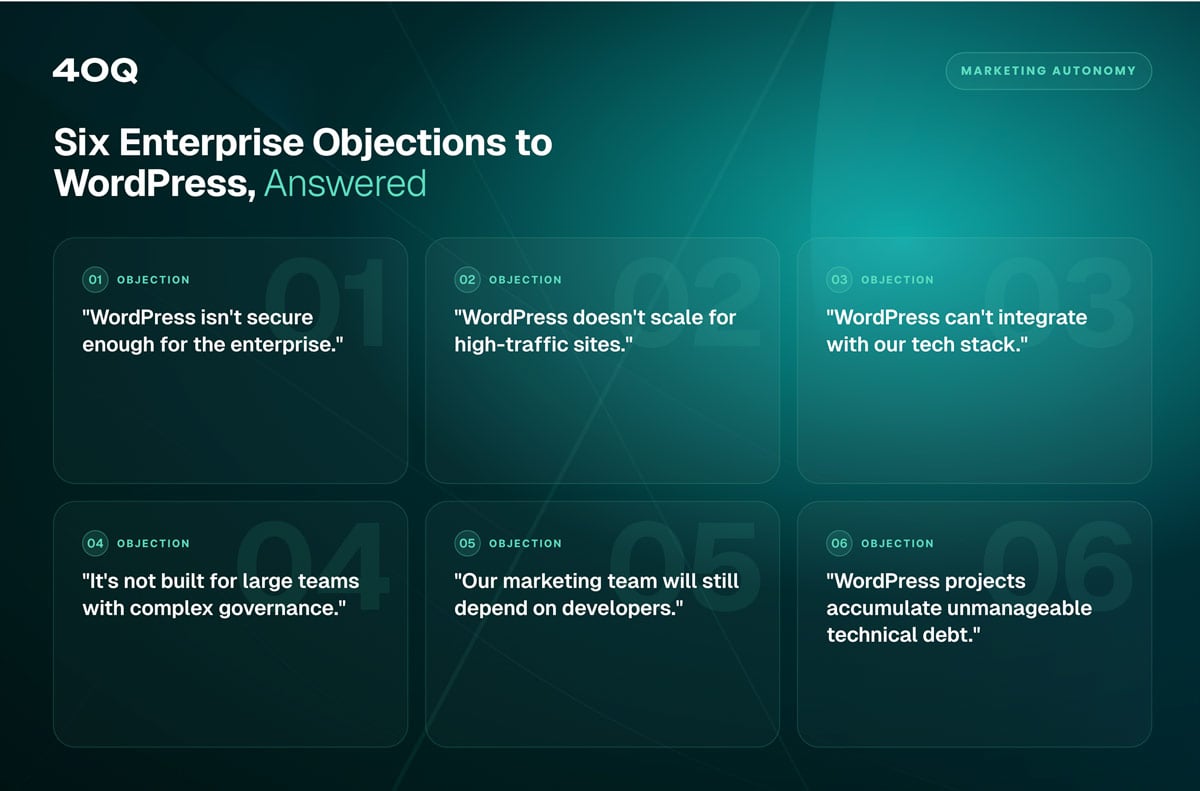
Objection 1: “WordPress isn’t secure enough for enterprise”
The direct answer: WordPress core has an excellent security track record. The risk surface in enterprise WordPress is not the core software, it is plugins, hosting configuration, and access management.
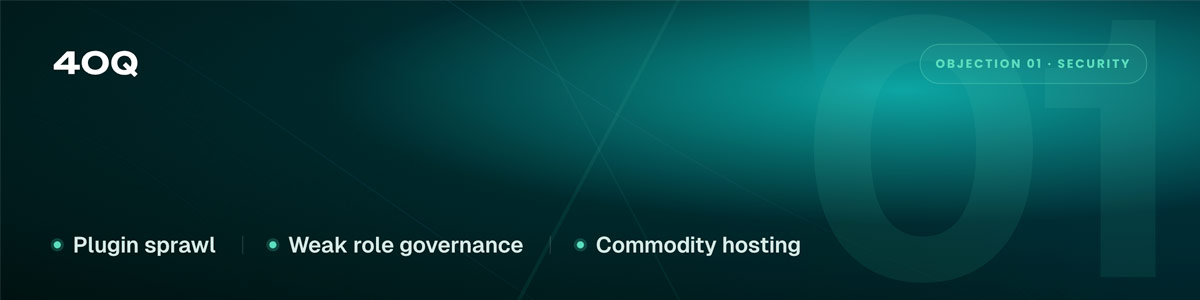
WordPress core is maintained by an active security team that releases patches rapidly. The platform processes hundreds of millions of transactions daily without breach. The security objections enterprise teams raise almost always point to one of three solvable problems:
Plugin sprawl. A site running 40 poorly-maintained plugins has a large attack surface. Enterprise WordPress implementations address this by curating a minimal, actively-maintained plugin set with a formal security review process. The rule: if a capability can be built as a custom block or a small custom plugin, don’t install a general-purpose plugin to do it.
Weak role governance. If any contributor can install plugins or edit theme files, the site is exposed. Enterprise implementations restrict these capabilities to specific administrator roles, with a documented change management process for any new software additions.
Commodity hosting. Shared hosting or underconfigured VPS environments lack the web application firewalls, malware scanning, and incident response processes that enterprise security teams require. For this, we partner with WordPress VIP, a platform built specifically for organizations where security, uptime, and compliance are non-negotiable. WordPress VIP provides enterprise-grade security scanning, DDoS protection, 99.99% uptime SLAs, and dedicated incident response. As a WordPress VIP Partner, We deploys and manage client platforms on VIP infrastructure, which means your security posture is backed by the same platform that powers enterprise organizations like Salesforce, Meta, and The New York Times.
40Q’s ThreatModeler implementation is a live example: a cybersecurity company whose enterprise buyers scrutinize every vendor’s security posture operates on a WordPress platform. It passed security review with role-based access controls, incident-ready rollback scripts, continuous Core Web Vitals monitoring, and deployment policies that require code review before anything reaches production.
Read the Complete ThreatModeler Case Study
Objection 2: “WordPress doesn’t scale for high-traffic enterprise sites”
The direct answer: WordPress handles enterprise scale traffic reliably when the hosting and caching layers are configured correctly. The platform’s performance issues are infrastructure problems, not architectural ones.
The New York Times, TechCrunch, CNN, and Bloomberg all run on WordPress.
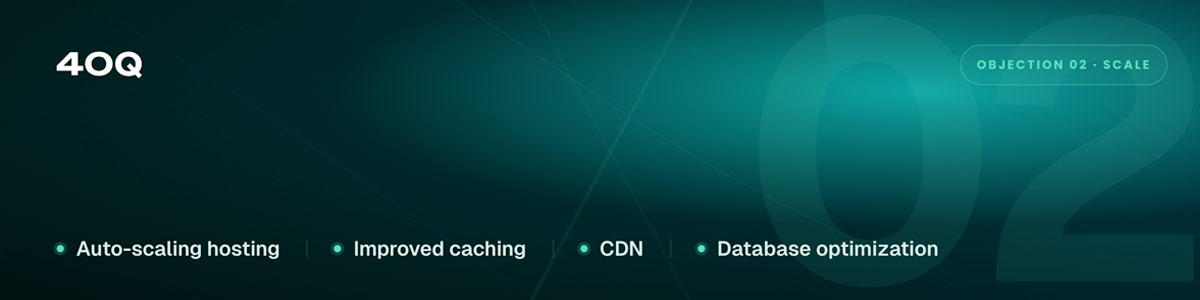
The performance decisions that determine whether WordPress scales at enterprise volume:
- Managed hosting with auto-scaling: WordPress VIP and Kinsta both scale server capacity automatically under load. Commodity hosting does not.
- Full page caching: a properly configured caching layer (WP Rocket, Redis, or server-level caching on VIP) means most page requests never hit PHP or the database at all.
- CDN for static assets: images, CSS, and JavaScript served from a CDN edge network rather than the origin server reduce load times and server load globally.
- Database optimization enterprise WordPress sites with large content libraries require indexed queries, object caching (Redis or Memcached), and periodic database maintenance.
The performance gap between a well-configured enterprise WordPress implementation and a poorly configured one is larger than the gap between WordPress and any alternative platform. The architecture matters more than the CMS.
Objection 3: “WordPress can’t integrate with our enterprise tech stack”
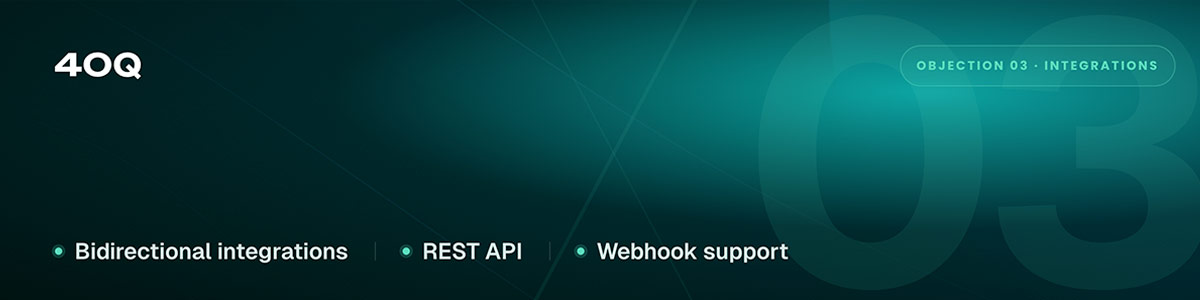
The direct answer: WordPress integrates with every major enterprise system. The platform’s REST API, webhook support, and plugin ecosystem support bidirectional integrations with Salesforce, HubSpot, Marketo, SAP, Oracle, Microsoft Dynamics, Auth0, Okta, Elasticsearch, and virtually any system that exposes an API.
The distinction that matters: plugin based integrations versus custom engineered integrations. A plugin integration connects WordPress to Salesforce in a generic way that works for simple use cases. A custom engineered integration builds a specific data architecture for your organization defining exactly which WordPress events trigger which Salesforce actions, which CRM attributes drive which WordPress personalization rules, and how data inconsistencies are handled.
40Q’s Everest Group implementation shows what WordPress delivers when properly engineered. A single platform manages Salesforce controlled user access, Auth0 SSO for both internal staff and external clients, Elasticsearch powered personalized search, and Cloudinary digital asset management while giving thousands of subscribers gated access to research reports based on their subscription tier. Every user interaction feeds back to Salesforce in real time, giving the Everest team complete visibility into how clients engage with their content before and after becoming customers.
The integration capability is there. Whether an agency has the engineering experience to implement it at this level is the question to ask.
Read the complete Everest Group Case Study
Objection 4: “WordPress isn’t designed for large content teams with complex governance needs”
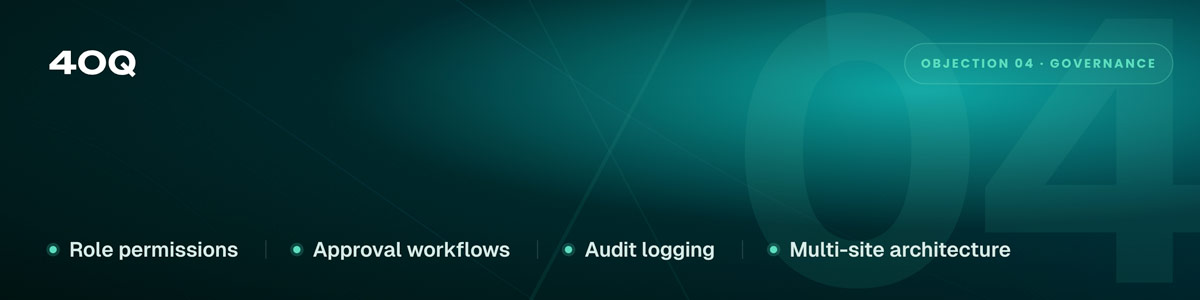
The direct answer: WordPress’s native user role system is functional but limited. Enterprise governance requires a custom role architecture built on top of it which is standard practice for any serious enterprise implementation.
What enterprise content governance requires, and how WordPress delivers it:
Granular role permissions. WordPress ships with five default roles. Enterprise implementations extend this with custom roles, each with precisely scoped capabilities. A contributor in the European office can edit content in their language cluster without any access to global navigation or plugin settings.
Staging and approval workflows. Enterprise content especially for regulated industries often needs to pass through legal review or brand approval before publication. WordPress supports this with workflow plugins (PublishPress, Uro) or custom-built approval chains, where content sits in a “pending review” state until an authorized approver publishes it.
Audit logging. Enterprise compliance teams need a record of who changed what and when. WordPress audit log plugins (WP Activity Log) or custom logging integrated with your SIEM provide this.
Multi-site architecture. Organizations managing multiple brands, regions, or microsites from one platform use WordPress Multisite a single installation managing dozens of distinct sites with shared or isolated content libraries.
The governance architecture isn’t automatic. It requires deliberate design by an agency that understands enterprise content operations. That’s the work and not a platform limitation.
Objection 5: “Our marketing team will still depend on developers”
The direct answer: This is the most valid objection — and the most solvable one, with the right architecture.
Marketing dependency on engineering is not inherent to WordPress. It is the result of how the site was built. A theme based WordPress site built without a component system forces marketing to request developer time for any layout change. A WordPress site built with 40Q’s custom Atomic Block System gives marketing complete creative freedom within enforced brand boundaries.
The Atomic Block System approach:
- Marketing builds any page layout by combining pre designed block components like hero sections, CTAs, cards, forms and grids without touching code
- Design constraints are structural: the block library only offers on brand options, so brand drift is impossible by design
- New campaign pages that previously took days now take minutes
- Developers are involved for new block development and integrations, not for routine content operations
This is the central thesis of 40Q’s enterprise WordPress practice. When Commvault moved from raw HTML templates to an Atomic Block System integrated with Marketo and 6sense, their marketing team doubled content publishing velocity.
The platform supports this architecture. Very few agencies build it correctly.
See how marketing autonomy works in practice and why most agencies don’t deliver it.
Objection 6: “WordPress projects accumulate technical debt that becomes impossible to manage”
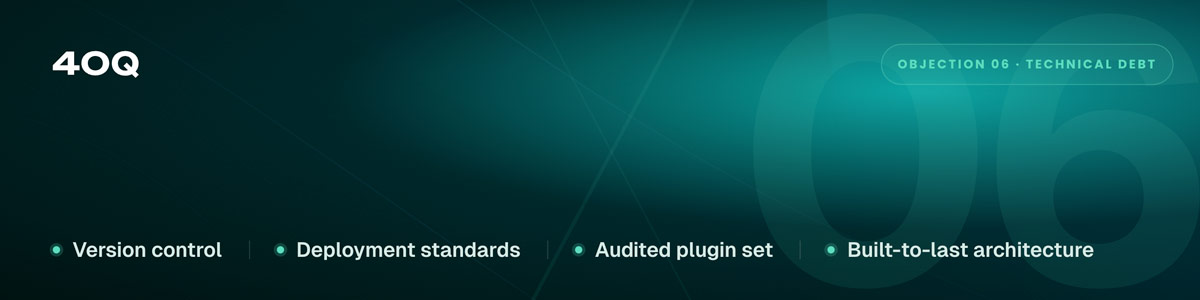
The direct answer: Technical debt in WordPress is not a platform problem. It is a decision problem. Every line of unnecessary code, every redundant plugin, every undocumented customization is a choice someone made. The platform does not make those choices.
The pattern is consistent across enterprise WordPress projects that fail: an agency builds the initial site without a long-term architecture plan, plugins accumulate to fill gaps that should have been custom-built, and within two years the codebase is fragile, undocumented, and expensive to change. That is not WordPress. That is what happens when a site is built without engineering discipline.
What prevents technical debt at enterprise scale:
A minimal, audited plugin set. Every plugin is a dependency. Enterprise WordPress implementations define a plugin policy before the first line of code: if a capability can be built as a custom block or a lightweight custom plugin, it gets built. General-purpose plugins that duplicate functionality or introduce unnecessary database queries do not make the cut.
Version control and deployment standards. No code reaches production without a pull request, a code review, and a staging environment validation. This is standard engineering practice in any serious software organization. It applies to WordPress the same way it applies to any other platform.
A component architecture built to last. 40Q’s Atomic Block System is designed so that adding a new content type or a new campaign template does not require touching existing code. New blocks extend the system. They do not modify it. That is the architectural decision that determines whether a WordPress codebase is maintainable at year three the same way it was at launch.
The question to ask any agency is not whether they know how to build in WordPress. It is whether they have an engineering process that prevents the site from becoming unmaintainable. Most don’t. That gap is where technical debt comes from.
When Enterprise WordPress Delivers the Most Value
WordPress enterprise is not a generic solution, it is purpose built for organizations where the marketing team needs to operate at speed without creating engineering bottlenecks. The implementations that deliver the clearest results share three characteristics:
The marketing team is under pressure to move faster than their current setup allows. If the core frustration is “we can’t publish at the pace our ideas demand” or “every campaign requires a developer ticket,” WordPress with a proper Atomic Block System resolves this structurally. Not by training marketers to use a simpler tool, but by giving them a governed system where they have genuine creative control.
The site is a strategic revenue asset, not a brochure. Organizations that see their website as a demand generation engine where landing pages, conversion paths, and CRM integrations directly affect pipeline and can get the highest return from enterprise WordPress. When Commvault moved to a governed block system integrated with Marketo and 6sense, the result was a 20% increase in demo conversions. The site became a revenue tool, not a cost center.
There is a clear vision for where the platform needs to go. WordPress can scale with organizations that know they will need more integrations, more content types, more markets, or more editorial workflows over time. The architecture is designed for that future and not just the current site. Organizations that see their web platform as a long term capability investment and not a one time project, are the ones that extract the full value of the platform.
The question is not whether WordPress can handle enterprise requirements, the question is whether the implementation is engineered to unlock those capabilities. Learn what makes a WordPress agency enterprise grade.
The Real Question: Is Your Agency Good Enough for Enterprise WordPress?
WordPress’s capabilities are not the limiting factor in most enterprise implementations that fail. The agency’s experience is.
Building enterprise WordPress correctly requires a specific combination of skills that most agencies don’t have and that gap becomes expensive to fix after launch. At 40Q, every engagement is built on:
- Content architecture that scales: we design the information structure before writing a line of code, so the platform grows with your organization instead of against it
- Custom Atomic Block Systems: not page builders. A governed component library built to your design system, so marketing publishes independently without breaking brand consistency
- Bidirectional CRM and marketing automation integrations: Salesforce, HubSpot, Marketo wired so data flows both ways and every interaction feeds your pipeline
- Enterprise SSO and role governance: Auth0, Okta, or Azure AD for authentication; a custom role architecture that matches how your organization actually works
- WordPress VIP infrastructure: as a VIP Partner, we deploy on the same platform that powers Salesforce, Meta, and The New York Times
- Performance engineered for your traffic patterns: not generic optimization, but architecture decisions made for your content volume, audience geography, and peak load
- An ongoing engineering relationship: we don’t hand off and disappear. Our longest client relationships run for years of continuous improvement
The question to ask any agency is not whether they know WordPress, it’s whether they have shipped a production implementation with your integrations, at your scale, in your industry. We have. Read about our success stories.
The Bottom Line
WordPress is not just adequate for enterprise, it is the platform that handles the specific challenge most enterprise marketing teams face: moving fast, maintaining governance, and connecting to a complex tech stack without requiring engineering involvement for routine content operations.
The platform risk is under control. The governance architecture is buildable. The integrations exist. The security model is solid when implemented correctly.
What enterprise WordPress requires is an agency that has solved these problems before; in production, at scale, in your industry. The platform does not fail enterprise organizations. Implementations built without enterprise engineering experience do.
Frequently Asked Questions
Apr 14, 2026
WordPress
Marketing compliance guide: tools, workflows, best practices

Feb 24, 2026
WordPress
Role of CMS in Digital Strategy: Powering Marketing Autonomy

Feb 12, 2026
WordPress