
WordPress
What is Marketing Autonomy? The Complete Guide

Martin Szigeti
May 27, 2026 | 3 min to read
What is Marketing Autonomy?
Marketing autonomy is the ability for non-technical marketing teams to create, publish, and update digital content without waiting for developer resources or technical bottlenecks.

In practice, this allows non-technical marketers to launch campaigns and update website content without waiting for developers. This means non-technical marketers can create landing pages in hours, not weeks. Campaigns can iterate in days, not months. A/B tests that scale from 1-2 per month to 10-15. With autonomy, marketing teams can move at business speed, not developer speed.
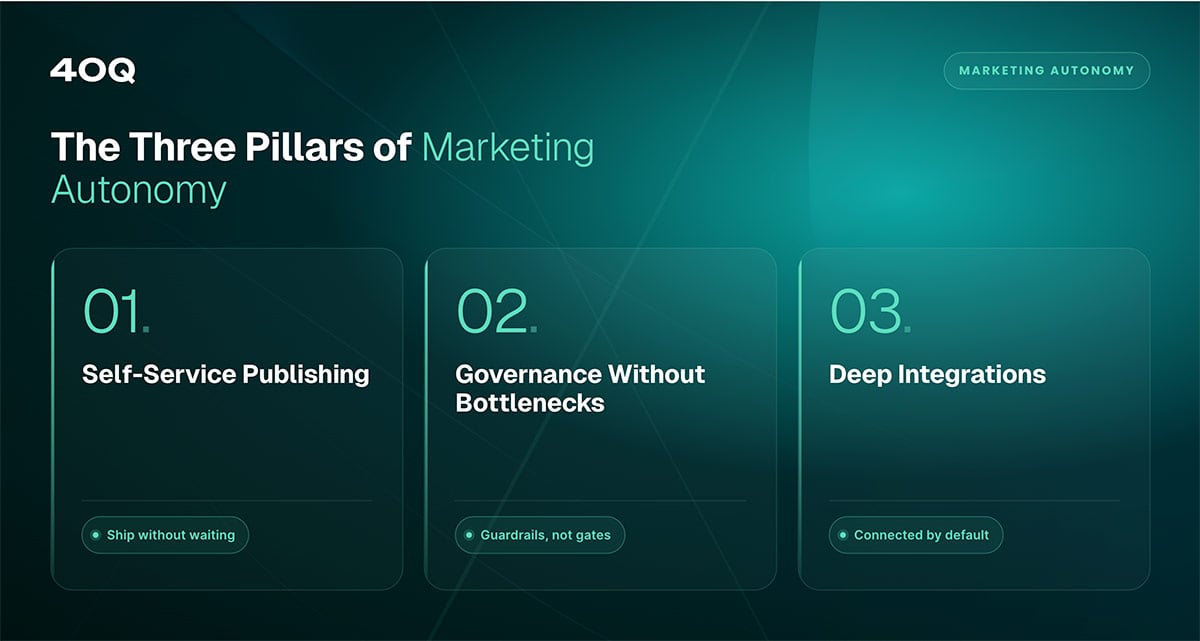
Marketing autonomy is achieved through three core components:
- Self-service publishing tools: Block-based editors, drag-and-drop interfaces, or template systems that eliminate the need to write code
- Enterprise-grade governance: Built-in workflows, permissions, and approvals that maintain brand consistency and compliance standards
- Deep platform integrations:Seamless connections between the website and CRM, marketing automation, analytics, and AI tools
The result: Marketing teams regain control of their primary channel (the website) and can move at marketing speed instead of development speed.
Why Marketing Autonomy Matters
The Cost of Developer Dependency
Most enterprise marketing teams operate under a broken model, the traditional model.
Marketing has an idea → Opens a ticket → Waits 1-2 weeks → Dev implements → Marketing reviews → Another round of changes → Wait another week → Finally launches
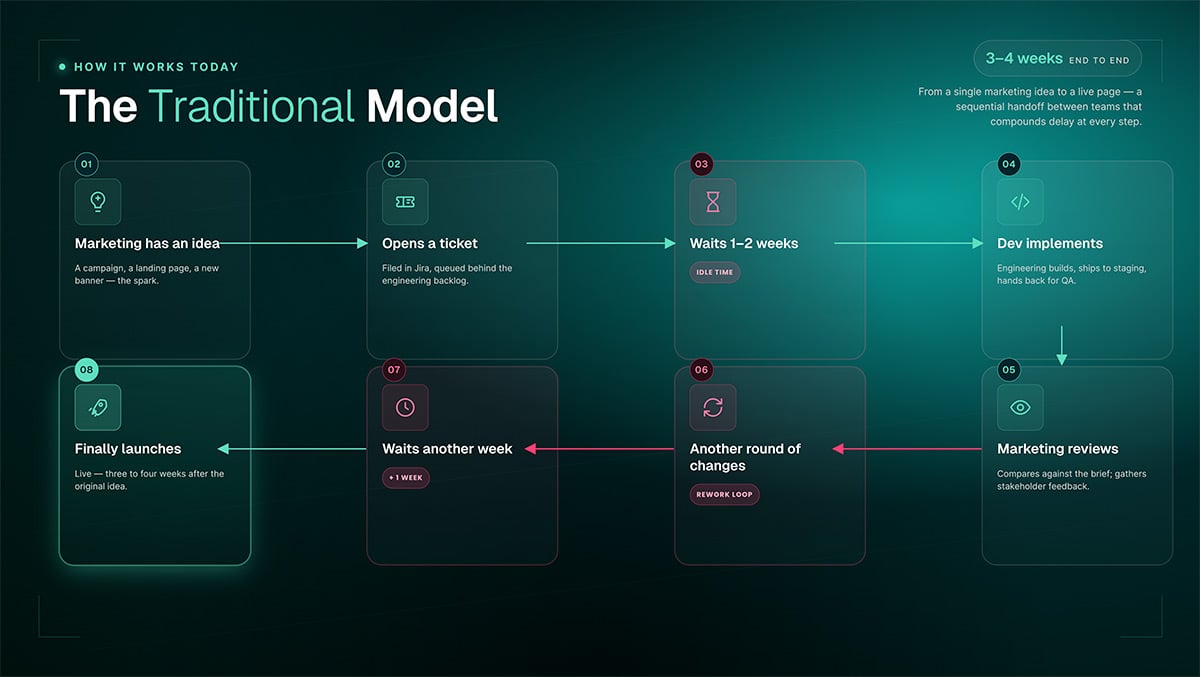
- Time from idea to launch: 2-4 weeks
- Campaigns launched per quarter: 3-5
- Revenue opportunities missed: Countless
This dependency creates cascading problems:
| Problem | Solution |
|---|---|
|
Slow time-to-market
|
By the time your campaign launches, the market has moved. Competitors react faster.
|
|
Lost revenue opportunities
|
Can’t capitalize on trending topics, seasonal moments, or competitive openings.
|
|
Team frustration
|
Marketing morale drops when every idea requires negotiation with dev. Ambitions shrink to match platform limitations.
|
|
Developer burnout
|
Dev teams spend time on marketing requests instead of building product. Nobody wins.
|
|
Reduced testing velocity
|
Can’t A/B test at scale when each variant requires a dev ticket. Optimization stalls.
|
| Solution | |
|---|---|
|
Slow time-to-market
|
By the time your campaign launches, the market has moved. Competitors react faster.
|
|
Lost revenue opportunities
|
Can’t capitalize on trending topics, seasonal moments, or competitive openings.
|
|
Team frustration
|
Marketing morale drops when every idea requires negotiation with dev. Ambitions shrink to match platform limitations.
|
|
Developer burnout
|
Dev teams spend time on marketing requests instead of building product. Nobody wins.
|
|
Reduced testing velocity
|
Can’t A/B test at scale when each variant requires a dev ticket. Optimization stalls.
|
The Data Back This Up

Thirty-eight percent of marketing and digital teams need developer support for most or every campaign, according to the survey. More than a third of developers spend between a quarter and half of their working time supporting GTM campaigns. And 42% say their tech platform makes that support more complex than necessary. (Martech 2026).
This creates a bottleneck where:
- Campaigns take 2-4 weeks to launch
- Only 3-5 campaigns per quarter are possible
- Developers spend 25-50% of time on GTM tickets
Source: Martech, “Why some teams launch fasters,” 2026
Marketing Autonomy vs. Developer Dependency: A Side-by-Side Comparison
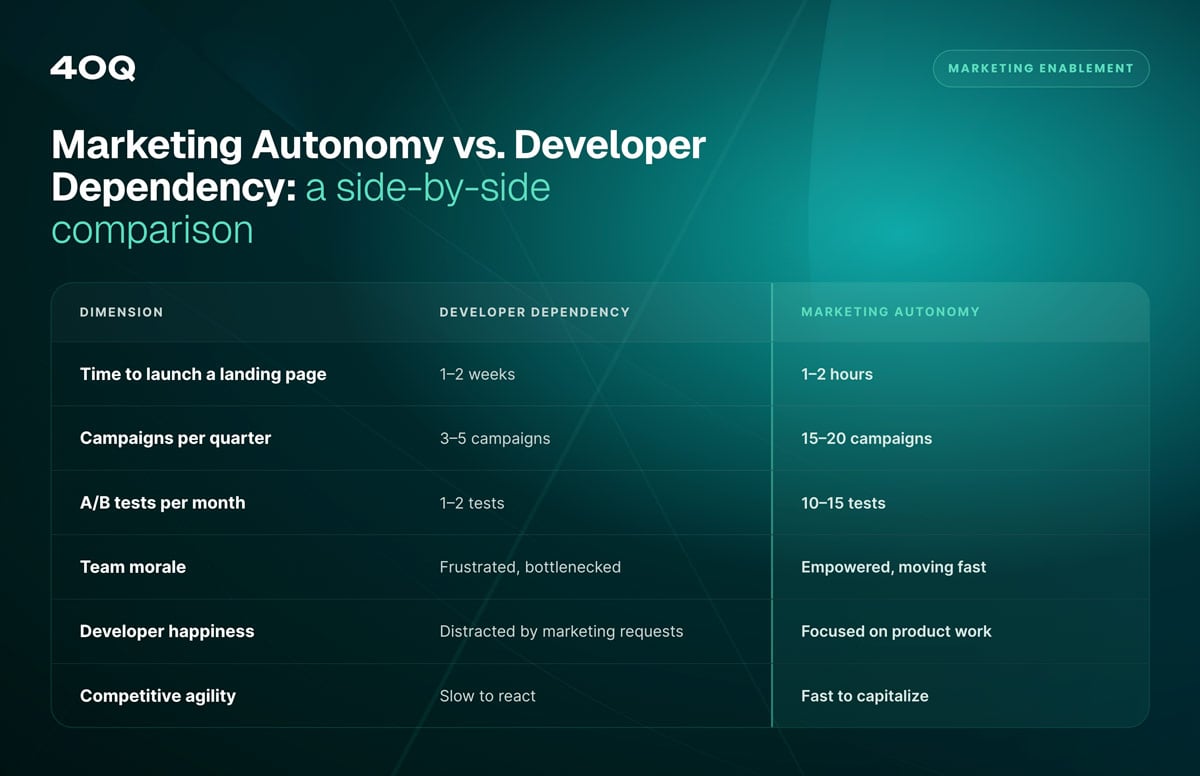
The difference between marketing autonomy and developer dependency is measurable. Teams operating under developer dependency launch landing pages in 1-2 weeks and manage 3-5 campaigns per quarter. Teams with marketing autonomy launch the same page in 1-2 hours and run 15-20 campaigns in the same period. A/B testing follows the same pattern: 1-2 tests per month versus 10-15.
The operational impact extends beyond speed. When marketing waits on development queues, team morale drops and developers lose focus on product work. Marketing autonomy reverses both: marketing moves at the speed of ideas, and developers stay focused on infrastructure and product, not ticket queues.
How Marketing Autonomy is Achieved
Marketing autonomy doesn’t mean chaos. It requires a platform that balances speed with control, giving marketing teams self-service capabilities while maintaining IT oversight.
The Three Pillars of Marketing Autonomy
1. Self-Service Publishing
Marketing teams need tools that let them create pages without touching code:
- Block-based editors: Modular components (hero sections, forms, testimonials, CTAs) that snap together like LEGO
- Pre-approved templates: Page layouts designed by your brand team, ready for marketing to populate with content
- Visual editing: What-you-see-is-what-you-get interfaces that eliminate guesswork
- Content reusability: Sections and components that can be duplicated and customized across pages
At 40Q, we build our own custom block systems, FAS™, that give marketers Webflow-level control inside WordPress but with enterprise governance baked in
2. Governance Without Bottlenecks
Autonomy without guardrails creates brand inconsistency and compliance risk. Marketing autonomy platforms include:
- Approval workflows: Route content to legal, brand, or compliance teams before publishing
- Permissions & roles: Control who can publish, who can edit, and who needs approval
- Brand consistency enforcement: Lock down fonts, colors, spacing, and layouts so marketing can’t break the design system
- Audit trails: Track every change, who made it, and when (critical for regulated industries like finance and healthcare)
3. Deep Integrations
Marketing autonomy extends beyond the website. The platform must connect to:
- CRM systems (Salesforce, HubSpot): Form submissions flow directly to sales pipelines
- Marketing automation platforms (Marketo, Pardot, ActiveCampaign): Visitor behavior triggers email workflows
- Analytics & BI tools (Google Analytics, Mixpanel, Looker): Campaign performance feeds into reporting dashboards
- AI systems (ChatGPT, Claude, Gemini): Automate content generation, image creation, and personalization
Real-World Examples: Marketing Autonomy in Action
Case Study 1: Threat Modeler (Cybersecurity SaaS)
Before: Marketing team waited 2 weeks per landing page. Launched 1-2 campaigns per quarter.
After 40Q implementation:
- Publishing velocity: 300% increase. Campaigns that took 2 weeks now launch in 2 days
- Revenue impact: Faster campaigns = faster lead generation = pipeline growth
How they achieved it: Moving from Elementor to a custom Atomic Block library eliminated developer bottlenecks. This shift gave the marketing team direct control of the website with no developer handoff required. The team now moves at the speed of their ideas, not the speed of a development queue.
Lear more about how we helped Threat Modeler

Case Study 2: UENO Bank (Digital Banking)
Before: 70% of marketing requests required developer intervention. Campaign launches delayed by regulatory review bottlenecks.
After 40Q implementation:
- Developer dependency: 70% reduction — marketing now publishes independently
- Compliance velocity: Built-in approval workflows ensure regulatory sign-off without slowing launches
How they achieved it: Enterprise WordPress with governance workflows, regional localization, and a deep FAS Block System™ configuration

See how we transformed Ueno Bank
Case Study 3: Everest Group (Research & Advisory)
Before: Two separate platforms (reports portal + marketing site) required coordination between multiple teams for any change.
After 40Q implementation:
- Platform consolidation: Unified 6,000+ pages into one integrated experience
- Publishing speed: 80% faster time-to-launch for reports
- Personalization: Salesforce integration enables dynamic content based on user profile
How they achieved it: Custom WordPress with deep Salesforce integration, custom content architecture, and a new personalization system.
Discover Everest’s success story

Marketing Autonomy by Industry
Different industries face unique challenges when implementing marketing autonomy:
Technology & SaaS
Key challenge: High campaign velocity + frequent product updates
Autonomy requirements: Fast page creation, seamless CRM/MAP integration, A/B testing at scale
Common platforms: WordPress, Webflow, custom React frontends with headless CMS
Read More: https://40q.agency/industries/wordpress-for-tech-companies/


Media & Publishing
Key challenge: High content volume + multi-regional distribution
Autonomy requirements: Fast content creation, editorial workflows, localization, CDN optimization
Common platforms: WordPress (VIP), Drupal, Ghost
Financial Services & Banking
Key challenge: Strict regulatory compliance + security requirements
Autonomy requirements: Approval workflows, audit trails, role-based permissions, regional compliance
Common platforms: WordPress (enterprise-grade), Sitecore, Adobe Experience Manager
Read More: https://40q.agency/industries/wordpress-for-financial-services/


Professional Services
Key challenge: Balancing brand consistency across regional offices + local customization
Autonomy requirements: Template systems, regional permissions, centralized brand assets
Common platforms: WordPress, HubSpot CMS, Contentful
Read More: https://40q.agency/industries/professional-services/
The Future of Marketing Autonomy
Three trends are accelerating the shift toward marketing autonomy:
1. AI-Powered Content Creation
AI tools (ChatGPT, Claude, Midjourney) can now generate:
- Landing page copy
- Blog posts
- Product descriptions
- Social media assets
- Images and graphics
But AI-generated content still needs to be published—and that’s where marketing autonomy platforms win. Teams with autonomy can act on AI-generated content in minutes. Teams without it still wait for dev.
2. Personalization at Scale
Modern buyers expect personalized experiences:
- Content tailored to their industry
- Offers based on their behavior
- Messaging that speaks to their role
Personalization requires testing velocity. Marketing autonomy platforms enable 10X more tests per month, which means faster optimization and better conversion rates.
3. Composable Architecture
The future of enterprise tech is “composable”—best-of-breed tools connected via APIs instead of monolithic all-in-one platforms.
Marketing autonomy is the bridge: marketing teams can orchestrate campaigns across CRM, MAP, analytics, and content platforms without needing dev to wire everything together.
How to Measure Marketing Autonomy Success
Primary Metrics
| Metric | Before Autonomy | Target After Autonomy |
|---|---|---|
|
Time to publish a landing page
|
1-2 weeks
|
1-2 hours
|
|
Campaigns launched per quarter
|
3-5
|
15-20
|
|
A/B tests per month
|
1-2
|
10-15
|
|
Developer tickets from marketing
|
20-30/month
|
2-5/month
|
| Before Autonomy | Target After Autonomy | |
|---|---|---|
|
Time to publish a landing page
|
1-2 weeks
|
1-2 hours
|
|
Campaigns launched per quarter
|
3-5
|
15-20
|
|
A/B tests per month
|
1-2
|
10-15
|
|
Developer tickets from marketing
|
20-30/month
|
2-5/month
|
Secondary Metrics
- Conversion rate improvement: More tests = better optimization
- Cost per acquisition (CPA): Faster launches = lower wasted spend
- Campaign ROI: Better timing = better results
- Developer productivity: Measure dev team output on product work
Get your Marketing Autonomy Score
6 questions. 1 minute. See how you compare to high-autonomy teams.
Conclusion: Marketing Autonomy is a Competitive Advantage
The bottom line: In 2026, marketing teams that control their platform move faster than teams that don’t. And in competitive markets, speed wins.
Marketing autonomy isn’t about eliminating developers—it’s about eliminating bottlenecks. It’s about letting marketing teams do marketing work without waiting for technical gatekeepers.
Companies that implement marketing autonomy see:
- 6X faster publishing (40Q client average)
- 70% reduction in developer dependency (UENO Bank)
- 300% increase in campaign velocity (Threat Modeler)
The question isn’t whether to implement marketing autonomy. The question is how much revenue are you leaving on the table while you wait?
Frequently Asked Questions About Marketing Autonomy

Feb 4, 2026
WordPress
7-Step Digital Marketing Checklist for Enterprise Teams

Jun 18, 2026
WordPress
What Makes a WordPress Agency Enterprise Grade?

May 6, 2024
WordPress