
WordPress
What Makes a WordPress Agency Enterprise Grade?

Martin Szigeti
June 18, 2026 | 3 min to read
An enterprise WordPress agency is not a digital agency that happens to build large websites. The distinction is functional: enterprise grade means the platform can be operated at scale, by teams that include marketing, legal, engineering, and regional offices, without constant developer intervention and without things breaking.
Most agencies can build a WordPress site. Just a few can architect a WordPress platform.
This guide defines exactly what separates the two
The Four Criteria for Enterprise-Grade WordPress
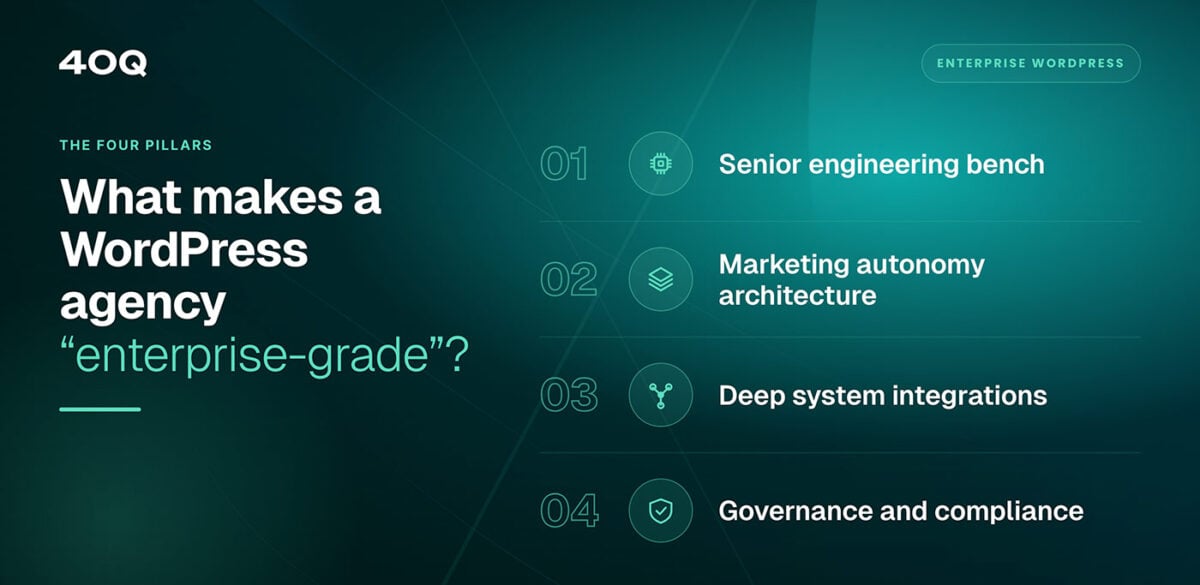
1. Marketing Autonomy Architecture
The single most common failure mode in enterprise WordPress is a platform where marketing can’t publish without filing an engineering ticket.
A standard agency builds a site. An enterprise agency builds a governed content system where:
- Marketers can assemble any layout from a library of pre approved block components, without writing code or modifying templates
- Design constraints are enforced by the system, not by asking people to follow a style guide
- New campaign pages can be launched in minutes, not days
- Role permissions ensure junior editors can’t accidentally overwrite global navigation
The technical foundation for this is a custom Atomic Block System, a block library built to your design system, where every component enforces brand constraints structurally. This is different from a page builder like Elementor or Divi, which give maximum flexibility but no governance.
When 40Q rebuilt ThreatModeler’s platform, they replaced a bloated Elementor setup with a custom Atomic Block architecture. The result: the marketing team went from needing developer support for every new page to launching campaign pages independently a 300% increase in marketing velocity.
What to ask any agency: Show me how a marketer on my team would build a new campaign landing page, without involving a developer. How long does it take? What can they break?
2. Deep System Integrations
Enterprise websites don’t exist in isolation. They are nodes in a larger technology stack connected to CRM, marketing automation, analytics, identity management, and often proprietary internal systems.
An agency that hasn’t shipped these integrations before will learn on your budget. Enterprise grade means the agency can point to live, production implementations of:
- Bidirectional CRM sync (Salesforce, HubSpot) WordPress feeds behavioral data to the CRM, CRM drives personalization back to WordPress
- Marketing automation (Marketo, HubSpot): every form, CTA, and conversion event tracked and routed correctly, not as a plugin afterthought
- Identity and access management: enterprise SSO via Auth0, Okta, or Azure AD for both internal teams and customer-facing authenticated experiences
- Search infrastructure: Elasticsearch or Algolia for sites with large content libraries, with relevance tuned to your taxonomy
- Intent data and analytics: integrations with GTM, 6sense, Apollo, or similar tools that enrich anonymous visitor data for sales teams
Everest Group implementation required all of these simultaneously: a Salesforce-managed content taxonomy, Auth0 SSO for internal and external users, Elasticsearch powered personalized search, and Cloudinary as the digital asset backbone across a platform that merged a research portal and a marketing site into a single authenticated experience.
What to ask any agency: Walk me through a Salesforce integration you’ve shipped in production. How does data flow between WordPress and Salesforce? What breaks when Salesforce changes a field?
3. Senior Engineering Bench
Enterprise WordPress problems are not solved with plugins. Custom block development, REST API extensions, complex data migrations, and performance optimization at scale require engineers who work at the WordPress core level.
Signs you’re talking to a senior engineering team:
- They discuss your problem in terms of architecture tradeoffs, not tool selection
- They have a documented approach to database optimization for high-traffic WordPress sites
- They can explain how they handle a major WordPress core update without breaking your custom blocks
- Their engineers contribute to or maintain open-source WordPress tools
- They’ve migrated large content libraries (thousands of posts, complex taxonomies) without data loss
The operational corollary is also important: enterprise projects don’t end at launch. An agency with a senior bench maintains a long-term relationship, handles security vulnerabilities quickly, and improves the platform continuously. 40Q’s Commvault engagement ran for years of continuous improvement following the initial two-month redesign sprint.
What to ask any agency: Who on your team has worked on WordPress core? What’s your process for a critical security update in a client’s production environment?
4. Governance and Compliance Architecture
Enterprise teams have stakeholders that standard web projects don’t: legal, compliance, information security, procurement, and sometimes regulators.
Enterprise grade governance means:
- User roles and permissions architected to match your organizational structure; editors, content managers, campaign managers, regional admins, and read-only reviewers all have different access
- Audit logs for content changes, user actions, and publishing events
- Staging and approval workflows that route content through legal or brand review before it goes live
- Security hardening appropriate to your industry especially relevant for financial services, healthcare, and cybersecurity companies
- Performance SLAs with documented uptime commitments and incident response processes
- WordPress VIP partnership (or equivalent managed hosting relationship) that provides enterprise grade infrastructure
What to ask any agency: How do you handle a situation where the legal team needs to review content before it publishes? What does your user role architecture look like for a team of 30 people with different editorial functions?
The Enterprise WordPress Technology Stack
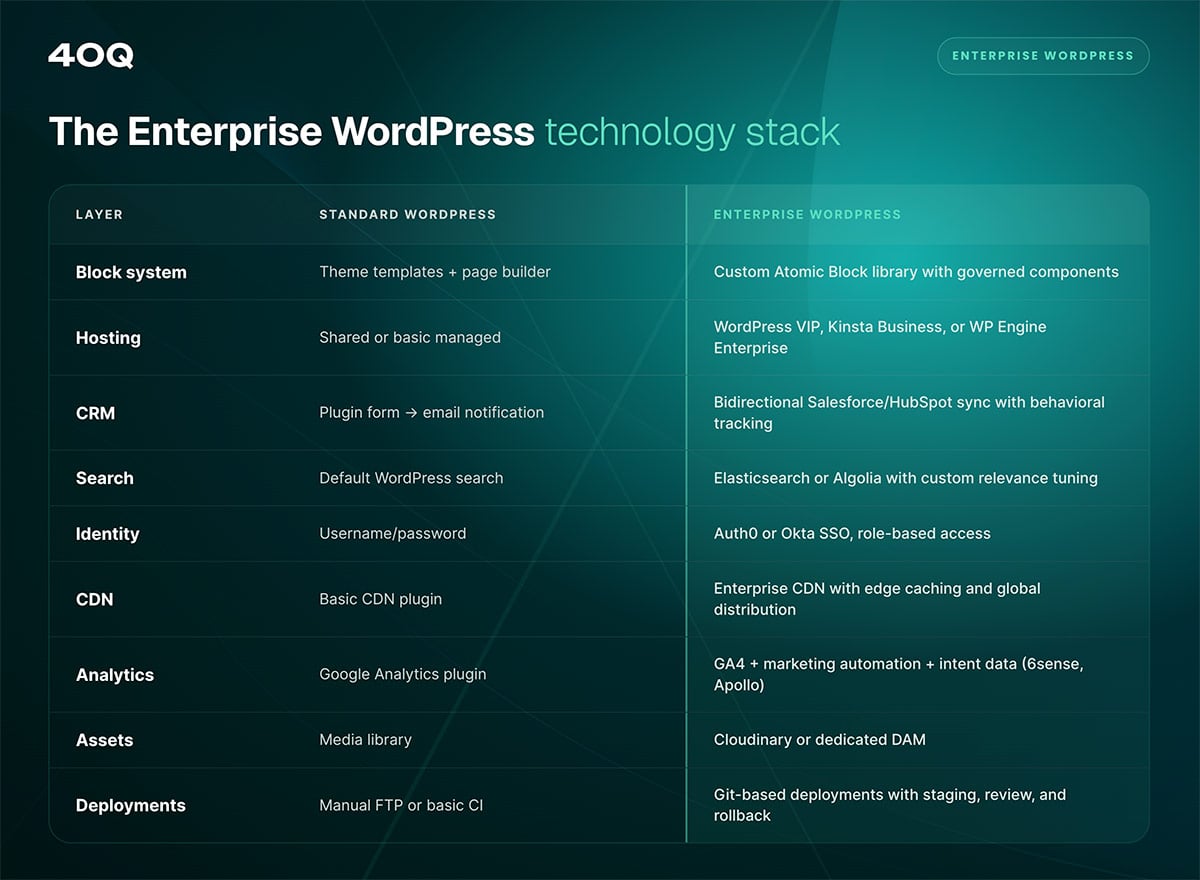
Enterprise WordPress and standard WordPress share the same core software. What separates them is every layer of the stack built on top of it. The block system moves from theme templates and page builders to a custom Atomic Block library with governed components, so marketing teams can publish within brand constraints without developer involvement. Hosting moves from shared or basic managed environments to WordPress VIP, Kinsta Business, or WP Engine Enterprise, with the performance guarantees and SLAs that enterprise traffic demands.
The integration layer is where the gap becomes most visible. Standard WordPress connects to a CRM through a plugin form that sends an email notification. Enterprise WordPress runs bidirectional Salesforce or HubSpot sync with behavioral tracking, meaning every visitor action on the site feeds the sales pipeline in real time. Search moves from the default WordPress engine to Elasticsearch or Algolia with custom relevance tuning. Identity management replaces username and password with Auth0 or Okta SSO and role-based access control across the entire organization.
The infrastructure and operations layers complete the picture. A basic CDN plugin becomes an enterprise CDN with edge caching and global distribution. A Google Analytics plugin becomes a full GA4 implementation connected to marketing automation and intent data platforms like 6sense and Apollo. The media library is replaced by Cloudinary or a dedicated DAM. And deployments move from manual FTP to Git-based workflows with staging environments, peer review, and rollback capability.
Why “Enterprise WordPress” Is Not the Same as “Headless WordPress”
Headless WordPress, where WordPress serves as a content API and a separate frontend (typically Next.js or Gatsby) renders the pages is frequently proposed as the enterprise solution. It’s worth understanding the tradeoff clearly.
Headless offers: maximum frontend flexibility, React/Next.js ecosystem, faster frontend page loads in theory.
Headless costs: every content change requires coordination between two stacks, marketing autonomy drops significantly (marketers cannot preview or publish content without a separate frontend rendering environment), build complexity doubles, and total cost of ownership increases substantially.
For most B2B enterprise organizations where marketing velocity is the primary constraint, headless WordPress creates more problems than it solves. The organizations where headless is genuinely justified are those where the frontend is managed by a dedicated React engineering team, completely separate from the content team which describes a minority of enterprise WordPress buyers.
The right enterprise architecture for most companies is WordPress VIP or managed WordPress with a custom block system. The right architecture for a media company with 10 frontend engineers who want complete rendering control is headless.
How to Evaluate an Enterprise WordPress Agency
The Request for Proposal is not enough
A well written proposal can describe capabilities an agency doesn’t have. The evaluation should include:
Reference checks with clients of similar scale and complexity. Ask specifically about what went wrong on the project and how the agency handled it. An agency with enterprise experience will have a story about a hard migration, a performance crisis, or a complex integration that failed and had to be rebuilt. An agency without that experience won’t.
A technical architecture review session. Present your actual technical environment your CRM, your analytics stack, your team structure, your content volume and ask the agency to describe specifically how they would architect the WordPress platform to connect to it. Generalized answers indicate a lack of hands-on experience.
A look at the actual team. Who will build your project? Senior engineers or junior developers supervised remotely? What percentage of the team’s time will be dedicated to your engagement versus split across multiple clients?
Choosing the right enterprise WordPress agency is as difficult as evaluating one. See the top enterprise WordPress agencies in 2026.
The “Marketing Autonomy” Criterion: Why It Matters More Than Everything Else
If you’re an enterprise marketing leader evaluating WordPress agencies, the single criterion that will most directly affect your day-to-day operations is whether the platform gives your team genuine autonomy.
“Marketing autonomy” means your team can:
- Launch a new campaign page without a developer
- Build a landing page for a product launch happening in 48 hours
- Update copy, swap images, add a CTA without breaking anything
- Create a new content type that follows brand standards automatically
- Publish in three regions without managing separate codebases
What prevents marketing autonomy in most enterprise WordPress builds is not bad intentions, it’s architecture. Page builders give flexibility but no constraints, leading to brand drift and technical debt. Hardcoded templates give consistency but no flexibility, creating developer dependency. The solution is a governed block system that provides flexibility within defined constraints.
Learn more about Marketing Autonomy with our complete guide.
work with 40q
Ready to move to a top tier enterprise agency?
Frequently Asked Questions

Feb 6, 2026
WordPress
Enterprise Website Best Practices for Rapid Growth
Oct 9, 2024
WordPress
Is ACF banned from Wordpress?

Feb 14, 2026
WordPress