
WordPress
Scalable hosting for enterprise WordPress success 2026

José Debuchy
March 10, 2026 | 3 min to read
Enterprise WordPress sites running on scalable hosting can reduce downtime by up to 50% during peak traffic surges. Yet marketing teams at medium and large organizations still struggle with publishing bottlenecks, waiting days for IT approval on simple content updates. This guide explains how scalable hosting empowers marketing agility while maintaining the IT control and security governance your enterprise demands in 2026.
Key takeaways
| Point | Details |
|——-|———||
| Dynamic resource allocation | Scalable hosting automatically adjusts CPU, memory, and bandwidth to match real-time traffic and content demands. |
| Marketing empowerment with IT control | Teams publish faster using self-service tools while IT retains security oversight through role-based access controls. |
| Enterprise security features | Includes web application firewalls, automated threat detection, and uptime guarantees for high-traffic WordPress sites. |
| Performance and cost efficiency | Outperforms traditional hosting in uptime during traffic spikes and delivers 30-50% cost savings through dynamic scaling. |
| Common misconceptions | Scalable hosting does not automatically solve all security issues; continuous IT governance remains essential. |
Understanding scalable hosting: definitions and foundations
Scalable hosting represents a fundamental shift from fixed server infrastructure to dynamic resource orchestration. At its core, it automatically allocates computing resources like CPU cores, memory, storage, and network bandwidth based on real-time demand. This approach contrasts sharply with traditional hosting models where resources remain static regardless of traffic patterns.
For enterprise WordPress environments, scalable hosting relies on several critical components working in concert:
- Load balancing systems that distribute incoming requests across multiple servers to prevent any single point of failure
- Auto-scaling mechanisms that spin up additional resources during traffic surges and scale down during quiet periods
- Containerized microservices architecture allowing independent scaling of specific WordPress components
- Content delivery networks that cache and serve static assets from geographically distributed edge locations
These technologies matter enormously for content-heavy organizations managing high-traffic WordPress sites. Enterprises publishing thousands of pages monthly or handling millions of monthly visitors need infrastructure that responds intelligently to variable workloads. A product launch driving 10x normal traffic should not crash your site or require emergency IT intervention.
Consider a global financial services firm publishing quarterly earnings reports. Traditional hosting would require over-provisioning resources year-round to handle the quarterly traffic spike. Scalable hosting provisions those extra resources only when needed, then scales back down automatically. This elasticity keeps performance consistent while controlling costs.

The relevance extends beyond raw traffic handling. Marketing teams launching simultaneous campaigns across regions need infrastructure supporting concurrent content operations without performance degradation. Scalable hosting enables this operational flexibility while maintaining the security posture IT teams require.
How scalable hosting drives marketing autonomy and IT governance
The tension between marketing speed and IT control has plagued enterprises for years. Marketing teams want to launch landing pages, update product information, and publish localized content immediately. IT teams need to maintain security, ensure compliance, and prevent unauthorized changes that could compromise the platform.
Enterprise-grade WordPress empowerment through scalable hosting resolves this conflict by creating clear lanes of responsibility. Marketing teams gain self-service publishing capabilities using proprietary block systems that eliminate developer dependency for routine content tasks. These systems provide pre-approved design components and content structures that marketing can assemble without touching code.
Role-based access controls form the governance backbone. IT defines who can publish what content, on which sections of the site, with what approval workflows. A regional marketing manager might have full publishing rights for their geography but zero access to global templates or security settings. This granular control means marketing moves fast within safe boundaries.
AI-assisted workflows amplify this speed advantage. Content suggestions, automated SEO optimization, and intelligent image processing happen in real-time as marketing teams build pages. These features run smoothly because scalable hosting provides the compute resources needed for AI processing without slowing down the user experience.
The performance impact is measurable. Organizations implementing WordPress for enterprise with scalable hosting report time-to-publish reductions of up to 70% compared to traditional developer-dependent workflows. A campaign landing page that once took two weeks now launches in two days.
Multi-user collaboration becomes seamless. Ten marketing team members can simultaneously edit different pages, preview changes, and publish content without experiencing lag or conflicts. Scalable hosting handles these concurrent operations by dynamically allocating resources to the WordPress admin interface and database queries.
Organizations migrating from legacy platforms discover dramatic improvements. Drupal to WordPress migration projects often cite marketing empowerment as a primary driver, enabled fundamentally by the scalable hosting infrastructure supporting modern WordPress architectures.
Pro Tip: Implement staged rollouts when transitioning to self-service publishing. Start with low-risk content types like blog posts, prove the model works, then gradually expand marketing autonomy to higher-stakes pages as confidence builds.
Security and performance: enterprise advantages of scalable hosting
Enterprise security requirements extend far beyond basic password protection. Organizations face sophisticated threats including distributed denial of service attacks, SQL injection attempts, cross-site scripting exploits, and credential stuffing campaigns. Scalable hosting provides web application firewalls and automated threat detection specifically designed for these enterprise-level challenges.
Web application firewalls (WAF) inspect every HTTP request before it reaches your WordPress installation. They block malicious traffic patterns, filter out bot attacks, and prevent common exploit attempts in real-time. Modern WAF implementations use machine learning to identify emerging threat patterns and adapt defenses automatically.
AI-driven threat detection goes deeper, analyzing user behavior patterns to identify anomalies. If a user account suddenly starts accessing unusual admin functions or attempting bulk data exports, the system flags this for investigation. These intelligent security layers operate continuously without manual intervention.
Uptime guarantees matter enormously for revenue-generating WordPress sites. Scalable hosting providers typically offer 99.95% or higher uptime service level agreements, backed by redundant infrastructure across multiple availability zones. When one server fails, traffic automatically routes to healthy instances without visitor impact.
Traffic surge handling demonstrates clear advantages. A viral social media post or news mention can drive 50x normal traffic in minutes. Scalable hosting absorbs these spikes by instantly provisioning additional resources, maintaining consistent page load times while traditional hosting would buckle under the load.
Content delivery acceleration through CDN integration significantly improves global performance. Static assets like images, CSS files, and JavaScript load from edge servers geographically close to each visitor. This distributed architecture reduces latency and takes load off the origin WordPress servers.
Containerized microservices architecture enables independent scaling of specific functions. If your image processing service experiences heavy load, those containers scale up while the rest of the system runs normally. This surgical scaling delivers better performance with lower overall resource usage.
Yet continuous IT governance is essential because scalable hosting provides tools, not guarantees. IT teams must configure security policies, monitor threat dashboards, review access logs, and maintain security hygiene practices. The hosting infrastructure enables security; human oversight ensures it.
Organizations implementing comprehensive approaches see measurable results:
- Page load times under 2 seconds even during traffic spikes
- Zero downtime during planned maintenance windows through blue-green deployments
- Automated security patch application without service interruption
- Real-time backup and disaster recovery capabilities with sub-hour recovery time objectives
Understanding how to secure WordPress enterprise grade requires viewing hosting infrastructure as one component of a broader security strategy. Following a detailed website security checklist enterprise WordPress ensures all layers work together effectively.
Common misconceptions about scalable hosting in enterprise contexts
Misunderstanding scalable hosting capabilities leads organizations to make poor investment decisions or overlook necessary complementary measures. Several persistent myths deserve correction.
Myth one: Scalability means simply adding more servers. Reality involves intelligent resource orchestration using algorithms that predict demand patterns, pre-position resources, and optimize across compute, memory, storage, and network dimensions simultaneously. Adding servers without this intelligence just creates expensive inefficiency.
Myth two: Scalable hosting cures all security risks automatically. Reality requires ongoing IT monitoring, security policy enforcement, access control management, and incident response capabilities. The hosting platform provides security tools; your team must wield them effectively. Studies show active IT governance reduces breaches by 35% compared to passive reliance on automated systems alone.
Myth three: Over-provisioning fixed resources costs less than dynamic scaling. Reality shows dynamic scaling delivers 30-50% cost savings by paying only for resources actually consumed. Organizations clinging to over-provisioning waste budget on idle capacity sitting unused 80% of the time.
Myth four: Scalable hosting solves performance problems caused by poor code or database design. Reality means scalable infrastructure amplifies what you build on it. Inefficient database queries or bloated plugins still cause problems regardless of hosting quality. Performance optimization requires addressing application-level issues alongside infrastructure scaling.
Myth five: All scalable hosting providers deliver equivalent capabilities. Reality involves significant variation in auto-scaling responsiveness, security feature depth, WordPress-specific optimizations, and support quality. Thorough evaluation prevents costly mistakes.
“Scalable hosting provides the foundation, but enterprise success requires a comprehensive approach combining infrastructure, application optimization, security governance, and organizational process. No single technology solves everything.”
Enterprise leaders who understand these realities make informed decisions about:
- When to invest in scalable hosting versus when to optimize existing code first
- How much ongoing IT security involvement remains necessary
- What cost modeling accurately reflects pay-as-you-grow economics
- Which provider capabilities align with specific organizational needs
Clarity on these points prevents disappointment and ensures scalable hosting delivers its full potential value when implemented thoughtfully as part of a holistic enterprise WordPress strategy.
Comparing scalable hosting with traditional hosting for WordPress
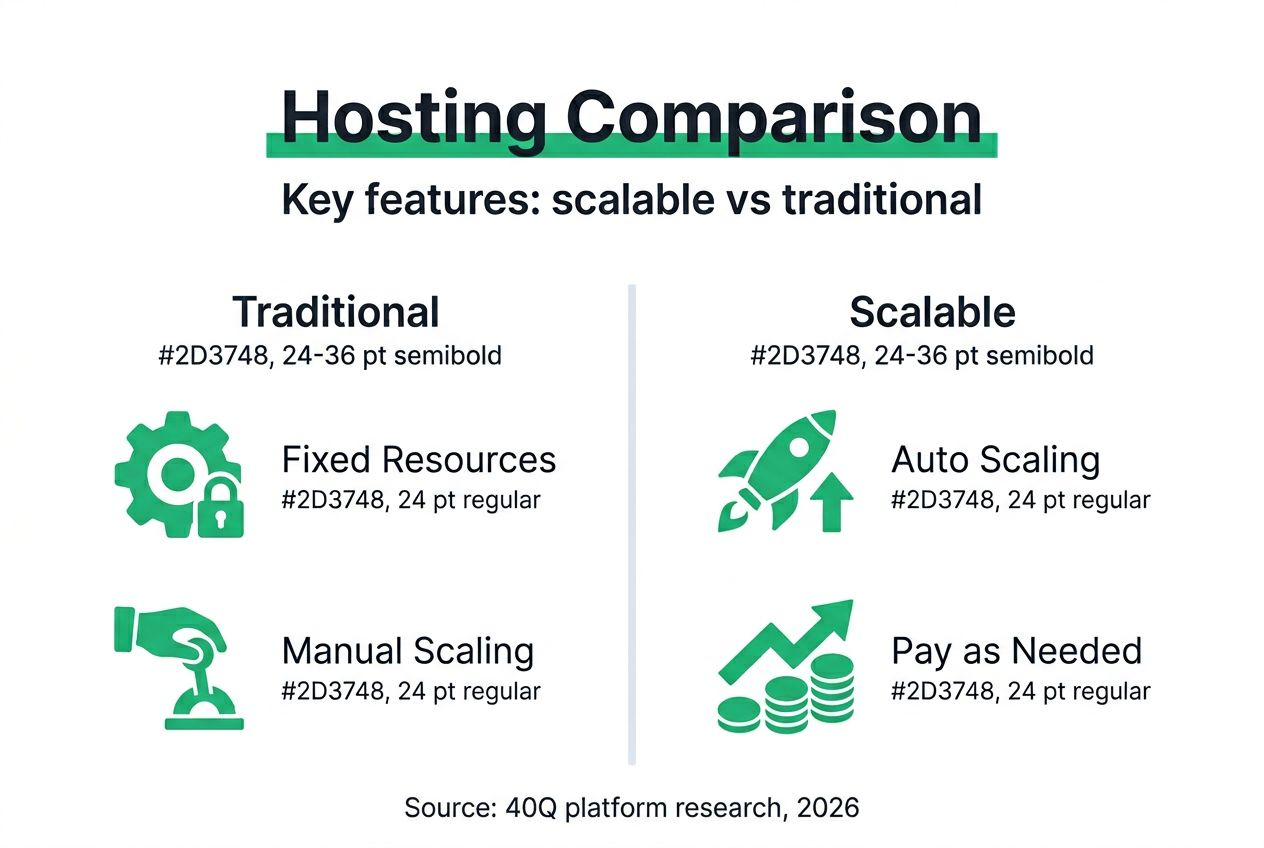
Side-by-side comparison reveals why enterprises increasingly choose scalable over traditional hosting for WordPress platforms.
| Feature | Traditional Hosting | Scalable Hosting |
|---|---|---|
| Resource allocation | Fixed capacity regardless of traffic | Dynamic adjustment matching real-time demand |
| Traffic surge handling | Performance degrades or site crashes | Automatically scales to maintain consistent speed |
| Downtime during peaks | Common, up to 50% more frequent | Reduced by up to 50% through elastic capacity |
| Cost structure | Pay for peak capacity 24/7 | Pay only for resources consumed |
| Marketing autonomy | Bottlenecked by IT for changes | Self-service publishing within governance controls |
| Security features | Basic, often manual implementation | Enterprise-grade WAF and AI threat detection |
| Geographic performance | Single origin server location | CDN integration for global edge delivery |
| Uptime guarantees | 99.5-99.9% typical | 99.95%+ with multi-zone redundancy |
The uptime difference matters enormously for revenue-generating sites. If your WordPress platform drives $10 million in annual revenue, traditional hosting’s extra 0.45% downtime costs $45,000 in lost opportunity compared to scalable hosting’s 99.95% uptime.
Resource allocation flexibility separates the models fundamentally. Traditional hosting locks you into a fixed server configuration. Traffic doubles? You manually upgrade to a larger server, causing downtime and often over-provisioning for the new normal. Scalable hosting adjusts in real-time, scaling up during the spike and back down afterward automatically.
Cost implications surprise many organizations. Traditional hosting appears cheaper initially with its fixed monthly fee, but that fee covers peak capacity you rarely use. Scalable hosting’s variable costs align with actual consumption, typically saving 30-50% over annual cycles.
Marketing operational flexibility represents a softer but equally important distinction. Traditional hosting’s rigid infrastructure reinforces IT gatekeeping because capacity constraints make every change potentially risky. Scalable hosting’s elastic resources enable handling high traffic WordPress scenarios confidently, giving marketing teams room to experiment without jeopardizing stability.
Performance consistency during traffic variability tells the real story. Traditional hosting delivers great performance at normal traffic levels, then degrades significantly during spikes. Scalable hosting maintains consistent page load times regardless of traffic volume by provisioning resources to match demand.
Key differentiators for enterprise decision-makers:
- Scalable hosting eliminates capacity planning guesswork through automatic adjustment
- Traditional hosting requires manual intervention and often causes downtime during scaling events
- Scalable hosting supports modern marketing autonomy requirements through reliable performance
- Traditional hosting creates IT bottlenecks because capacity limitations require careful change management
Organizations running content-heavy WordPress sites with variable traffic patterns gain the most from scalable hosting. Those with completely predictable, steady traffic might find traditional hosting adequate, though the cost and flexibility advantages still favor scalable approaches for most enterprise contexts.
Selecting and implementing scalable hosting solutions for enterprise WordPress
Choosing the right scalable hosting solution requires systematic evaluation against your specific enterprise requirements. Follow this structured approach to make informed decisions and execute successful implementations.
Start by evaluating providers on these critical dimensions:
- Dynamic resource orchestration capabilities including auto-scaling responsiveness and multi-dimensional scaling
- WordPress-specific optimizations such as object caching, database query optimization, and PHP configuration tuning
- Enterprise security features including WAF, DDoS protection, malware scanning, and security information and event management integration
- Compliance certifications relevant to your industry like SOC 2, ISO 27001, HIPAA, or PCI DSS
- Role-based access control granularity supporting your governance requirements
- Integration capabilities with AI content workflows, marketing automation platforms, and analytics tools
- Service level agreements covering uptime, support response times, and performance guarantees
- Transparent pricing models that align costs with actual resource consumption
Implement your chosen solution through these structured steps:
-
Assess your content volume, traffic patterns, and growth projections to establish baseline scalability requirements. Analyze historical traffic data identifying peak periods, growth trends, and seasonal variations. Document content publishing frequency, user concurrency needs, and geographic distribution of your audience.
-
Choose solutions offering role-based governance structures and AI-assisted content workflows that support your marketing autonomy goals. Evaluate how the scalable WordPress setup guide enterprise principles align with the provider’s capabilities. Verify the platform supports your required publishing workflows without compromising IT oversight.
-
Implement with careful integration into existing marketing workflows and IT oversight processes. Migrate staging environments first to validate performance and security. Train marketing teams on self-service publishing tools while training IT staff on monitoring dashboards and governance controls. Establish clear escalation paths for issues.
-
Monitor key performance indicators post-implementation to validate results and identify continuous improvement opportunities. Track uptime percentage, page load times across geographies, time-to-publish for marketing content, security incident frequency, and actual resource costs versus projections. Use these metrics to optimize configuration and justify investment.
Measuring success requires defining specific metrics before implementation:
- Uptime improvement from baseline to post-implementation steady state
- Time-to-publish reduction for typical marketing content pieces
- Security incident frequency and severity trends
- Cost per million page views or per published page
- Marketing team satisfaction with publishing autonomy
- IT team confidence in platform security and control
Pro Tip: Pilot scalable hosting with a high-visibility but non-critical property first. Prove the model works, build organizational confidence, refine processes, then expand to mission-critical properties once you have demonstrated success.
Successful implementation requires more than technology selection. Organizational change management ensures marketing teams embrace new self-service capabilities while IT teams shift from gatekeepers to governors. Enterprise-grade WordPress empowerment depends on people and processes adapting alongside infrastructure.
Partner selection matters as much as technology selection. Providers with deep WordPress for enterprise experience understand the unique requirements of high-traffic, content-heavy platforms. They offer guidance on optimization, security hardening, and workflow design that generic hosting providers cannot match.
Conclusion: unlocking content publishing agility with scalable hosting
Scalable hosting represents a strategic enabler for enterprises seeking to balance marketing agility with IT governance in WordPress environments. By providing dynamic resource orchestration, enterprise-grade security, and infrastructure supporting self-service publishing, it resolves longstanding tensions between speed and control. Organizations implementing scalable hosting gain measurable advantages in uptime, performance consistency, cost efficiency, and time-to-market for content initiatives. As digital demands intensify in 2026, scalable hosting foundations become increasingly essential for competitive advantage.
Explore scalable enterprise WordPress solutions with 40Q
Navigating the complexities of scalable hosting implementation requires expertise in both infrastructure and WordPress-specific optimization. 40Q specializes in building enterprise-grade WordPress empowerment platforms that combine scalable hosting foundations with proprietary tools for marketing autonomy. Our solutions integrate AI-assisted content workflows, role-based access controls, and comprehensive security governance tailored to high-traffic, content-heavy organizations.
We partner with medium and large enterprises to eliminate developer dependency for routine publishing while maintaining the IT control and security posture your organization demands. Our scalable WordPress setup guide enterprise approach and theme setup methodologies ensure your platform delivers both marketing speed and technical reliability.
Pro Tip: Partner with agencies experienced in scalable hosting and enterprise WordPress to accelerate deployment timelines and maximize the business value of your investment through proven implementation frameworks.
FAQ
What is scalable hosting and why is it important for enterprise WordPress sites?
Scalable hosting dynamically adjusts computing resources like bandwidth, memory, and processing power based on real-time demand. For enterprise WordPress sites handling high traffic volumes and frequent content updates, this ensures consistent performance and reliability during both normal operations and unexpected traffic surges.
How does scalable hosting balance marketing autonomy with IT governance?
It enables marketing teams to publish content independently using self-service tools like proprietary block editors and AI-assisted workflows. Simultaneously, IT teams implement role-based access controls, security policies, and approval workflows that maintain governance and compliance oversight without creating publishing bottlenecks.
What are the biggest misconceptions about scalable hosting for enterprises?
Common myths include believing it just means adding more servers, or that scalable hosting automatically eliminates all security risks. Reality requires intelligent resource orchestration and active IT governance. Continuous monitoring and security management remain essential for protecting enterprise WordPress platforms effectively.
How can enterprises choose the right scalable hosting provider for WordPress?
Look for dynamic resource orchestration capabilities, enterprise-grade security features including WAF and threat detection, seamless WordPress integration, and proven uptime service level agreements exceeding 99.95%. Evaluate providers offering AI-assisted content workflows, role-based governance controls, and transparent pricing models aligned with consumption patterns.
Recommended
Apr 14, 2026
WordPress
Marketing compliance guide: tools, workflows, best practices

Apr 3, 2026
WordPress
Content marketing trends 2026: 7 key shifts for CMOs
Nov 11, 2025
WordPress